

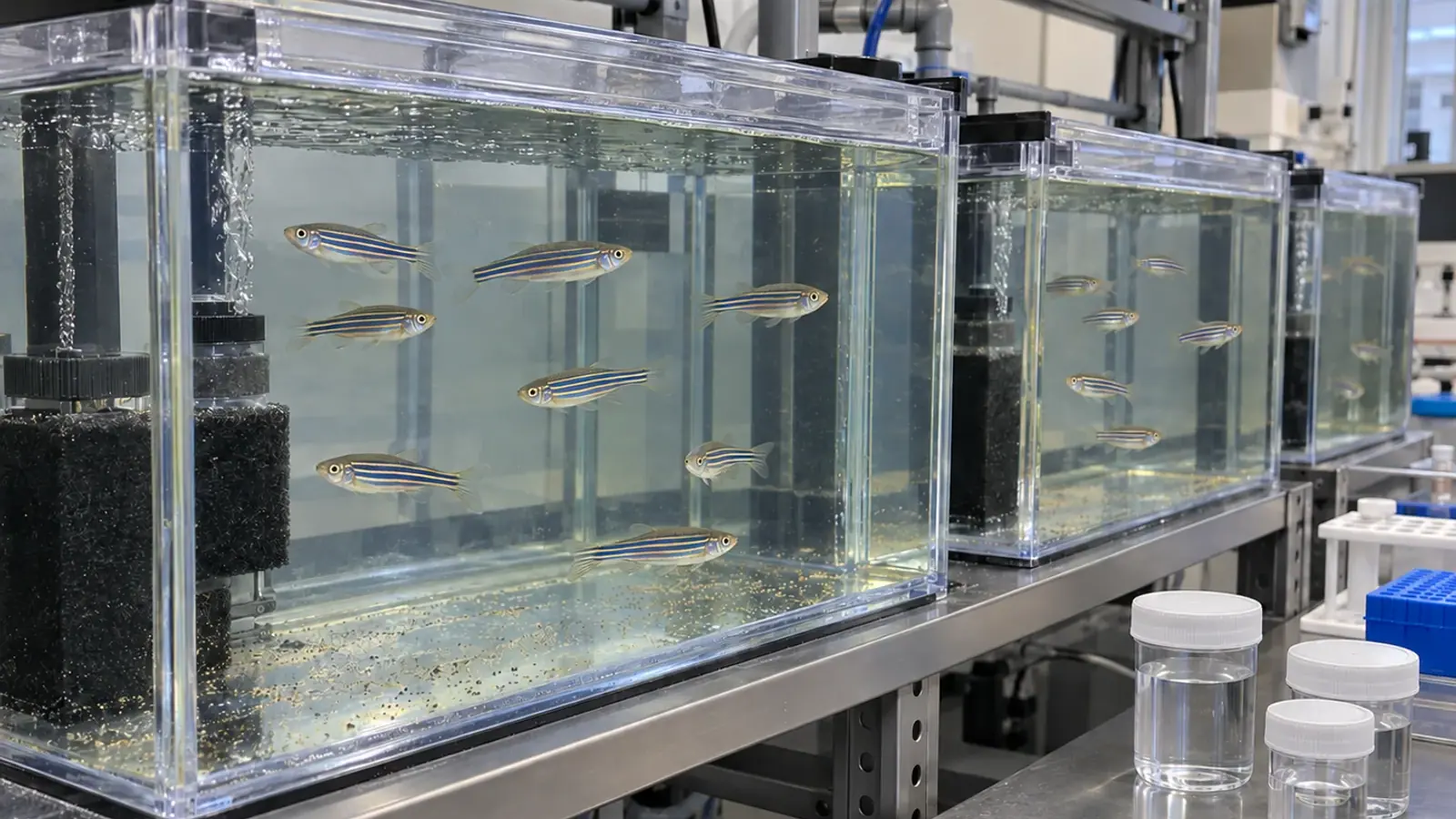
Zebrafish health monitoring: choose the sample matrix
Filtered water, detritus and faeces reveal different aspects of zebrafish facility health. An experimental comparison helps teams select specimens and define what a result can establish.

- Content type
- Practical guide
- Sector
- Research
- Animal group
- Zebrafish
Match the sample to the decision
Water testing can appear to offer a simple way to monitor a zebrafish group without sampling animals. In a Danio rerio facility, that approach becomes misleading if every target organism is assumed to enter the water in the same way. Begin with the decision: identifying an environmental reservoir, investigating infection in fish or assessing an introduction requires different evidence.
Crim and colleagues compared antemortem and environmental samples in two naturally infected populations in 2017. Their study included detritus, filtered water and faeces. It provides a focused comparison of sample matrices, rather than a general validation of quarantine release based on environmental testing alone.
The study should not be described as a direct trial of biofilm swabbing. Biofilms help explain the environmental ecology of some organisms discussed by the authors, but the sampled matrices and tested methods remain the ones actually reported. A plausible environmental reservoir does not establish the diagnostic performance of an arbitrary surface swab.
Preserve the experimental unit when reading results
The work included two trials using fish from the same source populations, with animals restocked for the second trial. The matrices were collected using defined volumes, periods and methods. Several filtered-water volumes were compared. An analysis described simply as a water test can therefore represent quite different sampling efforts.
The populations carried multiple agents naturally and differed in their health status. This allowed informative comparisons, but did not represent every research installation. Applying the findings to a different recirculating system, stocking situation or organism requires examination of those differences. A method suitable for one target may be poorly matched to another.
The number of positive environmental samples is not the number of infected animals. Read the tables with their unit intact: sample, group or fish. Otherwise, a high detection frequency in environmental material can be mistaken for clinical prevalence in the facility. The sampling design and the diagnostic question should remain visible beside any reported proportion.
Environmental mycobacteria do not diagnose individual disease
Mycobacteria provide a useful example. The study detected Mycobacterium chelonae in all environmental samples tested for that target, while animal results differed. Organisms capable of persisting and multiplying in the environment may be favoured by conditions in the holding system. Their detection does not mean that each fish has an established infection.
An environmental positive can still be consequential. It may identify a reservoir and support further investigation. It cannot, by itself, diagnose mycobacterial disease in an individual, attribute a lesion to that organism or justify treatment of the entire population. A report should specify the target species, sample matrix and inference the result supports.
Molecular testing detects genetic material. Finding DNA does not automatically demonstrate viability or a causal role in disease. When fish show abnormalities, environmental findings need to be examined alongside the animals and, where indicated, tissue examination or appropriate microbiological investigation. The purpose is to connect evidence to a defined health question.
Parasites require their own sampling logic
The nematode Pseudocapillaria tomentosa and the microsporidian Pseudoloma neurophilia release different material into the environment. Detritus produced consistent detections of the nematode in the experiment, while results for the microsporidian were much less consistent. Success with one target cannot validate a matrix for a whole panel of organisms.
Filtered-water volume and the infection situation also influenced detection. A target shed intermittently or in small amounts may be missed by a limited collection. Interpret a negative result in relation to organism biology and the actual protocol, rather than declaring all fish uninfected. Increasing effort is useful only when the collection method addresses the route by which the target becomes available.
Diagnostic sensitivity applies to a specified procedure, population and target condition. Detection proportions from these two populations are not universal sensitivity estimates for every zebrafish facility. They instead show where local validation or complementary sampling may be required. The distinction matters when laboratory results are used to authorise movements or introductions.
Faeces and embryos answer different questions
Faecal material can contain agents or stages released by animals. A positive can also reflect passage of an organism from the surrounding environment without proving established infection. Collection duration, grouping and handling therefore form part of the interpretation, rather than being minor operational details omitted from the report.
Embryo testing has a further limitation: a negative embryo sample does not demonstrate that the parents are free of infection. Assessing material intended for introduction and assessing adults in the source system are different questions. The matrix should be chosen according to which question the facility needs answered.
For an introduction, document the targets, source information, specimens available and remaining uncertainty. Quarantine release cannot be reduced to one negative PCR on one matrix. The combination of evidence belongs within the establishment’s health programme and should be agreed with the veterinarian and diagnostic laboratory. Environmental testing may contribute to that programme without replacing its other elements.
Keep method changes beside the health record
A sampling sheet can retain system and tank identity, date, matrix, volume or quantity, collection method and preservation. Date changes in cleaning, water renewal or collection procedures. Otherwise, a shift in results may reflect altered sampling as much as a change in health status.
The paper reports partial commercial funding and affiliations with a diagnostic laboratory. Read these disclosures alongside the limited number of source populations. They do not erase the comparisons, but they reinforce the need to assess methods and scope rather than accept a broad promise of detection.
Select matrices target by target and state what each positive or negative could justify. Water, detritus, faeces and animals contribute complementary information. None of these specimens supplies general proof that a population has no disease, and none should be interpreted without its collection history.
Plan the investigation with Vetofish
Vetofish can help define the questions, choose specimens and connect laboratory interpretation with facility decisions. Our laboratory analysis and diagnostic service supports aquatic research facilities in developing a sampling plan with explicit purposes and limitations.


