

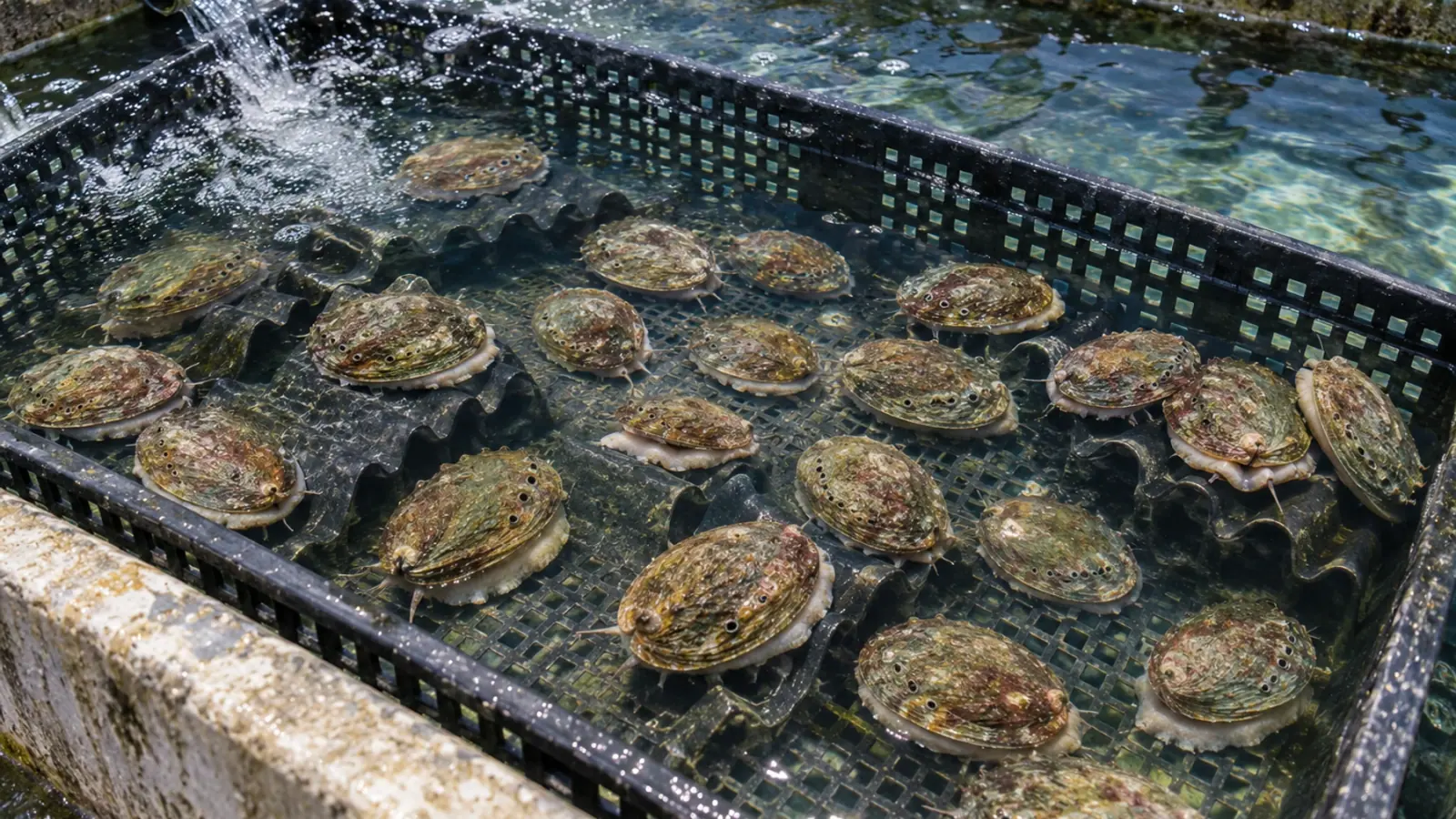
Abalone broodstock: comparing oils beyond weight gain
Weight gain alone cannot establish whether a feed suits abalone broodstock. A 2025 trial compared five lipid sources in female Haliotis discus hannai. The findings distinguish growth, egg production and larval outcomes separately, rather than naming one oil as universally superior.

- Content type
- Practical guide
- Sector
- Aquaculture
- Animal group
- Corals and invertebrates
- Keywords
- ReproductionTemperatureOxygen
A broodstock diet can produce weight gain without delivering the same improvement at every stage of reproduction. For an abalone hatchery, evaluating a feed means deciding which outcome matters and how that outcome will be measured. A trial published by Weiguang Zou and colleagues in 2025 provides a useful example in female Haliotis discus hannai.
The study compared formulated diets intended for broodstock. It did not cover all abalone species, commercial feeds or farming systems. Hatchery teams can use the separate results for adult growth, egg production and early offspring performance. Those results need to retain their own comparators and limitations.
The trial compared diets, with cages as rearing replicates
Five hundred females received five diets for 90 days. Each dietary treatment had four cages containing 25 animals, held in a farming pond. The added lipid sources were fish oil, perilla oil, safflower oil, olive oil and lard. The formulations were designed to provide similar amounts of crude protein and total lipid.
Matching total lipid does not match fatty acid composition. The experimental diets differed in their fatty acid profiles; the fish-oil formulation provided more EPA and DHA in this particular comparison. Testing these formulations did not establish the minimum requirement for either fatty acid, or a dose that hatcheries should apply generally.
The distinction between animals and replicates also matters. A cage was a rearing replicate. Taking additional measurements from animals within it does not create additional independent cages. When assessing the evidence or planning a site comparison, teams need to keep treatment, rearing unit and sampled individual separate.
A higher mean is not a demonstrated win over every alternative
Survival did not differ significantly among diets. Growth was less favourable in the lard group than in the other four treatments. Fish oil produced some of the highest values, but the results did not significantly separate it from every vegetable oil for every growth measure.
For example, final body weight was not significantly different between the fish-oil group and the perilla- or olive-oil groups. Calling one diet the best across all outcomes would lose this qualification. The growth table supports a narrower conclusion: particular formulations differed for particular endpoints under the conditions tested.
A hatchery comparison should therefore retain survival, growth, food intake and feed utilisation as distinct outcomes. A favourable measurement can identify an option worth investigating, but cannot establish suitability throughout production. Equally, a non-significant comparison does not demonstrate that two feeds are equivalent. Statistical evidence and the size of a useful production difference remain separate questions.
Egg production and offspring outcomes have different denominators
The researchers examined the gonad, the reproductive organ, alongside fecundity. Reproductive testing used 20 females per dietary group and a standardised sperm supply from males receiving the fish-oil treatment. This reduced one source of variation. It did not test the full range of possible maternal and paternal diet combinations.
Total fecundity was higher with fish oil than with the other tested lipid sources. However, gonad index and relative fecundity did not significantly distinguish fish oil from perilla or olive oil. Egg output per female, output relative to female mass and an index of gonadal development are therefore not interchangeable measures.
The subsequent stages also need separate interpretation. Fertilisation refers to eggs, hatching to fertilised embryos, and attachment to larvae followed after their swimming phase. Their percentages use different denominators. Several reported differences contrasted fish oil with lard without establishing a difference between fish oil and every vegetable oil.
For routine records, retaining those denominators prevents a successful early stage from being mistaken for success across the entire hatchery sequence. It also allows teams to identify where an apparent change first becomes visible. The study is a reason to make this distinction, rather than a ready-made forecast of a hatchery’s output.
Tissue observations add context without proving the whole mechanism
Ovarian sections showed differences in the appearance of oocytes, the female reproductive cells. These observations complemented egg-production results and tissue composition. On their own, they did not establish a complete causal chain from an individual fatty acid to a particular reproductive outcome.
The experiment concerned one species and life stage, five complete formulations and a 90-day feeding period. It did not test a dose-response series capable of defining an optimum. Nor did it compare full production costs, supply chains or environmental impacts. A plant-derived option cannot be certified as more sustainable on this evidence alone.
Water conditions were part of the experimental context. Temperature, salinity, pH and dissolved oxygen were monitored during rearing. These conditions are not universal husbandry targets for every installation. A farm comparison needs its own water records and a traceable account of other changes that could affect the animals.
Define the hatchery question before changing the feed
A team can begin by choosing its objective: broodstock preparation, egg output, early larval performance or consistency between batches. That choice determines what should be recorded. Adult final weight alone cannot answer all four questions, even when it is straightforward to measure.
Useful records connect cage identity, broodstock origin, feed batch, quantities offered and observations of consumption. Spawning records retain the numbers of females, eggs examined, embryos followed and larvae placed under observation. These are practical documentation proposals, rather than a substitute for a site-specific experimental design.
Changes made together need particular care. If the feed, water exchange and feeding routine all change at once, a different result cannot simply be attributed to the oil. Planning observations beforehand and retaining an appropriate comparator makes the outcome easier to interpret. Otherwise, a production record can document improvement while leaving its cause uncertain.
Compare the outcome that the decision actually concerns
The trial supports evaluating broodstock feeds stage by stage. It identifies differences between tested formulations while preserving several non-significant comparisons. The practical decision is to define the desired outcome, then assess growth, spawning and offspring with the relevant units and limitations.
Vetofish can help teams organise those questions and the associated records through its advisory and support service. For aquaculture operations, this means documenting batches and rearing conditions to make a comparison interpretable, without promising a reproductive gain.


