

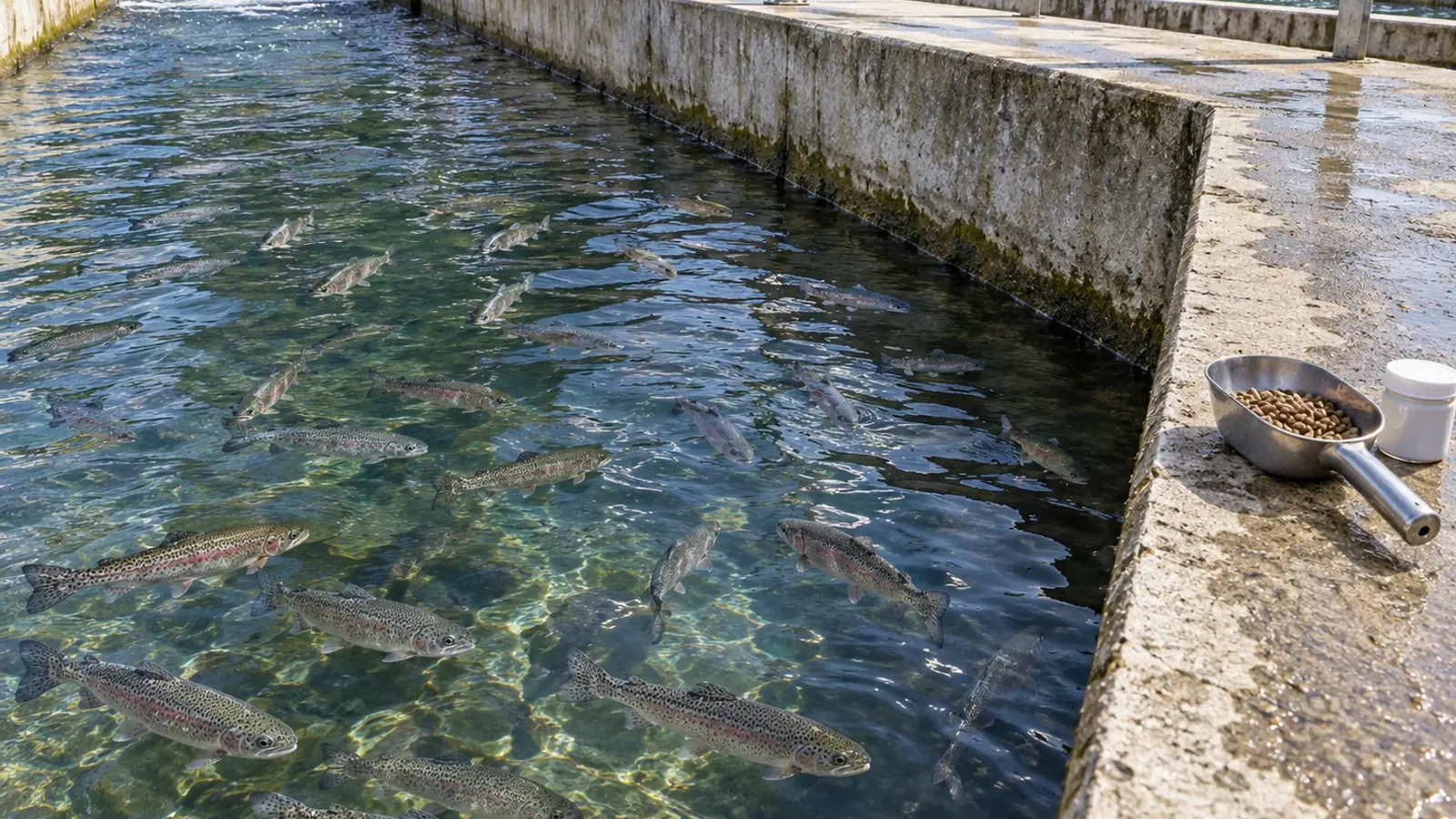
Fish feed pellets: separating hardness from water stability
Pellets that survive transport may still lose their structure in a fish tank. An openly available FAO technical chapter helps distinguish dry hardness from water stability and frame useful questions for suppliers, without treating either measurement as proof of nutritional value.

- Content type
- Practical guide
- Sector
- Aquaculture
- Animal group
- Fish
- Keywords
- TemperatureOxygenSalinity
Ask which property a specification describes
Feed quality checks often begin with appearance. Uniform pellets that leave little dust and resist breaking can look reassuring. Those observations mainly describe what happens before the fish eat them. Hardness is mechanical resistance measured using a particular device. Water stability concerns the material retained after immersion under specified conditions. A result for one property cannot stand in for a measurement of the other.
W. H. Hasting and D. Higgs make that distinction in their 1980 FAO chapter on feed manufacture. The chapter remains useful for interpreting physical specifications, but it is not a current standard covering every commercial feed. Its examples concern particular formulations, manufacturing systems and fish. The distinction can inform a supplier discussion without importing historical factory settings, recipes or results as present-day farm targets.
A request for “good-quality pellets” leaves room for different interpretations. Ask whether the supporting result measures breaking resistance, fines generated during handling or dry matter recovered after immersion. Each may answer a useful question. The test name and method must accompany the number, otherwise buyer and supplier may be discussing different properties while appearing to agree.
Read an immersion result with its test conditions
The FAO chapter describes an approach that compares dry material retained after immersion with the dry matter initially present. The recovery device and exposure conditions are part of the measurement. A percentage on its own cannot tell the reader which material was recovered or which particles escaped through the apparatus.
For a comparison between feed batches, request the immersion duration, water movement, recovery arrangement and sample treatment before weighing. Record the water temperature and type of water, including salinity where it matters for the farm. This is a proposed checklist for reading a report. It does not establish a new standard method or attribute additional requirements to the FAO publication.
A photograph of pellets remaining visible in a glass can document an observation, but it does not replace a dry-matter measurement. A softened or swollen pellet may retain a recognisable outline while material disperses. Equally, a residue measurement needs to be interpreted in light of screen openings and possible handling losses. The appearance and the laboratory result describe different parts of the same question.
Keep particle size and nutritional evidence separate
Particle size deserves its own place in a quality record. The nominal diameter of the finished pellet does not describe the size distribution of its ingredients. Neither measurement states how much fine material is present in a delivered bag. Combining them under one heading makes it harder to explain why two batches behave differently.
Digestibility concerns digestive use of feed. It cannot be read directly from pellet breaking resistance or from the residue left by an immersion test. If a supplier reports nutritional performance, check the species, life stage and method to which the result applies. Missing biological information does not turn a physical test into a biological one; it leaves a separate question unanswered.
A practical comparison sheet can therefore use separate columns for product dimensions, fines, behaviour in water and available nutritional evidence. An empty cell is preferable to an assumed result. The sheet also helps frame a specific request for further information rather than treating one unfavourable observation as a complete assessment of the feed.
Connect the sample to the production system
Uneaten particles can contribute to suspended material in a production tank. Their presence does not establish that feed explains every change in water clarity, because other particles circulate through the system. Recording where fines appear, when they are noticed and which handling step preceded the observation helps locate the problem without diagnosing it from cloudy water alone.
One possible investigation is to compare a sample taken at delivery with another collected after the farm’s usual distribution route. That comparison needs to be planned with the supplier and technical team. It does not identify the cause of breakage by itself. Sampling, sample transport and test conditions still have to be documented before a difference can be interpreted confidently.
Fish feeding behaviour also needs its production context. Reduced intake is not proof that a pellet is too hard. Retrieve the relevant tank observations, including temperature and dissolved oxygen, and consider the event within routine health and husbandry monitoring. This article proposes no universal hardness or stability threshold and no automatic ration change based on a physical test alone.
An investigation record should distinguish an observation from its explanation. “More fines were recovered after this handling stage” is a reportable observation under stated conditions. “The conveyor caused the feeding problem” requires additional evidence. Keeping those statements apart makes the next check easier to choose and prevents a tentative explanation from becoming an established cause in later discussions.
Keep a comparison that can be checked later
Keep the batch identity, question and method together so the comparison can be checked. A result becomes usable when the farm manager can retrieve its sample record, laboratory report and corresponding production observations. If the method changes, mark the break in comparability rather than extending a series as though every value had been obtained in the same way.
That record supports a realistic specification: which property needs controlling, under which conditions and with which verification? It also prevents a laboratory number from becoming a guarantee of growth, health or profitability. Quality control should reduce an identified uncertainty and make clear whether the answer is sufficient for the decision being considered.
Vetofish supports fish farmers in defining these questions, critically reading the available results and connecting them with farm observations. The aim is a proportionate verification plan for the problem at hand, without promising a production outcome or replacing the health and husbandry follow-up of the fish.
To move from evidence to action, explore our advice and support service and our expertise in aquaculture.


