

Demand feeding in carp: track what the fish actually eat
Faster-growing carp do not necessarily use feed more efficiently. A carp experiment shows why demand feeders need to be checked against uneaten pellets, fish condition and water quality.


- Content type
- Practical guide
- Sector
- Aquaculture
- Animal group
- Cyprinids
- Keywords
- TemperatureOxygenStress
A working feeder is not proof of successful feeding. Its activation counter records requests, and its settings describe intended delivery. Neither tells the farm how much feed was eaten, whether all fish had access, or whether extra growth came at the cost of poorer feed efficiency. Those outcomes require separate measurements.
A controlled common carp study published by Mes and colleagues in 2023 provides a useful example. Fish that operated their own feeder ate more and grew faster, yet used feed less efficiently than fish offered scheduled meals. For farms reviewing automatic equipment, the practical lesson is to assess intake, growth and water conditions together.
What the carp experiment compared
The researchers used 120 juvenile common carp, Cyprinus carpio, in four combinations of feeding strategy and experimental diet. Each combination was repeated three times, giving twelve tank units with ten fish per unit over 21 days. The two diets contained 39% and 48% crude protein. These were experimental treatments, rather than proposed feed specifications for commercial farms.
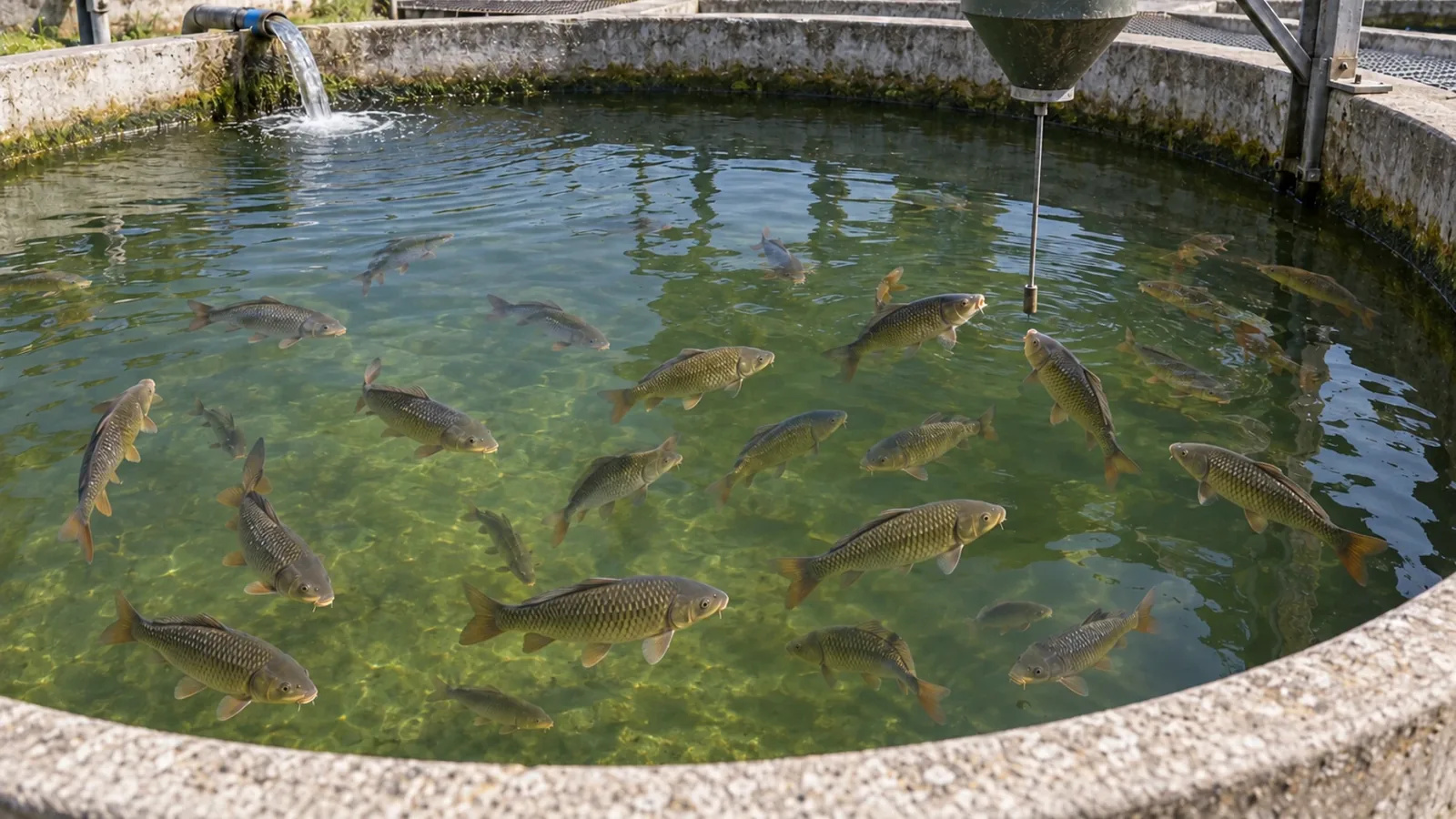
In demand-fed groups, touching a submerged pendulum released a small portion of feed, subject to a minimum interval between releases. The comparison groups received two meals a day, based on the previous day’s intake of their demand-fed counterparts. Uneaten feed was recovered to estimate actual consumption. Meal-fed fish did not eat the full amount offered during the available feeding period.
Demand-fed fish consumed more and showed faster growth. However, their feed conversion ratios were higher, meaning more consumed feed was needed for a unit of weight gain. Faster biomass production therefore did not demonstrate better conversion. Intake and conversion were measured at tank level; the individual carp were not independent replicates for those outcomes.
Verify delivery before interpreting the fish
An automatic setting needs a physical check. Pellet size, moisture, blockage and mechanical operation can change the mass released by a command. Periodically weighing feeder output under normal operating conditions helps establish whether the recorded programme matches actual delivery. A change in activation frequency may otherwise be mistaken for a biological change when the mechanism is responsible.
Uneaten-feed measurements also need consistent rules. The collection point, recovery interval and likely losses should be documented. Pellets carried into an inaccessible part of the system cannot simply be counted as eaten. Where full recovery is impractical, retain that uncertainty in the calculation instead of reporting an intake estimate with unjustified precision.
Whole-tank totals can hide unequal access. Observations across feeding areas and times may identify fish remaining away from the device, persistent chasing or widening size differences. Mes and colleagues tracked individual growth but could not measure individual intake. Their results do not establish how particular fish shared the ration or explain each individual’s growth rate.
Keep falling appetite visible
Chen and colleagues’ 2026 technical review describes precision feeding as a chain of sensing, decision-making, delivery and feedback. Cameras and water sensors can contribute to that chain, but performance depends on species, life stage, visibility, installation and maintenance. Moving or fouling a camera may alter the measured signal without an equivalent change in fish behaviour.
A feed-control system should preserve abnormal events. If it automatically reduces delivery whenever the fish respond less strongly, the dashboard may continue to show little waste while daily consumption falls sharply. Offered feed, estimated intake, fish response and operator interventions therefore need distinct records.
When an unexpected change occurs, check dissolved oxygen, temperature and water circulation, then observe ventilation, swimming, lesions and mortality. Stress, deteriorating water conditions and disease are possibilities to investigate. Feeding activity cannot identify an infectious agent. Delivering additional pellets as an informal appetite test should not replace examination of the fish and their environment.
Nitrogen results do not establish pollution control
The carp study also examined nitrogen metabolism. After accounting for intake, measured nitrogen excretion did not differ significantly between the compared treatments. Part of the nitrogen balance remained unexplained. Measurements of dinitrogen production supported a possible contribution from gill-associated bacteria, without establishing a treatment technology for commercial effluent.
Some calculations depended on assumptions about digestibility and nitrogen retention. This short, controlled experiment did not demonstrate a general reduction of ammonia in farm systems or improved fish health. Un-ionised ammonia and ammonium also have different implications for toxicity; interpretation requires water chemistry, including pH and temperature, rather than a feeding label alone.
Design a farm comparison around the intended outcome
Before changing a programme, specify the question. Faster growth, fewer uneaten pellets, more even access and a stable intake pattern are different objectives. Record a baseline, choose an observation period appropriate to the stock, and keep other conditions comparable. Changing diet, stocking density and feeder settings together makes it difficult to identify which change mattered.
A small set of consistent records is usually more useful than numerous graphs with no decision attached. Include feed mass delivered, recovered waste, estimated biomass, mortality and relevant water measurements. Define who reviews an anomaly, who can pause or manually operate the feeder, and how the intervention is logged. Neither study provides a universal alarm threshold for every farm.
Results also need to be read against the system’s constraints. A demand feeder tested with juvenile carp does not automatically perform similarly with another species, size class or production system. Any transfer should be assessed on the farm, with fish observation remaining part of the evaluation rather than disappearing once equipment is installed.
Maintain veterinary oversight of feeding changes
Demand feeding can alter intake and growth, but its value depends on several outcomes considered together. Verify consumption and preserve the changes that should prompt a closer look at the stock. Better conversion and better health should be demonstrated rather than inferred from a faster growth curve.
Vetofish’s consultancy and support service can help review feed records, water conditions and response criteria for aquaculture operations. The work can support a documented comparison and a practical response procedure, without promising a predetermined improvement in production.


