

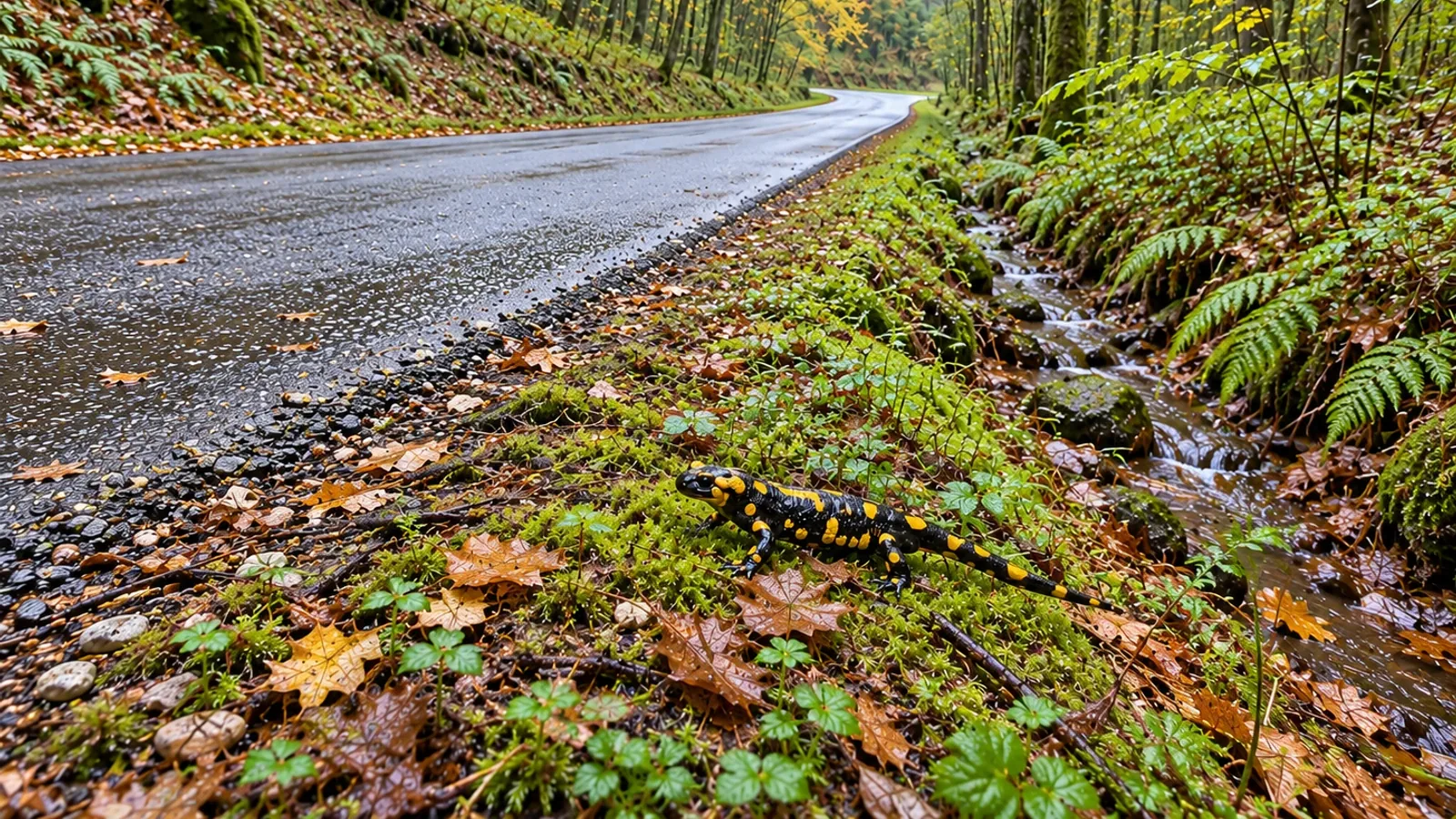
Amphibian roadkill counts depend on carcass persistence
Few amphibian carcasses on a road may reflect rapid disappearance rather than few collisions. A 2011 Portuguese study showed that persistence varied between animal groups and conditions. Comparing roadkill counts requires the survey schedule and observation method.


- Content type
- Scientific news
- Sector
- Environment
- Animal group
- Amphibians
Comparing roads only by the dead animals still visible can produce a misleading ranking. Between a collision and a survey, a carcass may be moved, consumed or fragmented until it is no longer detected. No visible remains does not therefore mean that no collision occurred.
Sara M. Santos, Filipe Carvalho and António Mira studied this persistence along roads in southern Portugal. Their 2011 paper remains useful for understanding the observation process in amphibian road surveys. It describes how long an already detected event can leave a visible trace, rather than directly measuring the full number of animals killed by traffic.
Daily checks began with animals already found dead
Four road sections totalling 37 kilometres were surveyed daily between December 2004 and February 2006. An observer driving slowly recorded the animals found, their position and condition. Carcasses were left where they had been found, so their presence could be checked on subsequent visits. Persistence was consequently followed from the first detection.
The analysis included 4,447 vertebrate carcasses. Amphibians were grouped into anurans, including toads and frogs, with 409 records, and urodeles, including salamanders and newts, with 833 records. These are aggregated categories containing different species. Their results are not separate persistence estimates for every species represented in the samples.
Persistence is a property of the observation window
Estimated persistence after one day was 0.267 in the anuran group and 0.455 in the urodele group. These values concern the chance that an already detected carcass remains present under the study conditions. They are not collision risks for a living amphibian, and they are not the proportions of a local population killed on the roads.
Persistence decreased further with time. More widely spaced visits therefore lose more events, with the loss varying between the groups sought. A weekly survey and a daily survey cannot be compared as if their opportunity to find carcasses were identical. Even a daily visit does not guarantee detection of every animal killed before it takes place.
The temporal resolution also matters. Disappearance between two visits does not establish the precise hour at which a carcass was lost. That limitation needs to remain visible when the findings are used to discuss survey timing or compare methods with finer observation intervals.
Separate persistence, detection and the living population
A carcass may remain on the road but be missed by an observer. It can also disappear before any observer arrives. These are separate processes. Animals lost before the first visit are absent from this persistence sample, so the reported probabilities cannot automatically reconstruct the total number of collisions.
Describe the road sections actually searched, visit frequency, interruptions and the observation method. A carcass count does not directly measure the abundance of the living population. Capture–recapture, when appropriate and authorised for a separate question, follows living individuals; it was not undertaken in this study. Combining those objectives without the necessary data would give the road count an unjustified demographic interpretation.
Distinguish a recorded observation and an estimate requiring additional assumptions. Both can be useful, but they answer different questions. A zero count has the same need for a documented search opportunity as a large count; neither becomes self-explanatory because it appears straightforward.
Context needs to travel with the numbers
Weather, temperature, position on the road and animal characteristics may influence persistence. The researchers examined such factors and found that relationships varied between groups. A single Portuguese coefficient should not be transferred to another region as though it were a fixed biological constant.
For wetland managers, habitat and breeding season help place crossings in context. They do not replace information about the search. Retain the visit time and, where known, the delay since a movement period. Fewer carcasses could accompany lower mortality, reduced animal movement or a change in the disappearance of remains. The count alone cannot distinguish these explanations.
An assessment before and after mitigation also needs to examine whether methods and conditions remained comparable. The persistence study does not show that a particular crossing structure or barrier works elsewhere. That requires an evaluation designed for the local species and question. A change in visible roadkill is one piece of evidence to interpret, rather than an automatic measure of effectiveness.
Present an observed count before any proposed correction
Report the number actually found with the search effort that produced it. If a correction is then proposed, identify its source, assumptions and additional uncertainty. A corrected estimate should remain recognisable as an estimate. Missing visits and inaccessible road sections must remain in the record rather than disappearing behind a final number.
The management conclusion is to connect every total with its observation window. A road where remains disappear rapidly may look less harmful than it is. Planning must also account for staff safety and local arrangements; the paper does not justify improvised surveys in traffic or placing animals on a road to repeat the experiment. The scientific question should be developed with the responsible road and conservation managers.
Support for interpreting environmental monitoring
Our advisory and support service can help clarify objectives, required records and limitations in work concerning aquatic environments and populations. Vetofish can contribute to separating a mortality observation, a proposed explanation and a demographic estimate, alongside the relevant specialists. The purpose is a traceable decision, without treating a small count as evidence that traffic has no impact.


