

Aquaculture sludge: assess safety before recovery
Collecting sludge removes material from fish tanks without resolving its safety or destination. A 2025 review separates biological hazards, chemical contaminants and questions that need answering before recovery.


- Content type
- Practical guide
- Sector
- Aquaculture
- Animal group
- Fish
Removing solids creates another material stream
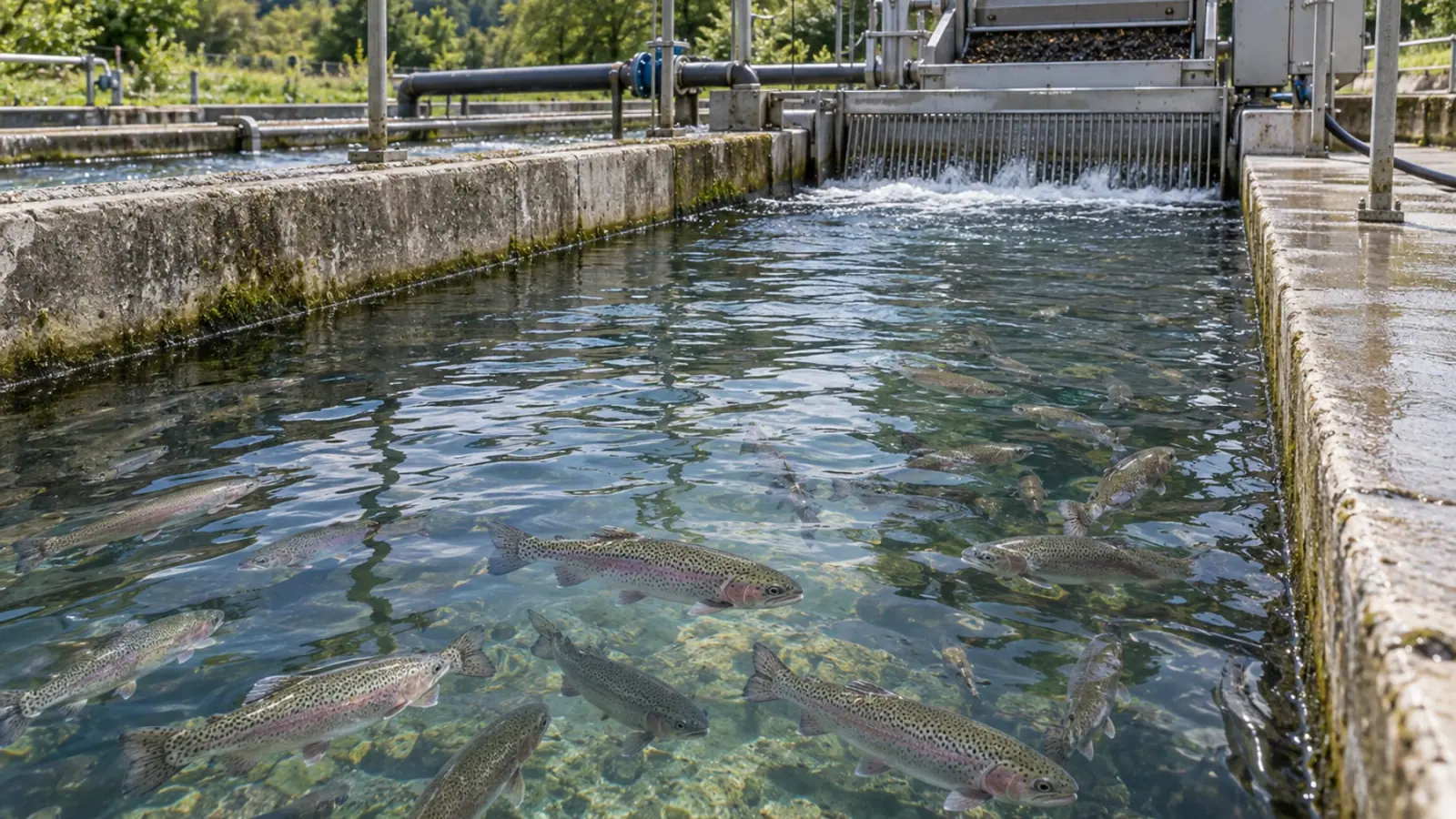
Solid removal supports the operation of a recirculating fish farm, but it does not make faeces and uneaten feed disappear. It transfers part of the organic matter into a concentrated stream that needs collection, storage and a defined destination. Water conditions for the fish and the safety of the resulting sludge are connected questions, each requiring its own assessment.
Pettersen and colleagues’ 2025 review examines biological and chemical hazards in fish sludge and their possible fate when invertebrates consume it. Its focus includes proposed circular production systems facing regulatory barriers. The review provides a basis for asking safety questions; it does not certify a particular process or establish that treating a material makes every intended use acceptable.
Identify the material before selecting an outlet
Sludge is not a uniform commodity. Its characteristics can vary with the farmed species, feed, incoming water, equipment and collection point. Freshly separated material is not necessarily equivalent to a mixture held in storage. Settling and filtration also influence how material is distributed between the water and solid fractions.
For a farm manager, the useful starting point is a description of the actual stream. A batch record can connect collection to its source circuit, dates, storage conditions and relevant health events. Mixing batches before these details are available makes a later laboratory result harder to interpret and can prevent the source of a problem being traced.
The review brings together existing knowledge and identifies gaps. It does not provide a universal composition for fish sludge. Results obtained previously at another farm, or for a different purpose, cannot automatically qualify the material currently leaving an installation. The question is whether the evidence describes this stream and this proposed use.
Biological and chemical questions need different answers
Biological assessment concerns the presence and fate of microorganisms and other agents that could affect animals, staff or a receiving production chain. Pettersen and colleagues identify limited direct evidence for some combinations of fish sludge, processing and invertebrate species. The absence of published adverse findings is not a general demonstration of safety.
Chemical contaminants require a separate assessment. Their occurrence depends in part on incoming materials and concentration pathways. Potential accumulation in the organism used for recovery must be distinguished from its growth performance. Producing biomass does not establish that the harvested product has an acceptable safety profile.
A process designed to address a biological hazard does not, by itself, demonstrate control of chemical elements. Equally, satisfactory chemical measurements do not describe the microbiological status of a batch. Each part of the assessment needs a clear purpose, appropriate methods and interpretation criteria agreed with the relevant specialists.
Growth does not demonstrate hazard removal
A practical message from the review is that invertebrates should not be expected to remove every hazard. Species differ in their ability to accumulate or reduce particular substances. Findings from one organism and substrate cannot simply be applied to a different combination, even if both appear suitable for biomass production.
Before a recovery trial, the project should specify which material enters which process, what product is obtained and how that product would be used. This separates biological feasibility from safety assessment and regulatory acceptability. An organism can grow on a substrate without establishing that its biomass is suitable for the proposed destination.
The 2025 review identifies European regulatory barriers to using fish sludge in feed production. That dated assessment does not replace a review of the rules applicable when a particular project is designed. Neither circularity nor publication of a scientific study establishes permission. Projects outside Europe also need to assess their own jurisdiction and intended use.
Follow the stream through real working conditions
Biosecurity also concerns movement around sludge storage. Tools, containers, vehicles and staff can connect areas that are intended to remain separate. Reviewing the actual working route, including occasional maintenance or emergency operations, is more informative than relying only on the original installation diagram.
Vetofish recommends documenting collection points, container changes, destinations and responsibilities. These records help answer practical questions: can a batch still be identified after mixing? Does a laboratory report remain connected to the sampled material? Can an unexpected finding be reported before the material leaves the farm? Each question affects whether a decision can be justified later.
Testing should support a defined decision. A long list of measurements can produce a substantial report without clarifying whether the material is suitable for its destination. Selecting relevant hazards and a sampling strategy requires knowledge of the installation, the proposed outlet and the limitations of the methods available. More measurements cannot repair a missing link between the sample and its origin.
Conclusion: establish suitability before recovery
Aquaculture sludge recovery needs an assessment that follows the material to its intended final use. Good tank performance, a single favourable test or successful invertebrate growth cannot substitute for that assessment. Maintaining batch identity, distinguishing hazard categories and making uncertainties explicit provides a more useful starting point for deciding whether a recovery pathway can proceed.
How Vetofish can help
Our aquatic health expertise service can support a review of material flows, identification of relevant hazards and preparation of questions for laboratories and recovery partners. For aquaculture businesses, this connects farm health management with collection and outgoing material streams. The aim is a documented assessment suited to the project, without promising approval of a particular outlet.


