

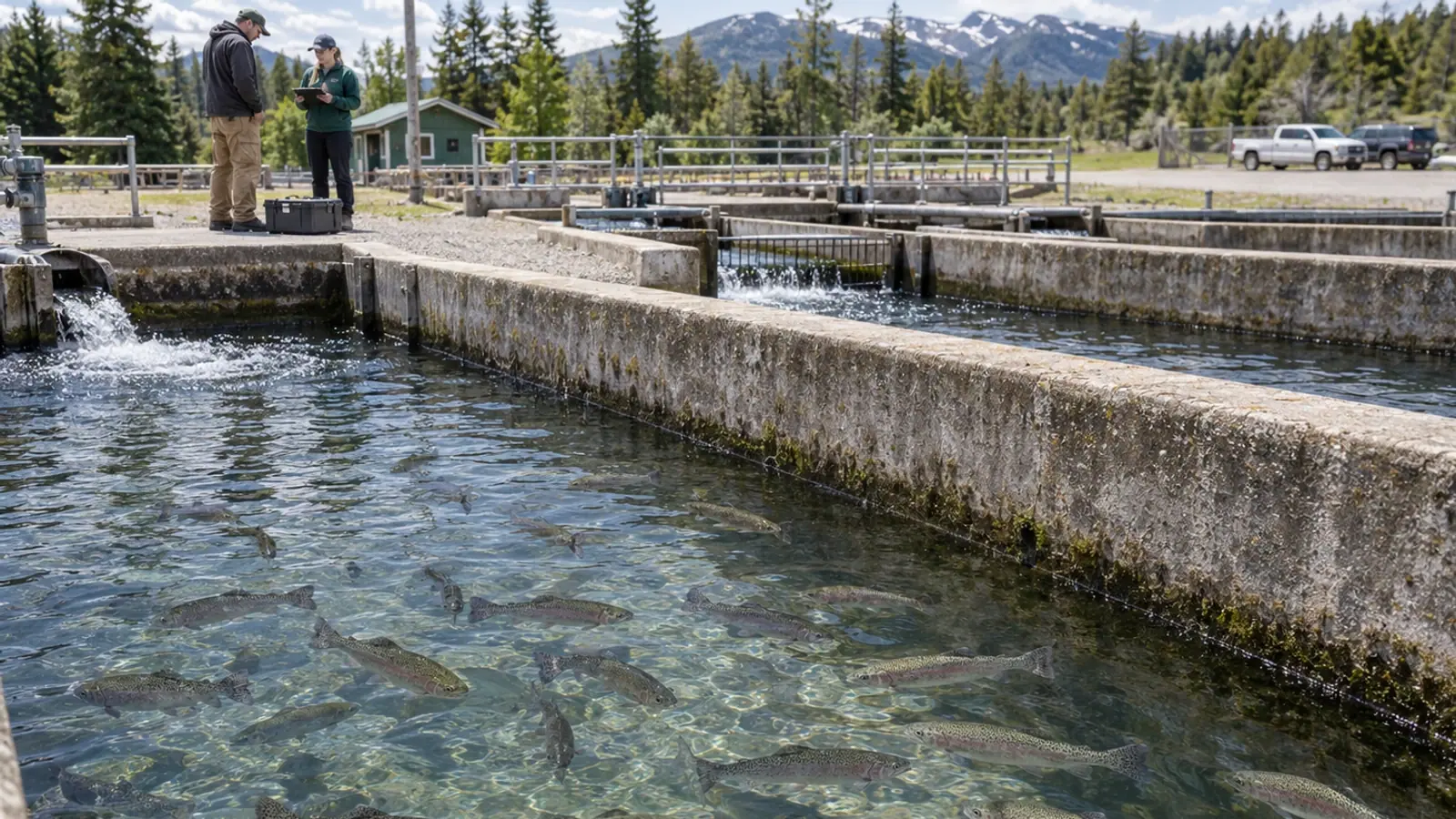
Fish farm biosecurity: managing contractor access
An urgent repair can bring wet equipment, contaminated footwear and a vehicle into a fish production area. Biosecurity planning needs to cover access, permitted movements and the handover back to farm staff.

- Content type
- Practical guide
- Sector
- Aquaculture
- Animal group
- Fish
- Keywords
- BiosecurityDisinfectionOxygen
A contractor repairing a pump may have little experience of fish production. The job can still take them close to incoming water, shared equipment and livestock. A meter reading, a commercial visit and a vehicle repair each create different routes through the premises. Risk depends on what arrives, the contacts it can make and where it moves, rather than the length of the visit alone.
The WOAH Aquatic Animal Health Code provides a framework for biosecurity at aquaculture establishments. Measures need to fit the relevant hazards, species and production system. The chapter does not offer a universal interval between farm visits or a disinfection recipe that works against every agent. Farm managers need to turn the risk assessment into arrangements that staff can use during routine work and equipment failures.
Agree access before the contractor arrives
External biosecurity addresses possible introductions from outside the establishment. For an incoming contractor, useful information includes recent contact with other aquatic facilities, their animals, water and equipment. A declaration can guide the reception procedure, but it is not proof that the person or their tools are free of contamination. Staff need clear criteria for additional measures and someone who can decide when information is incomplete.
Ask what will be brought onto the premises: tools, replacement pumps, hoses, footwear, vehicles and salvaged components. Clothing may present a limited concern while a wet pump from another facility warrants closer attention. A blanket tool restriction is difficult to apply if nobody has arranged a suitable alternative for the repair. Resolving that problem before arrival avoids an improvised exception beside the tanks.
Before arrival, identify the entrance, parking area, site contact and permitted work zones. The person receiving the contractor checks that the promised arrangements are available, including appropriately sized dedicated footwear, clean equipment and a suitable preparation area. A short site plan can make boundaries easier to understand than a lengthy procedure first presented at the gate.
Treat people and equipment as separate routes
Cross-contamination can follow a wet cable, a tool or a boot sole between production units. Assess the contractor’s movements separately from the movement of equipment. An escort needs to understand zone boundaries and which items are reserved for particular stocks. Permission to enter the premises does not by itself authorise access to every production area.
For work near fish tanks, prepare a work surface that limits splashes towards the water and prevents used components being placed on clean equipment. Keep dismantled parts apart from those ready for installation. An identifiable separation is easier to maintain than adjacent piles whose purpose becomes unclear as more people join the job.
WOAH discusses visitor records, advance information and measures concerning clothing, footwear and movement. A farm can translate these into a brief job sheet covering the intervention, zones, equipment and responsible staff member. That sheet supports coordination. It cannot substitute for the underlying assessment or practical training, particularly where maintenance work crosses several units.
Establish cleaning requirements before disinfection
Disinfection depends on the target agent, material and conditions of use. Spraying a product over a surface covered in organic matter does not establish that the surface has been adequately treated. Cleaning, inspection and any subsequent treatment need separate instructions, responsibilities and completion criteria. Concentrations and contact times should come from a procedure appropriate to the actual task.
A footbath has value only within a workable procedure. Staff need to know how footwear is prepared, how the solution is renewed and how the installation is checked. A brief dip of heavily soiled boots into a neglected bath represents a procedural failure even if the visit is logged. A generic article cannot establish a chemical treatment suitable for every facility.
A biofilm on wet equipment also warrants attention. The visible exterior of a component says little about inaccessible internal surfaces. If cleaning and treatment cannot be demonstrated, the team needs a documented alternative, such as equipment reserved for the establishment. Wastewater from cleaning must be managed with its origin and destination in mind, rather than directed towards a production tank for convenience.
Include vehicles and urgent repairs
Maintenance vehicles sometimes carry equipment right to the installation. A parking boundary can reduce contact with production zones, provided there is a practical way to move the load from there. Assess the route, contacted surfaces and loading arrangements. Washing every vehicle indiscriminately is not a substitute for identifying a plausible introduction pathway and dealing with it.
During a water supply or equipment failure, protecting the animals is urgent. A prepared emergency access route, dedicated tools and an identified decision maker make it easier to retain proportionate precautions. Record any deviation made during the incident, including why it was necessary, additional contacts, compensating measures and checks required after the repair.
The Scottish Government’s biosecurity planning guidance offers a public example of organising access and procedures. Its legal requirements belong to that jurisdiction. Operators elsewhere should relate the practical principles to their own applicable requirements and site risks, rather than treating a foreign guide as local law. The English account therefore distinguishes a useful planning example from a universal obligation.
Complete the handover, not just the repair
The handover includes removal of used parts, storage of tools and checks on equipment returned to service, including flow and oxygen where water circulation was interrupted. The farm’s responsible staff member also reviews where the contractor actually went and any departure from the agreed route. A departure signature alone cannot describe what was exposed, cleaned or placed beside a stock of fish.
Periodic review works best with real tasks: a delivery, an overnight callout, a prolonged construction job or a regular contractor visit. Look for instructions that cannot be followed with the available equipment and revise them before the next incident. The aim is controlled, traceable access, without claiming that introductions can be eliminated.
For aquaculture establishments, Vetofish can review these routes with staff through its health expertise and biosecurity service. Support can produce a reception procedure, equipment arrangements and return-to-service criteria that fit the maintenance jobs the farm actually encounters.


