

Aquarium alkalinity: compare what was actually titrated
Two results labelled alkalinity may describe different samples and methods. The USGS manual revised in 2012 distinguishes filtered water from whole-water measurements. For public aquariums, that distinction is a useful starting point when checking an apparent change before adjusting the system.

- Content type
- Practical guide
- Sector
- Public aquariums
- Animal group
- Fish
- Keywords
- pHCO₂Temperature
Two results labelled alkalinity may describe different samples and methods. The USGS manual revised in 2012 distinguishes filtered water from whole-water measurements. For public aquariums, that distinction is a useful starting point when checking an apparent change before adjusting the system.
Start with the quantity being measured
Alkalinity describes the capacity of water to neutralise acid under a defined analytical method. It helps explain buffering behaviour, but it is not the same quantity as the pH measured at a particular moment. A result depends on the sample submitted and on how the analysis is carried out and reported. Similar numbers do not establish that those conditions match.
In the USGS manual’s operational terminology, alkalinity is measured on filtered water. Acid neutralising capacity, or ANC, refers to an unfiltered sample and may include a contribution from particles. That distinction helps readers understand the method. It does not mean every aquarium kit or commercial laboratory uses the terms in precisely the same way. A product label or a KH abbreviation is not a substitute for the analytical instructions.
The useful first question is which fraction of the water was tested. Whole water, water left to settle and a filtrate should not be assumed equivalent. Even if all three originated in the same circuit, their reports should retain enough information to show what happened between collection and analysis.
A pH change does not necessarily consume alkalinity
The manual explains that carbon dioxide exchange, considered by itself, can change pH and carbonate speciation without changing alkalinity. It is therefore incorrect to describe every CO₂ input as consuming a reserve. Other processes, including precipitation and some oxidation reactions, can affect the result. Those mechanisms should not be treated as interchangeable explanations.
The ions contributing to acid neutralisation are not fully described by a pH reading alone. Investigating a discrepancy requires the circuit history, the sample and the method. A single pH change cannot specify how much of an additive is required. This becomes especially relevant when different staff are monitoring different parameters on the same system.
One practical starting point is a timeline: when was pH measured, when was the sample collected and when was it analysed? The sequence does not prove a cause, but it separates a circuit event from a possible change during handling. Temperature and storage conditions belong in the same record, alongside the original laboratory report.
Filtration and titration belong with the result
Sampling should represent the question. Water taken beside a deposit may not describe the same conditions as a sample from a well-mixed flow. For a time series, the sampling point and subsequent handling must be documented well enough to support repeat measurements. Recording only the circuit name leaves important uncertainty about what was actually compared.
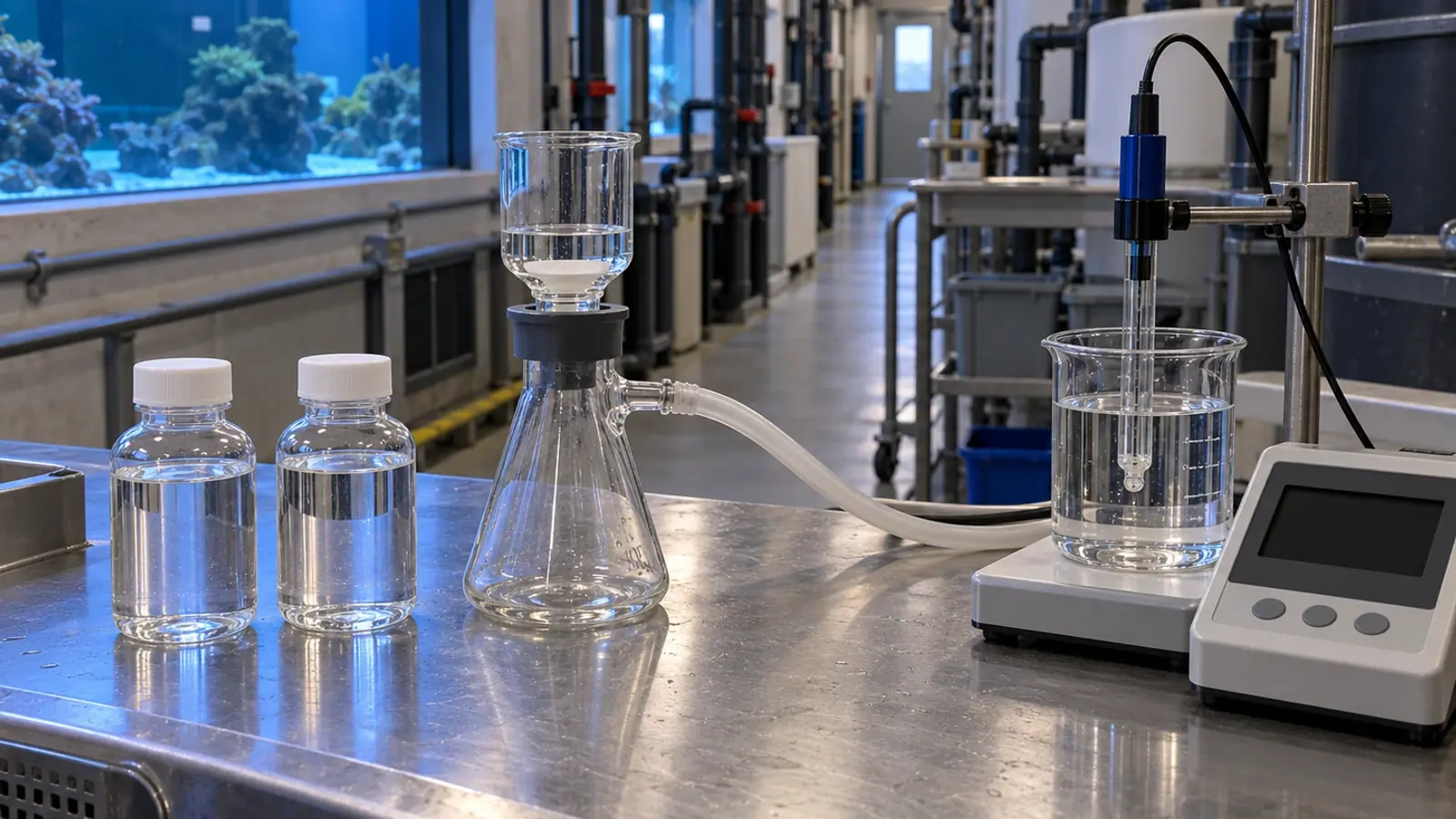
The USGS manual describes electrometric titration methods that interpret pH as acid is added. It distinguishes curve-based approaches from fixed-endpoint methods, a choice that can matter in some waters. This does not render every commercial aquarium test unusable. Suitability depends on the purpose, the instructions and the quality of the measurement process.
An aquarium can ask its laboratory to identify the method, filtration and reporting units. It should also identify the water matrix and relevant recent changes in the circuit. Freshwater and seawater should not be treated as interchangeable analytical settings. This discussion provides no acid preparation or improvised titration procedure for use around animal systems.
Check units without losing the original value
A result reported as calcium carbonate equivalents uses a calculation convention. It is not a direct measurement of the mass of calcium in the water. Before comparing it with another unit, establish that the same analytical quantity is involved and that the proposed conversion matches the reporting basis of both methods.
A monitoring sheet should retain the original value and unit. If a conversion is useful, document the rule and its purpose rather than overwriting the laboratory result. The original report remains important when a chart appears to show a sudden change or when another laboratory is asked to investigate. A converted figure without provenance is difficult to audit.
For example, a change of analytical provider may be followed by different reported values. Before interpreting the difference as lost alkalinity in the exhibit, compare sample fractions, methods and units. A confirmation analysis designed around that question can be more informative than immediately trying to restore an old number through a water-chemistry adjustment.
Agree on the evidence before adjusting the circuit
Keep the sample description, method and result together so the comparison can be checked. The USGS document provides measurement terminology and analytical guidance. It does not establish a biological target suitable for every aquarium animal, or a local legal requirement. Interpretation still depends on species, water matrix and circuit operation.
A shared review can also clarify what each team means by an alkalinity result. A laboratory may be answering a different question from the one assumed by the staff reading the spreadsheet. Making those assumptions explicit helps identify whether further sampling, analytical confirmation or another line of investigation is needed.
Vetofish can help review discordant reports, prepare a focused confirmation analysis and connect circuit observations with laboratory findings. A useful starting file includes original reports, collection conditions and recent system changes. It supports a discussion based on comparable evidence, before the label alkalinity becomes a reason to alter the water.
To move from evidence to action, explore our testing and diagnostic service and our expertise for public aquariums.


