

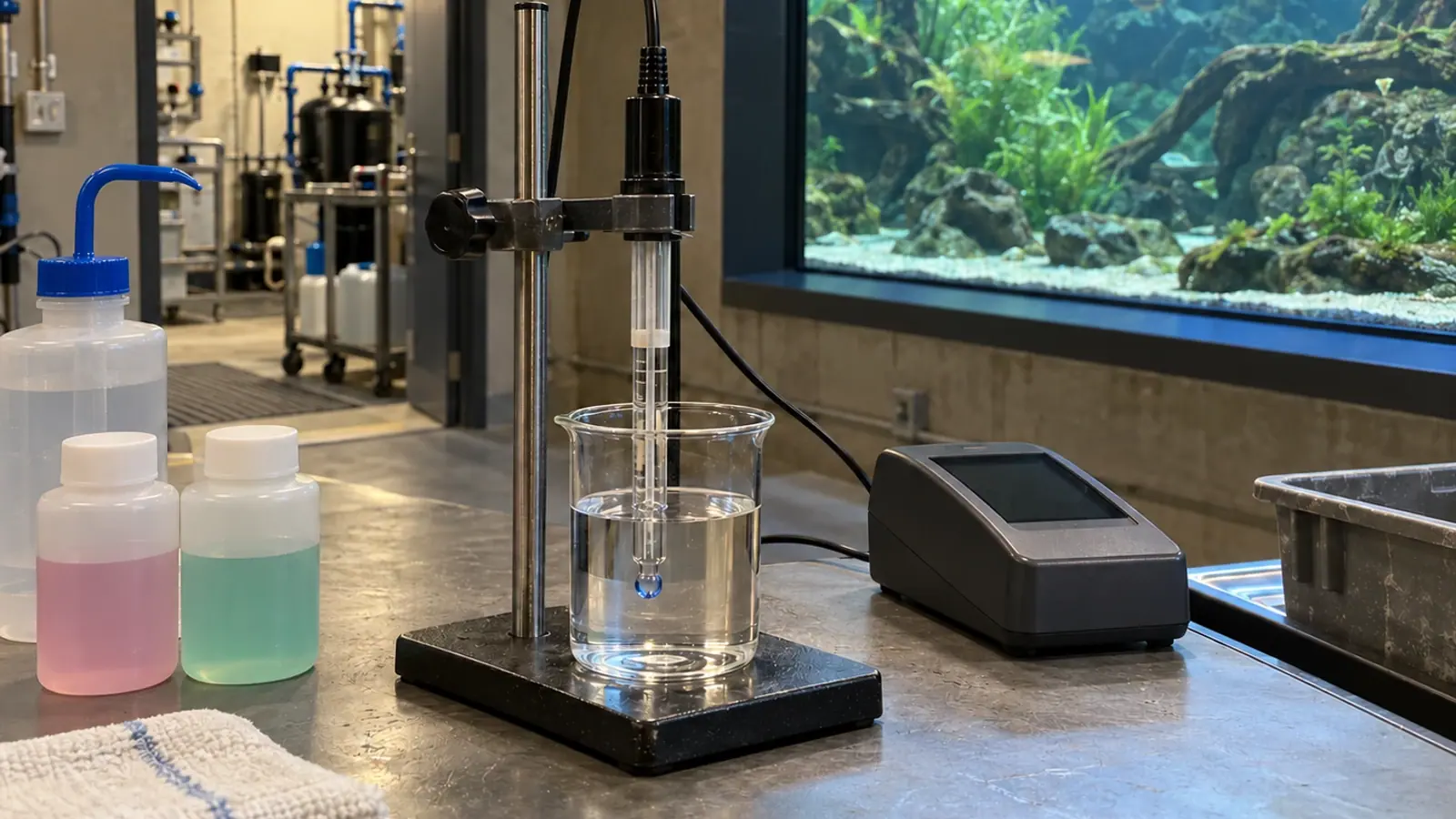
Aquarium pH: check calibration before adjusting the water
A pH change needs a measurement history before it becomes a water-treatment decision. The USGS manual revised in 2021 describes electrode and buffer checks that help aquarium teams separate measurement problems from genuine changes in water chemistry.


- Content type
- Practical guide
- Sector
- Public aquariums
- Animal group
- Fish
- Keywords
- pHTemperatureCO₂
A steady display is not proof of accuracy
A pH meter produces a number from an electrode response and a calibration. Its reading depends on both, as well as the condition of the equipment. A stable display can therefore be consistently wrong. In a public aquarium, acting on that reading alone can lead staff to treat an instrument problem by changing the exhibit water.
The USGS manual revised in 2021 describes a sequence of checks: inspect the equipment, select suitable buffers, calibrate, measure under appropriate conditions and verify the results. It addresses measurement in natural waters. Applying its principles to an aquarium requires attention to the particular instrument, water matrix and monitoring objectives of the collection.
pH expresses hydrogen-ion activity on a logarithmic scale. A difference of one pH unit corresponds to a tenfold difference in that activity. It is not a concentration reported in milligrams per litre, and two decimal places on a screen do not demonstrate accuracy to that level.
Select buffers around the expected reading
A calibration buffer provides a known pH under specified conditions. It is the reference used to establish the instrument response. Buffer pH changes with temperature, so the number in the product name cannot replace the supplied temperature table or the correct automatic recognition setting.
USGS guidance recommends at least two buffers that bracket the expected sample pH. Its example for water expected between pH 7 and 8 uses buffers 7 and 10.01. Those values define the calibration range. They do not set the water conditions required by the fish. The instrument manual determines which buffer families it recognises and the required calibration sequence.
Keep the buffer batch number, opening date and expiry date with the measurement record. Pouring a portion into a dedicated vessel avoids putting an electrode directly into the stock bottle. Used buffer should not be returned to that bottle. These precautions protect later calibrations from contamination and dilution that may not be visible.
Inspect the electrode before repeating calibration
A damaged cable, scratched glass bulb, fouled junction or unsuitable filling solution can impair the response. Repeating calibration without examining the system may simply create another set of doubtful readings. Changes in calibration slope and the time taken to stabilise can help staff recognise deterioration.
Cleaning, refilling where applicable and storage must follow the instructions for the electrode model. Gel-filled and refillable designs do not have identical maintenance requirements. Deionised water suitable for rinsing is not automatically an appropriate storage liquid. The USGS manual specifically warns about loss of ions from gel-filled electrodes stored in very dilute water.
Do not rub the bulb with paper that could scratch it. During measurement, prevent the bulb from contacting the vessel wall or bottom and check for troublesome bubbles. Maintenance belongs in a separate working area away from animals, with compatible products and the manufacturer’s handling precautions. A general cleaning routine should not override the requirements of a particular electrode.
Record temperature with the pH
Temperature affects electrode response and the chemical equilibria in the water. Automatic temperature compensation deals with the instrument response specified by the system; it does not make the water chemically identical at every temperature. A pH value without its measurement temperature and method therefore lacks part of the context needed for comparison.
Buffers must be recognised correctly at the calibration temperature. A reference check under measurement conditions helps test compensation rather than assume it works. USGS acceptance criteria belong to a defined monitoring programme. They are neither biological tolerance limits nor general legal requirements for public aquariums in France or elsewhere.
Very low-conductivity water can produce a slow or unstable response. Seawater also requires an appropriate approach to ionic strength and measurement conventions. Instruments used in different matrices do not become directly comparable because their displays have the same number of digits. The method must match the question and the water being measured.
Measure before the sample changes
The manual recommends measuring at the site or promptly after collection. Gas exchange, including exchange of carbon dioxide, temperature changes and biological activity can alter the pH in a container. A later measurement does not automatically reconstruct conditions in the exhibit when the sample was collected.
For an aquarium team, we recommend defining a location, depth and measurement time that address the monitoring question. Record the time, place, temperature, meter and electrode identities, and the checks performed. If water is removed for measurement, retain the delay and handling conditions too. Consistent records help distinguish genuine daily change from a change in technique.
Water buffering capacity, commonly considered through alkalinity, is a different property from the pH at one moment. A calibration buffer and the buffering capacity of exhibit water consequently have different roles. Adding a water-treatment product cannot repair an electrode fault. Nor does a sound pH result, by itself, establish the cause of signs observed in fish.
Conclusion: verify the reading before making changes
An unexpected value calls for a check of references, electrode condition and measurement circumstances. Once the reading is considered usable, staff can interpret it alongside the exhibit history and other observations. Instrument verification and assessment of the animals answer complementary questions.
Practical training with Vetofish
Vetofish can help teams develop a common measurement procedure, interpret calibration logs and train operators. Training can use concrete problems such as unstable readings, disagreement between meters or a change of buffer, then connect the checks to the decisions required before altering aquarium water.
To move from evidence to action, explore our training courses and our expertise for public aquariums.


