

Aquarium water alarms: plan the response
A temperature or pump-failure notification helps protect fish only when someone can act on it. Public aquariums need to plan alarm priorities, delivery and on-site verification alongside their choice of sensors.
- Content type
- Practical guide
- Sector
- Public aquariums
- Animal group
- Fish
- Keywords
- OxygenTemperaturepH
Decide what happens after a notification
An alarm in a public aquarium may arrive during another procedure, while staff are elsewhere or outside opening hours. Its recipient needs to recognise the circuit, understand the urgency and know who can intervene. Having a graph on a phone is of limited value if nobody has responsibility for checking what it means on site.
Start with recognisable failures: a stopped pump, falling water level, an unusual pH reading or a temperature excursion. For each one, identify the possible animal consequences, the checks needed and the actions available to the recipient. Someone who receives the message but cannot access the plant room cannot provide the complete operational response.
What a connected prototype has actually shown
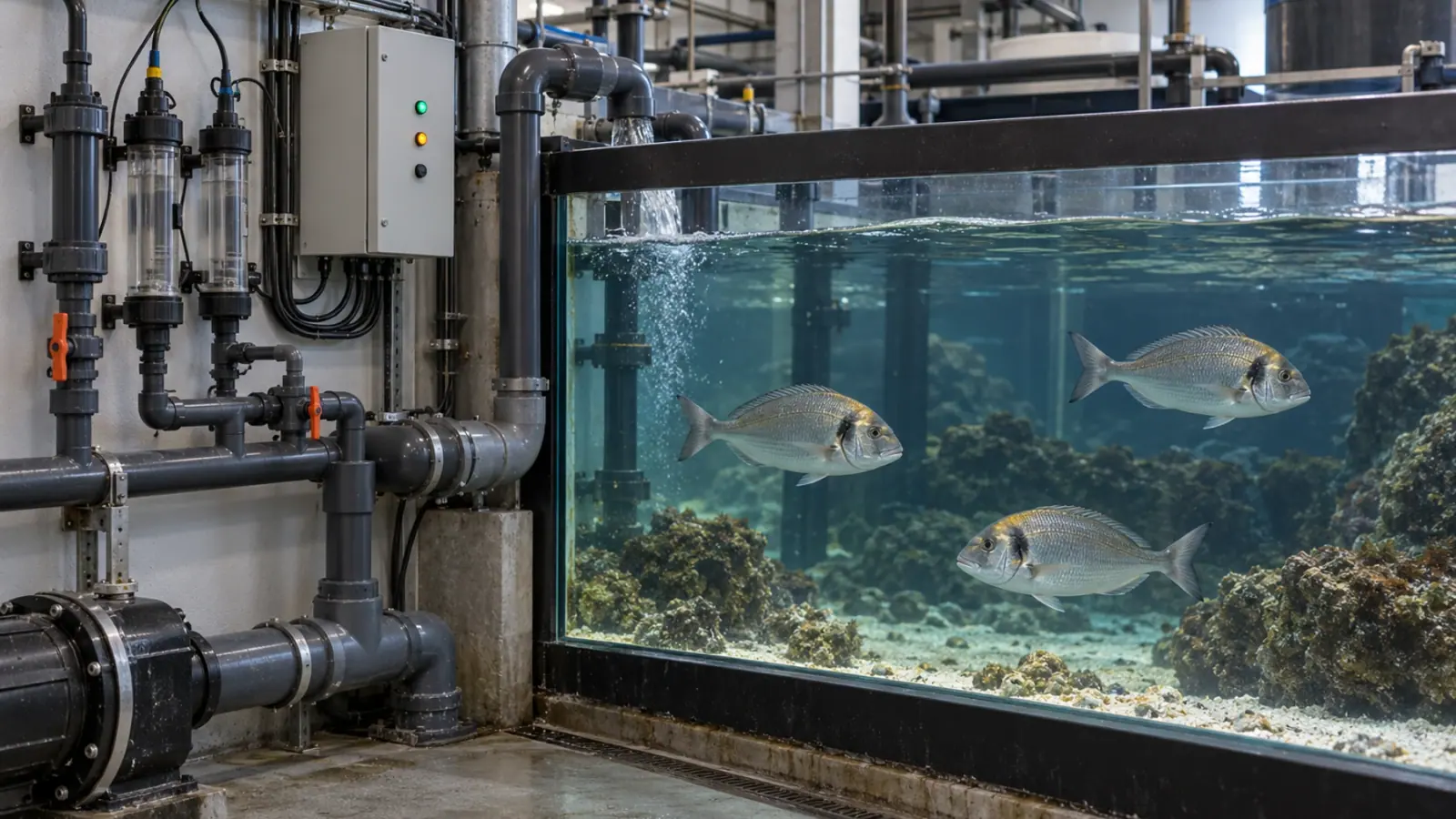
Malandrakis reported a connected monitoring system for recirculating aquaculture in 2025. Its inputs included temperature, pH, conductivity, water level and pump operation. The paper describes a month of operation and comparisons with reference instruments. It demonstrates how several measurements and equipment signals can be brought into one monitoring system.
The work was conducted in an aquaculture installation, rather than validating performance across public aquarium designs. A pump-stop alert was reported, but there was no controlled experiment quantifying a reduction in mortality caused by notifications. The anticipated protective benefit should therefore be distinguished from an outcome measured under a comparative study design.
The prototype did not directly measure dissolved oxygen or ammonia. Electrical current drawn by a pump or aerator describes an aspect of equipment operation; it does not measure water flow or oxygen available to fish. Depending on the circuit, equipment can remain powered while a hydraulic or biological problem persists. Sensor selection should follow the failures that staff need to detect.
Reserve alarms for conditions requiring a response
The UK Health and Safety Executive’s alarm-management principles focus on conditions needing assessment or action while there is still time to respond. These principles come from industrial safety. Applying them to aquarium organisation is a practical adaptation, rather than a veterinary standard for aquariums or a statement of French legal requirements.
Setpoints need justification against the circuit, species, normal operating pattern and time required for intervention. Copying another facility’s settings may generate persistent notifications or miss an important change. Staff should understand routine variation after feeding or maintenance, while remaining alert to genuine faults that happen during those activities.
A simple hierarchy can separate information for the next inspection round, a fault requiring prompt verification and a condition needing immediate intervention. Names and messages must be understandable under pressure. Several nearly identical priority levels, or colours without an associated instruction, add interpretation work when staff have little time available.
Check the measurement and preserve the record
The US Geological Survey’s guidance on continuous water-quality monitors covers maintenance, calibration checks, fouling and instrumental drift. It was written for monitoring natural waters. These quality-control principles can also inform aquarium monitoring, without providing universal biological limits for the animals held there.
Conductivity and pH probes need accessible maintenance positions that represent the water they are intended to assess. A reading next to a dosing point, or in a poorly exchanged volume, may differ from conditions in the exhibit. Record probe locations, moves and interventions so that a change in the time series can be interpreted correctly.
When an alarm arrives, staff should compare the reading with the animals, the circuit and, where needed, an independent measurement. Mark questionable data in the historical record. Automatically deleting it would remove evidence of both sensor faults and real events. The verification process needs to preserve the distinction between those possibilities.
Test delivery, acknowledgement and silence
A notification test should cover reception, identification of the responsible person, acknowledgement and escalation when that person is unavailable. Plan tests so that animal support remains secure. Simulating a fault within the monitoring system may be preferable to creating an actual equipment failure; the appropriate method depends on the installation and available technical expertise.
The plan must also detect a monitoring system that has gone quiet. Network loss, power interruption and a disconnected sensor can all stop useful information. No messages does not mean acceptable water conditions. Consider backup equipment and communication together, particularly where a power failure could disable several parts of the response chain at once.
After an event, record the signal time, receipt, verification and action. Include the identified cause or any remaining uncertainty. These records make recurrent alerts and actual delays visible. A frequent message should only be disabled after its cause has been examined and the protection still available has been established.
Keep the response workable as the aquarium changes
Review settings and instructions after changes to an exhibit, its population or its operating pattern. Technical staff, animal carers and veterinary oversight should be involved where animal health is affected. The procedure needs to identify who can change a setting, who confirms recovery and how the next shift receives the information.
Each alarm needs an owner, a defined verification step and a feasible response. Assess those elements during staff training and after real incidents. Review should improve the ability to act, rather than simply reduce the number of notifications arriving on a screen.
Our advice and support service can help connect health risks with alarm procedures and intervention capacity. For public aquariums, the aim is a response chain that teams can understand and test against the circuits and animals in their care.


