

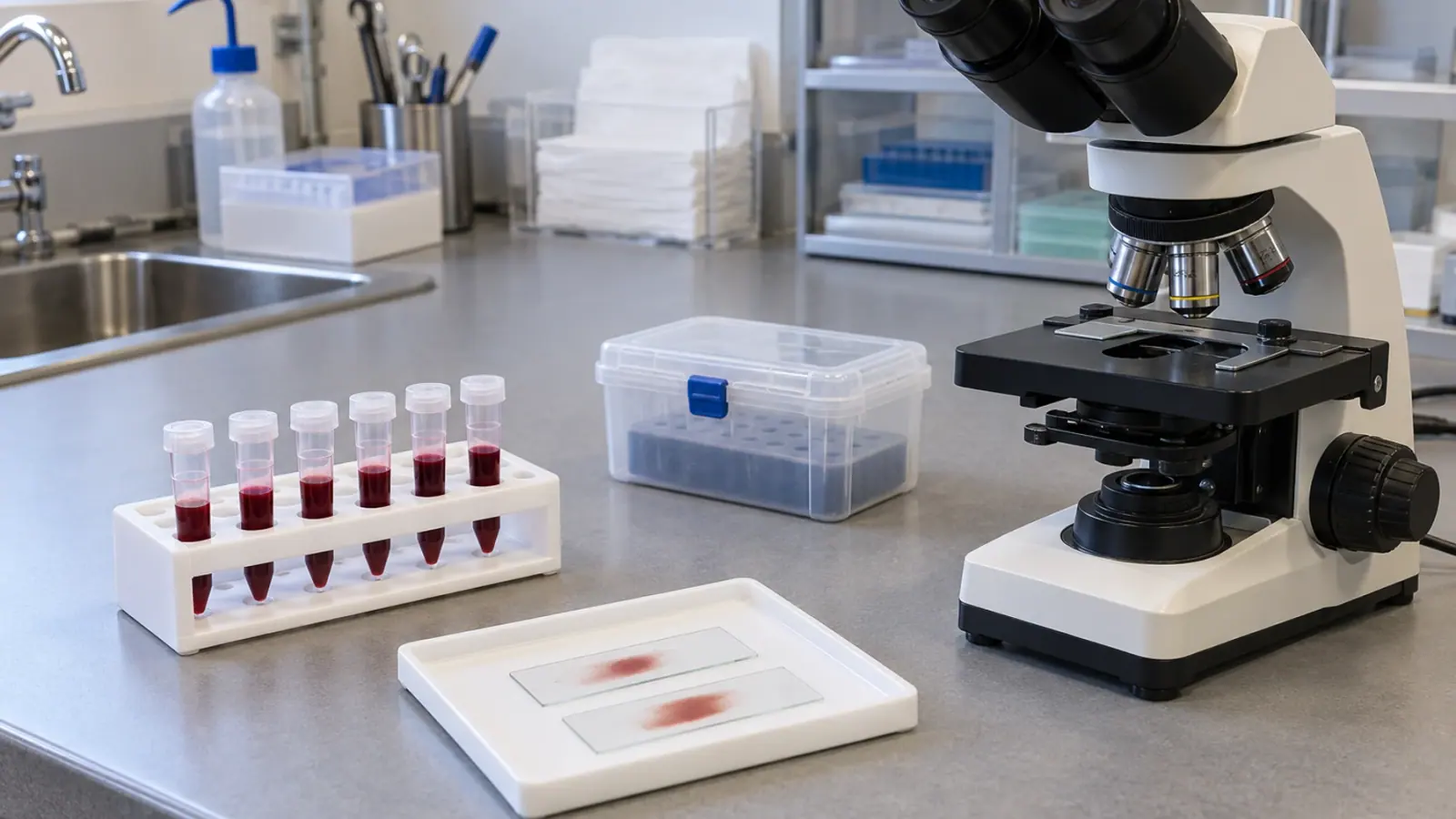
Fish blood tests: prepare the sample plan before capture
An unsuitable collection tube can change a fish’s blood result. Public aquarium teams, the veterinarian and the laboratory need to agree on the sample type, anticoagulant and transport conditions before arranging capture.


- Content type
- Practical guide
- Sector
- Public aquariums
- Animal group
- Fish
- Keywords
- ImmunityAnaesthesiaTransport
Decide what the test needs to answer
A blood result may help investigate a fish’s condition, but it also reflects what happened to the sample. Public aquarium teams should begin with a specific question. Are they examining blood cells, measuring biochemical variables or looking for a molecular target? Those purposes may require different sample types and handling conditions.
The WorldFish blood sampling guide distinguishes preparation for serum, plasma, nucleic acid extraction and blood smears. It is a technical resource, rather than a single prescription for every species in a mixed aquarium collection. Before capture is arranged, the veterinarian and receiving laboratory need to agree on what is required and what the result can reasonably show.
Agreeing these details avoids collecting a valuable sample in a tube unsuitable for the intended test. The required amount, transport arrangements and priority of examinations should be agreed together, with the animal’s clinical circumstances in view.
Serum, plasma and intact cells serve different purposes
Serum is obtained after blood has clotted. Plasma is separated from blood in which clotting has been prevented. These fluids are not interchangeable for every assay. The submission should specify the intended sample type, exact collection tube and planned preparation.
When cells are the target, the anticoagulant needs to preserve their number, appearance and, where relevant, function. Fish erythrocytes have nuclei, which matters when selecting counting and analytical methods. An instrument or procedure developed for mammalian blood should not be assumed to work reliably with fish blood.
Haemolysis is the destruction of red blood cells. It may interfere with interpretation or make a cell count unreliable. Record it explicitly without immediately treating it as evidence of disease in the fish: collection and subsequent processing may also contribute.
The receiving laboratory is best placed to say how a particular sample defect affects its assay. A usable result for one purpose may still be unsuitable for another, so sample quality should be discussed in relation to the question being asked.
A trout study illustrates the effect of the tube
De Iorio and colleagues compared three anticoagulants in rainbow trout, Oncorhynchus mykiss, in a study published in 2025. They examined lithium heparin, K3EDTA and acid citrate dextrose A, known as ACD-A. Six fish from one batch, weighing 400–700 grams, provided blood that was divided between anticoagulant treatments.
Under the conditions tested, heparinised samples did not show the haemolysis found with the other two anticoagulants. Erythrocyte counts and aspects of cell morphology differed between tubes. Some measurements of leukocyte function were also affected.
The findings were not identical across every measurement or technique. ACD-A samples were excluded from some flow cytometric analyses because of difficulties with cell preparation. That limitation prevents a simple ranking of three tubes for every diagnostic purpose.
The blood was collected after the trout had been killed at the farm. The study therefore does not establish a safe sampling volume for a living fish, or the safety of repeated collection. It also does not validate an anticoagulant for sharks, seahorses or the other species held in public aquariums.
The practical lesson is to check compatibility between species, sample preparation and assay. It is not a recommendation to replace all existing collection tubes with one product.
Agree the sample pathway before handling the fish
A preparation sheet should link the fish identifier with species, tank, clinical question and priority tests. Record the agreed sample type, collection tube and contact at the receiving laboratory. Its opening hours and processing schedule may affect whether the planned collection is useful.
Capture, restraint and any anaesthesia require a veterinary plan appropriate to the animal. They can influence physiological measurements, so their timing and circumstances belong with the sample record. This article does not provide an invasive sampling procedure or a universal collection volume.
WorldFish describes different processing pathways for different analyses. Its technical settings should not automatically be transferred to every species or laboratory. An agreed procedure for a defined matrix is a stronger basis than choosing a tube by cap colour alone.
After collection, retain the preparation and dispatch times, transport conditions and any incident. Report an unusual delay or a break in storage conditions even if the tube looks satisfactory. The laboratory can then decide whether the intended test remains interpretable and whether a qualification is needed.
Interpret changes alongside sample quality
A difference between two blood results may reflect the animal, its environment or the analytical pathway. Before calling it clinical progression, check whether sample type, anticoagulant, method and laboratory remained comparable. A number on its own cannot resolve those alternatives.
Species, developmental stage, reproductive condition and husbandry circumstances can also influence blood variables. A reference interval needs a relevant population and method. A value taken from a different species or protocol is not a universal boundary between health and disease.
An individual’s previous results can provide useful context, provided the limits of comparison remain visible. The assessment should also include the clinical examination, keeper observations and tank records. Blood analysis supports diagnosis; it does not replace that wider investigation.
Make the next sample worth collecting
The useful decision comes before capture: what information is needed, from which sample, and with what limitations? Planning preserves the value of material that may be difficult to obtain again and helps avoid additional handling with little diagnostic benefit.
Our diagnostic and laboratory service can support public aquarium teams and their veterinarian in preparing submissions and interpreting the findings. A focused first discussion can cover the proposed tests, species involved and practical sampling constraints at the facility.


