

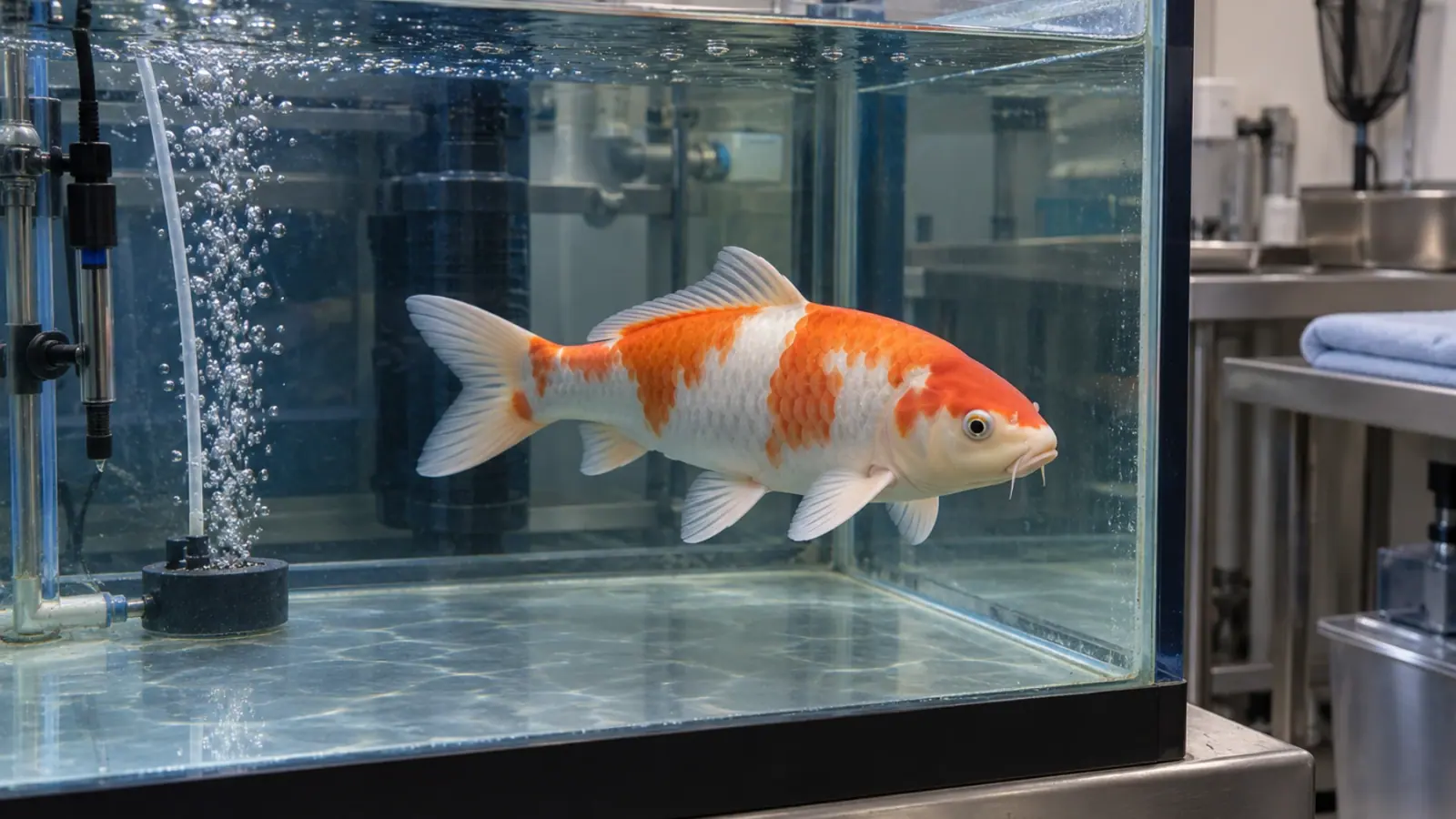
Fish anaesthesia: monitoring ventilation and recovery
During anaesthesia, a motionless fish may still need urgent attention. Ventilation, observable responses, water conditions and recovery require joint assessment using criteria suited to the species and procedure.


- Content type
- Practical guide
- Sector
- Public aquariums
- Animal group
- Fish
- Keywords
- AnaesthesiaOxygenTemperaturepH
Agree on monitoring before induction begins
During a procedure on a public-aquarium fish, the person performing the intervention cannot simultaneously follow every change in the animal and water circuit. Assigning monitoring responsibilities makes it possible to identify deterioration, announce it and record the response. Before induction, staff need to understand the clinical objective, species and available equipment, including who can pause the procedure and request veterinary reassessment.
The reviews by Neiffer and Stamper and by Martins and colleagues provide a useful basis for this planning. Both emphasise variation between species and procedural conditions. This practical discussion mainly concerns bony fishes. It is not a drug protocol and cannot automatically be extended to sharks, rays or every species held in a collection. Their anatomy, ventilation and responses may require a different approach.
Observe several responses rather than relying on stillness
Ventilation, equilibrium, muscle tone and responses to stimuli specified in the protocol provide different information. Their development needs to be related to elapsed time and interventions. A motionless fish has not, by that observation alone, been shown to be at an appropriate anaesthetic depth. Lack of movement also fails to establish adequate analgesia for a potentially painful procedure.
The observation scheme must suit the species. Opercular movements can be useful in fishes that actively pump water, whereas other species depend more strongly on water passing through the mouth and over the gills. A generic respiratory rate or posture description can therefore mislead. Selected signs should be observable in the actual clinical setup, without introducing repeated handling simply to complete a standard form.
Check the animal’s ventilation and the water pathway
Counting respiratory movements is helpful when those movements are interpretable. It is also necessary to check that water actually reaches the gills. A running pump does not prove that its flow is correctly directed. A displaced tube, obstruction or change in the fish’s position can alter delivery while the equipment continues to sound normal. Monitoring should cover the pathway as well as the machine.
Dissolved oxygen should be measured where the reading represents water used by the animal. A gas-supply setting does not replace that measurement, and a dense stream of bubbles does not establish suitable oxygenation. Staff need to understand the probe’s operation and limitations and how to verify an unexpected reading. Increasing oxygen delivery without interpreting the situation is not a universal corrective action for every change in ventilation.
Add cardiac information when a suitable method is available
Where species, body size and equipment allow, ultrasound or Doppler monitoring may provide additional cardiac information. These techniques need appropriate positioning and operator competence. They complement other observations rather than removing their value. An absent or unstable signal may have a technical explanation, which needs checking while the animal continues to be assessed through the other available indicators.
The cited literature does not establish a single target heart rate for all fishes. Trends, circumstances and concurrent observations matter more than an isolated value. Equipment developed for another species does not become valid merely because a number appears on its display. Monitoring choices should be based on an interpretable method for the fish concerned, including recognition of situations in which the measurement is unavailable or unreliable.
Follow water conditions throughout the procedure
Temperature influences the physiology of an ectothermic animal and the conditions of anaesthesia. It should be followed alongside pH and other relevant water variables. In a small volume or reused circuit, water quality can change during the session. A satisfactory initial check therefore cannot describe the entire procedure, particularly when several animals are treated in succession or the intervention lasts longer than expected.
The monitoring record should connect a clinical observation with the circuit conditions and action taken: a flow change, veterinary adjustment, equipment incident or water replacement. This sequence helps interpretation afterwards and communication during the procedure. It does not justify improvising drug concentrations, treatment or emergency measures from a general article. Those decisions need a veterinary plan suited to the animal and available clinical support.
Make recovery an observed phase of care
Recovery requires appropriate water, an environment that limits injury and a person available to observe the fish. After immersion anaesthesia, moving to anaesthetic-free water is part of the recovery protocol. Spontaneous ventilation, movements, equilibrium and swimming should be considered together. A sudden return of activity may introduce its own risk if the animal collides with the container or attempts to escape.
The first movement does not end monitoring. Criteria for return to the holding system, and reasons to extend observation, should be agreed before the procedure. Expected recovery depends on species, intervention and clinical condition. A time reported for another species is not a universal countdown. An unusual recovery needs reassessment by the veterinary team rather than a retrospective assumption that the fish simply needed longer.
Use a record that supports decisions
A useful form brings together identity, objective, water conditions, procedural stages, observations over time and actions taken. It distinguishes variables that were measured from those that could not be assessed. A broken signal or an inaccessible response should remain visible instead of being recorded later as presumed normal. Reviewing a case then becomes possible without reconstructing missing observations from memory.
Vetofish supports intervention planning and follow-up through its therapeutic care service for public aquariums. Working through the observation criteria with keepers can produce monitoring that is feasible at the site: staff know what to watch, which changes to announce and when veterinary reassessment is needed.


