

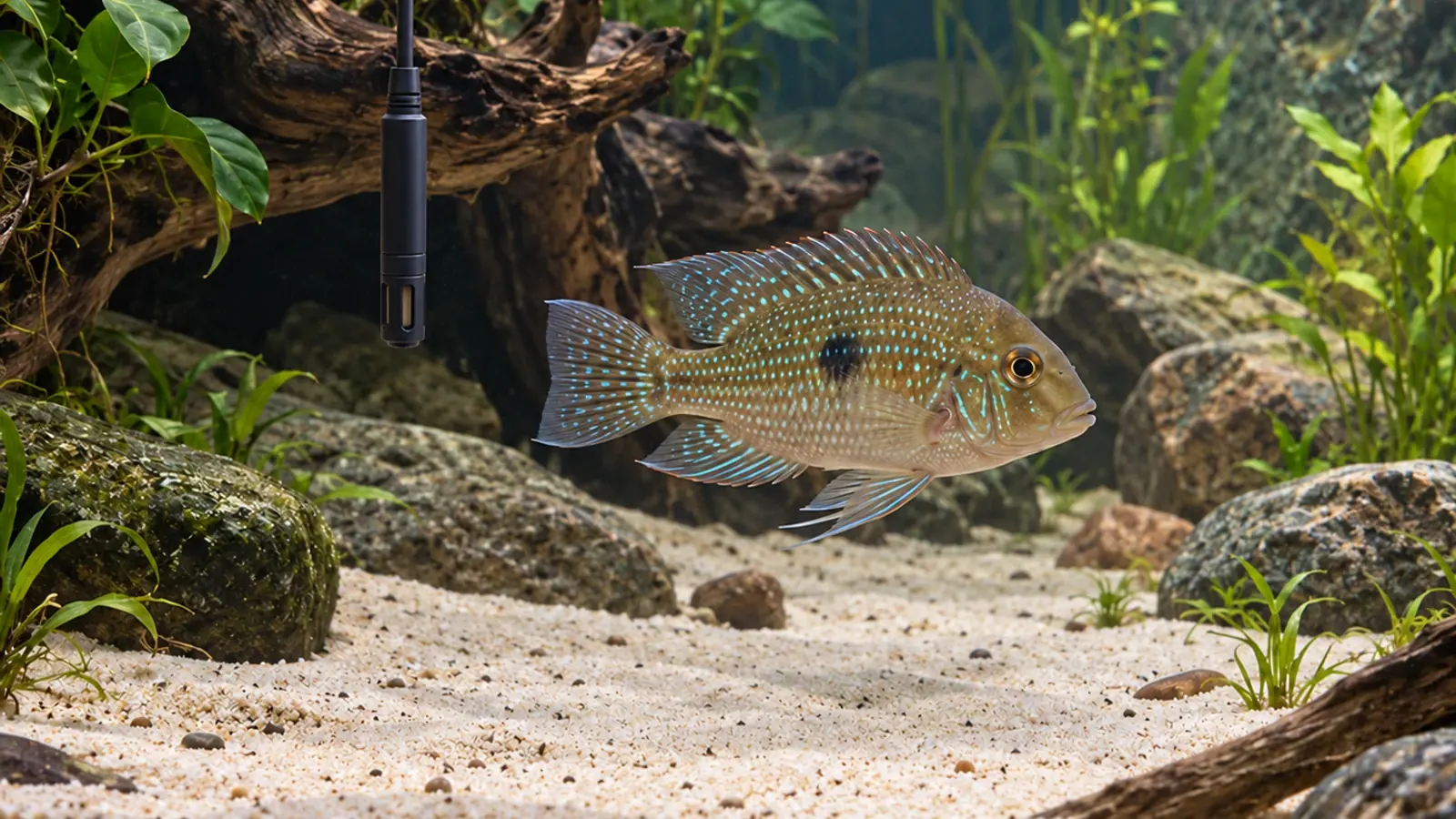
Measuring aquarium oxygen before water leaves the system
Water can change between collection and analysis. USGS guidance revised in 2020 explains why dissolved oxygen is best measured onsite, providing an established basis for planning monitoring across public aquarium systems.


- Content type
- Practical guide
- Sector
- Public aquariums
- Animal group
- Fish
- Keywords
- OxygenSalinityTemperature
An oxygen reading taken when a water bottle reaches a laboratory may no longer describe the water that fish encountered at collection. Contact with air, temperature changes and reactions within the sample can shift the result. The reading describes the water in the bottle at analysis, which may differ from the water originally collected.
The dissolved oxygen chapter of the US Geological Survey’s field manual, revised in 2020, explains why this parameter is best measured onsite. The institutional guidance concerns natural waters from fresh to saline conditions. Its measurement principles can inform public aquarium monitoring, while remaining distinct from a validated aquarium protocol or a legal requirement outside the USGS.
Measure the water before moving it
Dissolved oxygen is molecular oxygen held in solution. Its concentration can change after a sample is separated from the water body. The manual notes that substantial changes may occur within minutes, particularly when water was originally isolated from the atmosphere.
Transfer to a container, mixing and gas exchange can alter those conditions. Knowing the delay does not automatically make the result correctable. The direction and size of the change depend on what happened to the sample. A later reading cannot simply be converted back into the original value with a general calculation.
For an aquarium team, a reasonable application is to plan the measurement at the location relevant to the question. A reading from the display, an inlet or another part of the circuit describes that point. Recording its location is more useful than assuming that all connected water is homogeneous.
Choose a location that answers the question
The USGS guidance considers whether measurement positions represent the water being assessed. A single point can stand for a wider area only when the conditions and mixing justify that interpretation. Aquarium teams can use this principle when planning monitoring, with arrangements adapted to their own systems.
A reading close to a strongly aerated inflow answers a different question from one in the area occupied by animals. Similarly, a value obtained in the plant room cannot describe every part of the display by itself. The purpose is not to collect as many readings as possible, but to identify the exposure each location is intended to document.
Depth and time belong with the result. Retaining them allows a comparable observation to be repeated and helps explain differences between records. Otherwise, an apparent change may reflect moving the sensor rather than changing conditions at the same place.
This distinction also matters during incident review. A technically sound measurement can still answer the wrong question if its location is omitted or misunderstood. Data quality includes the relationship between the observation and the part of the system being assessed.
Keep concentration and physical conditions together
Milligrams per litre and percentage oxygen saturation are related but different quantities. Concentration describes the amount in solution. Percentage saturation compares that amount with a calculated equilibrium concentration under specified conditions.
Temperature, atmospheric pressure and salinity affect that relationship. A saturation percentage therefore needs those conditions to be interpretable. The same percentage under different conditions need not correspond to the same concentration.
Instrument settings should remain available with the record. Some instruments apply corrections automatically, while others require the operator to account for them. Applying a correction twice, or assuming that a disabled compensation is active, can produce a misleading result.
This is especially relevant when staff work across freshwater and seawater systems. A spreadsheet column without units, water matrix or compensation information conceals an important change of context. The values should remain traceable to the conditions and settings used to obtain them.
Give the sensor time to describe the water
The chapter covers optical sensors, whose operating characteristics differ from those of amperometric sensors. Their requirements for water movement at the sensing surface are not identical. Staff therefore need the method and instructions for the instrument in use, rather than a handling routine transferred from another meter.
The sensor and temperature measurement must be properly immersed and allowed to equilibrate with the water. The first number on the display is not necessarily a stable reading. Stabilisation criteria need to suit the monitoring objective and the equipment.
A bubble at the sensing surface, fouling or incomplete immersion are points to examine when a reading appears inconsistent. Calibration and performance checks belong in the measurement record. They cannot compensate for an unrepresentative location or for changing the sample during the measurement.
The distinction helps separate two problems that can look similar on a display: an instrument that is not performing as intended and water that genuinely differs between locations. Both deserve investigation, but they require different evidence.
Relate the reading to fish observations
An oxygen value is not a complete health diagnosis. Requirements depend on the animals and their circumstances. This guide does not provide a universal threshold that declares every aquarium fish free from respiratory difficulty.
Monitoring can bring readings alongside behavioural changes, circuit performance and recent interventions. This is a proposed application for aquarium collections, rather than an experimental result obtained by the USGS in aquarium fish.
An absence of visible signs cannot retrospectively validate a poorly documented measurement. Equally, unusual behaviour does not immediately identify oxygen as its cause. Establishing the quality of the data and interpreting its biological meaning are complementary tasks.
Leave a record another person can interpret
A usable record identifies the circuit, location, depth, time, instrument, method, units and associated conditions. It retains performance checks and any difficulties encountered. A transported sample should remain clearly distinguished from a reading taken directly in the water body.
The 2020 manual offers an established basis for organising measurement quality. Its internal USGS requirements are not automatically requirements for a French aquarium or an aquarium elsewhere. A local monitoring procedure must also work with the animals, access to the exhibit and the operation of the facility.
Vetofish can help define monitoring locations and interpret water records alongside health observations. The purpose is to establish what each reading actually describes and which information is missing before a difference is interpreted or a circuit’s operation is changed.
To move from evidence to action, explore our advice and support service and our expertise for public aquariums.


