

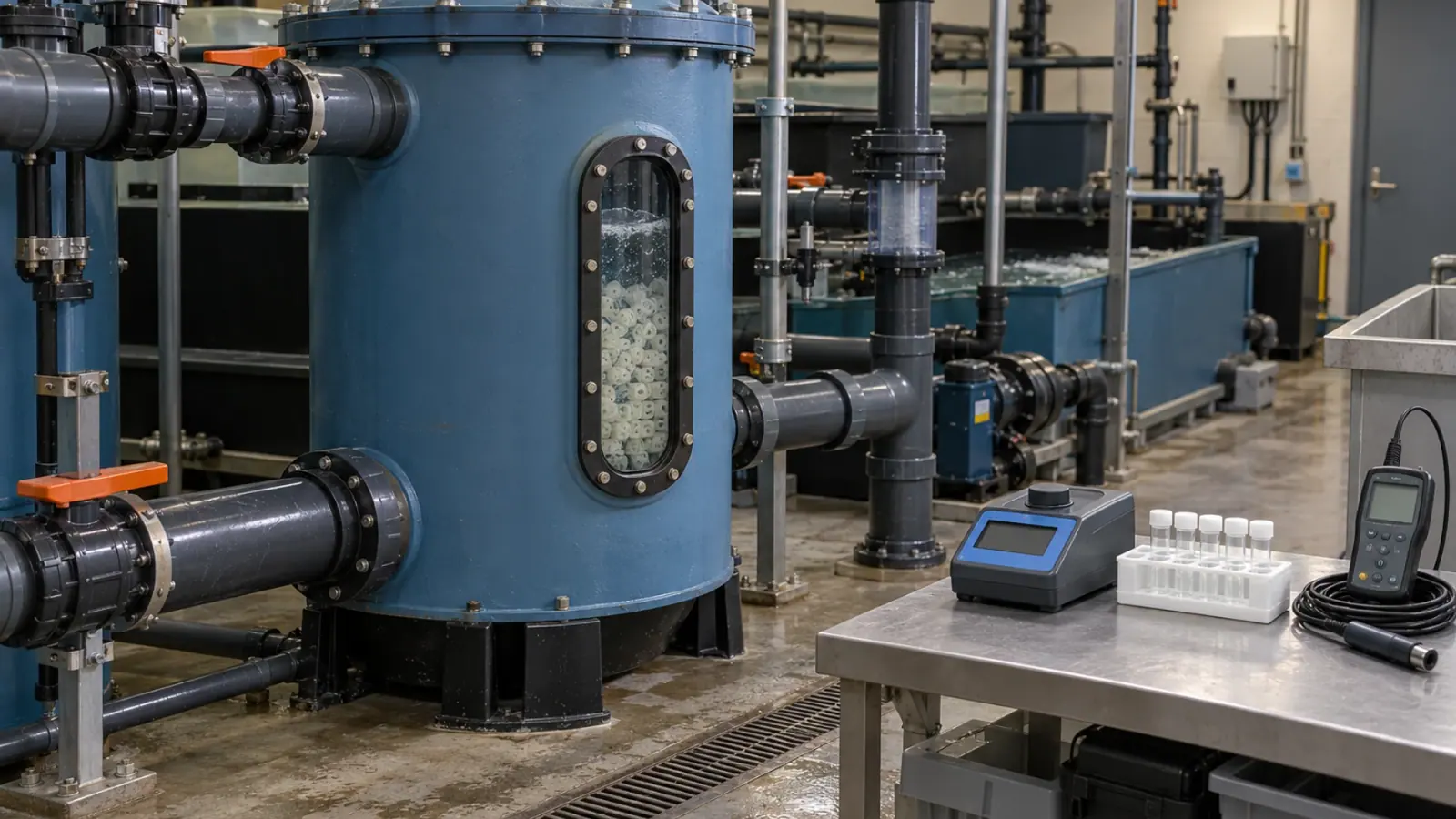
Tank treatments: keep watch on nitrification
Clear water and surviving fish do not confirm that a biofilter is functioning normally after treatment. Ammonia and nitrite monitoring needs to be interpreted alongside water circulation, feeding and system history.
- Content type
- Practical guide
- Sector
- Public aquariums
- Animal group
- Fish
- Keywords
- DisinfectionOxygenpHTemperature
A tank treatment addresses a health problem, but the treated water may also reach bacteria that the system depends on. In a recirculating aquarium, microorganisms transform nitrogenous waste produced by fish. If that activity slows, the consequences can emerge after the original clinical signs appear to improve. Monitoring therefore needs to cover both the animals and the function of the installation.
Water clarity does not measure nitrogen processing
Nitrification converts ammonia nitrogen into nitrite and then nitrate. Microorganisms in the filter biofilm carry out this work. Clear water provides little evidence about their activity: a filter can remove visible particles while failing to process the nitrogen load quickly enough.
Concentration and treatment capacity are also different measurements. Low nitrogen concentrations in a lightly fed tank or a system with substantial water replacement can coexist with reduced biofilter activity. Conversely, a rise may follow increased feeding or altered circulation. Interpreting an analysis requires a record of what enters the system and what leaves it.
The US Geological Survey’s 2015 technical review brings together research on formalin effects in freshwater recirculating systems. Exposure conditions and filter characteristics affected the findings. That evidence does not supply one answer for every medicine, disinfectant or public aquarium. A useful monitoring plan starts by identifying the treatment and the system being assessed.
What a freshwater study actually demonstrated
In 2022, Fredricks and colleagues examined two recirculating systems: a warmwater installation holding yellow perch and grass carp, and a coldwater installation holding rainbow trout and lake trout. They monitored nitrification before and after four consecutive daily exposures to a formaldehyde preparation.
The volumetric rate of total ammonia nitrogen removal fell after exposure. Responses and recovery differed between the systems. Nitrite findings required more careful interpretation: lack of a statistically significant difference in one measure did not establish that the relevant nitrifying bacteria were unaffected.
No fish mortality occurred during or after those exposures. That observation did not make the filter response irrelevant. It showed that a technical function could deteriorate without immediately producing visible deaths in systems retaining some operating margin. Counting deaths alone would have missed the change in nitrogen processing.
The experiment helps identify a function worth monitoring. It does not demonstrate that the tested preparation is harmless, nor does it establish a treatment protocol for an aquarium collection. Its experimental concentrations should not be copied into clinical practice from this account.
Establish a baseline that includes system operation
A useful baseline combines water testing with biomass, ration, water replacement, filter flow, temperature and recent maintenance. An up-to-date diagram can show whether treated water will reach the biofilter and where it will return to the animals. Sampling points need clear identifiers and a repeatable collection method.
Total ammonia nitrogen must be distinguished from the un-ionised ammonia fraction. Results also need explicit units, particularly when one method reports nitrogen mass and another reports the mass of the whole compound. Water pH and temperature help interpret the toxic fraction; comparing numbers without that context can produce a poor decision.
Monitoring should also include nitrite, dissolved oxygen and other parameters relevant to the filter. Feeding and sampling times belong in the record. A sample taken immediately after substantial water replacement cannot be compared uncritically with one collected late in a feeding cycle.
The plan should specify who reviews results and how an unexpected reading is checked. Those responsibilities matter when laboratory results arrive after a shift change or when the usual system operator is absent. Recording a measurement is useful only if somebody can connect it to an appropriate response.
Follow recovery beyond the end of exposure
After treatment, the team can compare water-quality trends with ration, replacement water and circulation changes. Monitoring frequency depends on the assessed risk, the product and the system’s operating margin. The 2022 experiment cannot provide a universal follow-up period for public aquariums.
When a trend deteriorates, confirm the measurement and its context while protecting animals under the plan agreed with the veterinarian and technical team. A unit mismatch, expired reagent or changed sampling point can distort interpretation. Those checks must not delay urgent action when an animal health risk is already established.
A return to an acceptable concentration does not necessarily demonstrate complete filter recovery. Reduced feeding or increased dilution can hide impaired capacity. Monitoring should accompany the return to normal operation, without deliberately overloading the system to test its fish.
Bypassing a filter requires a complete circuit assessment
Keeping a chemical away from the biofilter can appear an obvious protective option. Whether it is appropriate depends on oxygenation, waste management, available water volumes, the return pathway and the possibility that an infectious agent remains in the filter. Closing a valve without assessing the whole route can simply move the problem elsewhere.
The American study involved freshwater systems and one preparation. It did not establish tolerance in marine biofilters, immature filters or collections containing invertebrates. Several characteristics differed between systems, so their responses cannot be attributed to temperature alone. A public aquarium needs an assessment suited to its species, installation and veterinary context.
Include filter performance in the health review
Treatment outcome should be assessed with the course of disease and the operation of the installation. Documenting nitrification can reveal delayed risk, help explain a water-quality change and improve preparation for future interventions. It cannot justify describing a product as safe for all biofilters.
Vetofish can review monitoring plans, sampling points and coordination between veterinary and technical teams through its consultancy and assessment service, supporting public aquariums.


