

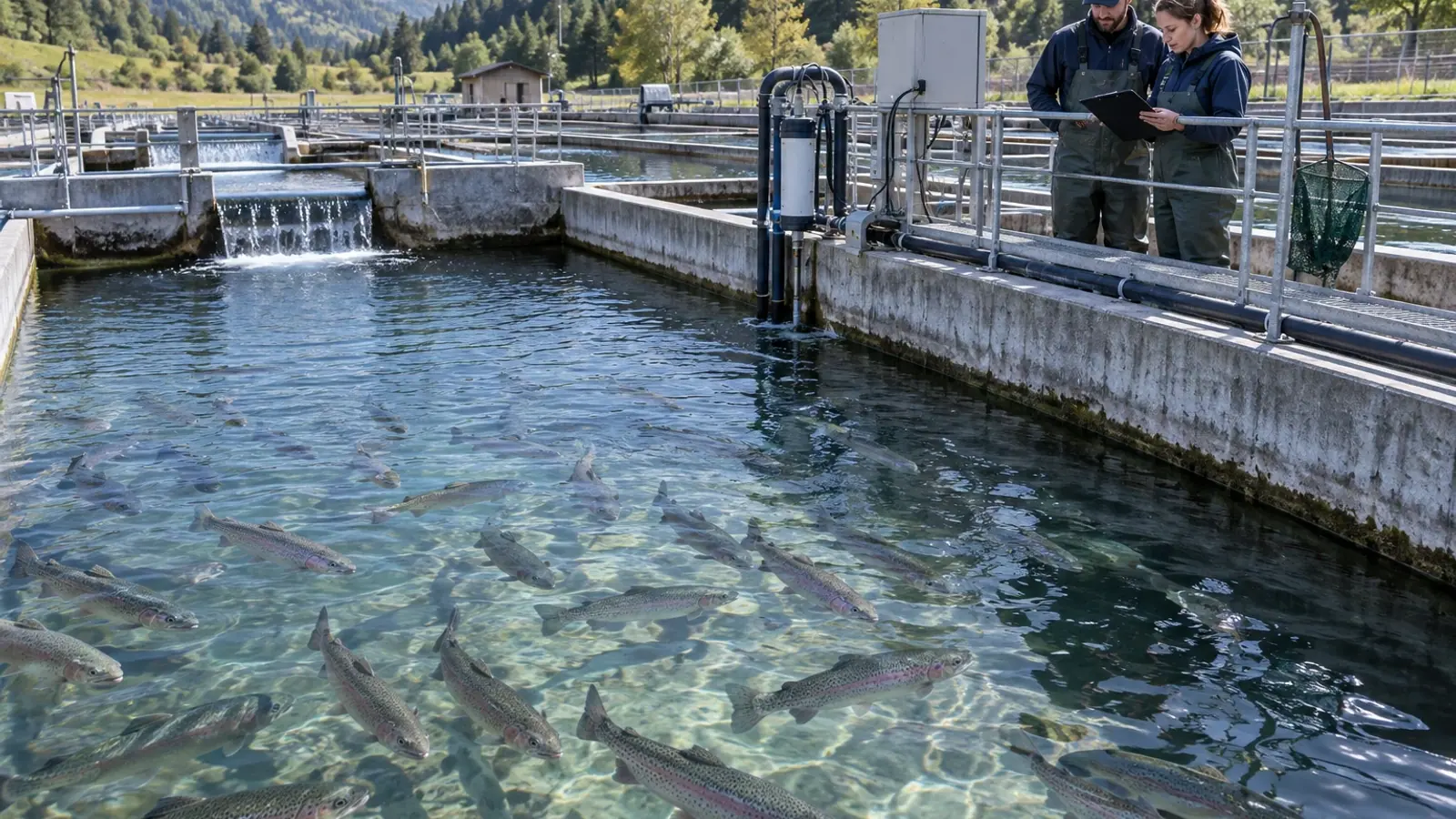
Aquaculture biosecurity: monitor the risks that matter
A longer pathogen list is not automatically a stronger health plan. Risk-based surveillance connects hazards, transmission routes, consequences and each farm’s capacity to act.
- Content type
- Practical guide
- Sector
- Aquaculture
- Animal group
- Fish
A biosecurity plan does not become effective simply by adding every conceivable pathogen to a testing schedule. Species, life stage, stock origin, water source, equipment, staff movements and market pathways give each aquaculture site a distinct risk profile. Surveillance should therefore answer an operational question: which events must be detected early enough for a defined response to change the outcome?
WOAH’s Aquatic Code asks establishments to identify relevant pathogenic agents and their transmission pathways, then select proportionate measures. FAO’s Progressive Management Pathway applies the same principle at broader scales: start from risks and existing capacity, document progress and strengthen the system step by step.
Start with the production system
An open marine cage, a river-fed raceway and a recirculating system have different entry routes and containment options. Map movements of animals, water, equipment and people, then connect each pathway to hazards plausible for the species, production stage and location.
This prevents false uniformity. An agent absent from the region, with no susceptible host or credible route into the site, may not justify the same effort as one documented at the supplier and readily carried in water. Conversely, a non-listed hazard may deserve high local priority when it repeatedly disrupts production.
Biosecurity is more than disinfection. It aims to prevent introduction, limit amplification within the farm and prevent onward release to other units or the environment.
Rank risks without false precision
A practical matrix can combine likelihood of introduction, likelihood of exposure, severity of consequences and capacity for detection. Low, medium and high categories may be more defensible than an apparently exact numerical score. Keep the rationale, uncertainties and review date beside every ranking.
Evidence also needs grading. Compatible mortality, a positive PCR result and a characteristic lesion answer different questions. Molecular detection alone does not prove viability or causation. A useful programme combines animal observation, mortality and performance trends, water quality, necropsy and targeted laboratory tests.
Separate routine baseline surveillance from event-triggered surveillance. The latter should activate after unusual mortality, reduced feeding, equipment failure, a supplier alert or a relevant environmental change. Aggregating weak signals only at monthly level can conceal a developing event.
Link every test to a decision
Before sampling, define what will change after a positive, negative or inconclusive result. A test may clear an introduction, extend quarantine, separate a batch, intensify examination or trigger statutory reporting. Without an action threshold, data collection becomes expensive and hard to interpret.
The plan specifies the target population, epidemiological unit, frequency, sample size, tissues, transport conditions and laboratory. It also states sensitivity limits: a negative result from a small sample does not demonstrate freedom across an entire establishment.
Keep non-specific indicators visible. Reduced appetite, uneven growth or a gradual rise in removals may precede diagnosis. Plotting them by unit and batch is more informative than a single farm-wide monthly total.
Select barriers that can be verified
Each priority pathway requires an observable barrier: supplier qualification, separation of health status, water treatment, dedicated equipment, movement order, cleaning, disinfection or effluent control. Written procedures are useful only when implementation can be demonstrated.
Audit real movement patterns. A dedicated net that crosses zones, a poorly maintained footbath or a routinely bypassed hygiene barrier will not deliver the expected risk reduction. Incidents and near misses should feed improvement rather than disappear from the record.
WOAH recommends routine review, at least annually and whenever operations, facility design, husbandry, disease risks or incidents change. Review should also remove low-value controls and redirect resources toward newly important risks.
Proportionate does not mean minimal
Risk-based surveillance is not a reason to test less by default. It means testing the right population, at the right time, with a prepared response. Regulatory obligations remain the baseline; local analysis complements rather than replaces them.
Vetofish can help farms map entry pathways, rank hazards transparently, design sampling and define escalation thresholds. The objective is a living and auditable plan connected to daily decisions—not a catalogue of tests detached from how the site actually works.
Governance must name the plan owner, a deputy and the people authorised to isolate stock, stop movements or contact the laboratory. Training should use the real site layout and include weekend and night-shift scenarios. A procedure that depends on one unavailable person is not resilient.
A concise dashboard can track barrier compliance, laboratory turnaround, incidents, corrective actions and overdue reviews. These are measures of system performance, not proof of pathogen absence. Trend review should ask whether warnings led to timely action and whether repeated deviations reveal an impractical rule.
Scenario exercises are useful. Teams can rehearse unexplained mortality, a supplier alert, loss of water treatment or equipment crossing between health zones. The record should identify decisions, missing information and improvements rather than staging a demonstration in which every answer is known.
Risk ranking should also be communicated to suppliers, contractors and laboratories at the level required for their role. Shared definitions of the epidemiological unit, notification threshold and sample priority reduce delay while protecting confidential commercial information.
To move from evidence to action, explore our health expertise and biosecurity service and our expertise in aquaculture.


