

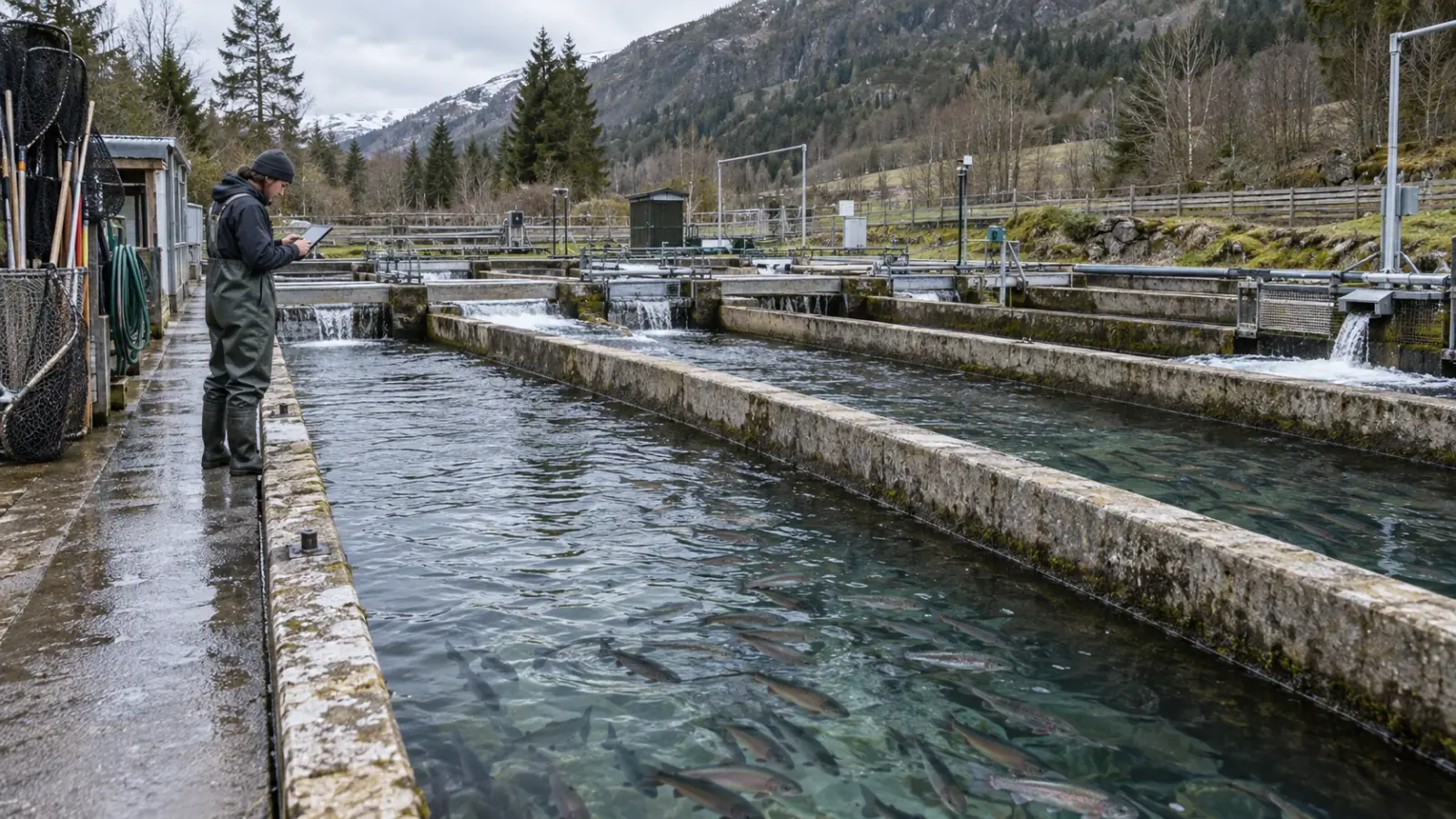
Fish-farm biosecurity starts with real-world flows
A biosecurity plan is not a generic checklist. It must follow the routes by which a pathogen could enter, circulate within and leave a farm.
- Content type
- Practical guide
- Sector
- Aquaculture
- Animal group
- Fish
Biosecurity on an aquaculture farm is neither a footbath nor a document left on a shelf. The World Organisation for Animal Health (WOAH) describes it as a combination of management and physical measures that cumulatively reduce the risk of pathogens entering, spreading within and leaving an establishment. The practical starting point is therefore the farm as it actually operates. Animals, water, equipment, vehicles, staff, feed and waste do not always follow the routes shown on a site plan.
Map epidemiological units, not just buildings
One establishment may contain receiving, quarantine, hatchery, grow-out, equipment storage, mortality handling and effluent-treatment units. A wall does not create sanitary separation when nets, boots or hoses regularly cross it.
A useful map records the origin, destination, frequency and owner of each flow. It also identifies whether movement is one-way, whether the item can be cleaned and disinfected, and what happens during an incident. Water needs particular attention: open, semi-open and recirculating systems offer different levels of control. WOAH guidance requires a plan tailored to the production system, species, husbandry, environment and credible hazards.
Rank risks before selecting controls
The most expensive intervention is not automatically the highest priority. Planning begins by identifying hazards and transmission pathways, then estimating likelihood and consequence. Animals from an uncertain source, shared wet equipment and uncontrolled intake water may present different risks depending on species, life stage and local health status.
This prevents two common failures. One is applying the same precaution list everywhere, even when it misses the dominant pathway. The other is attempting to monitor every conceivable pathogen without a connection to the stock. FAO’s progressive pathway emphasises proportionate objectives, shared responsibility and measurable improvement rather than immediate perfection.
Manage introductions without promising zero risk
Before arrival, the farm records supplier, origin, batch identity, movement history and available health evidence. A certificate or negative test does not stand alone: sampling date, matrix, sample size and method limitations determine what the result supports.
Quarantine needs an explicit purpose. It may support observation, sampling, acclimation or separation of health status. Duration and examinations depend on the target hazard; there is no universal period that covers every agent. Water, staff and equipment routes must maintain separation throughout. Release should follow written criteria rather than the apparent absence of mortality.
European animal-health law includes registration, approval for specified establishments, surveillance and movement requirements. It does not make every general technical measure an identical legal duty for every farm. Operators should confirm the applicable status and obligations with the competent authority.
Turn the plan into observable procedures
A standard operating procedure states its objective, responsibilities, steps, precautions, records and review date. Priority procedures follow the selected pathways: animal reception, staff movement, cleaning before disinfection, shared equipment, mortality removal, feed, visitors, vehicles, effluent and escapes.
Records must remain usable. WOAH examples include animal origin and destination, quarantine, visitors, stocking density, growth, treatment, vaccination, water quality, cleaning, morbidity, mortality and laboratory findings. Accumulating forms without review does not show control. A smaller set of time-series indicators can reveal drift and trigger action.
Prepare for an incident before it happens
The plan defines alert thresholds such as an unusual rise in mortality, shared clinical signs across units, a water-quality excursion, a barrier breach or a non-compliant introduction. It assigns immediate decisions: restrict movements, preserve appropriate animals or samples, contact the veterinarian and, where relevant, notify the competent authority.
A tabletop exercise often exposes gaps. Who has the contact list? Where is clean equipment stored? Can a shared pump be isolated? What information accompanies a specimen? Answers must remain workable overnight, at weekends and with reduced staffing.
Audit the system and learn from deviations
WOAH recommends scheduled audits and review at least annually, and also after facility or husbandry changes, a new health threat or a biosecurity incident. An audit should not inspect paperwork alone. It follows actual work, checks supplies, observes crossing flows and asks staff about informal workarounds.
A documented deviation should lead to a change in procedure, training or equipment. This feedback loop makes biosecurity a living management system. It also distinguishes an effective control from an expensive routine that no longer addresses the priority risk.
Keep the claims proportionate
Biosecurity reduces probability; it cannot prove that a farm is free of every pathogen. Health monitoring still needs clinical observation, production data and appropriately designed laboratory testing. A positive molecular result does not necessarily demonstrate disease, while a negative result does not erase sampling limitations.
The same caution applies after an incident. A single breach may not explain a mortality event, and a plausible route is not a confirmed source. Timeline reconstruction, epidemiological links and diagnostic evidence should be considered together before responsibility or causation is assigned.
Vetofish can support flow mapping, risk assessment and practice audits, as well as procedure design and alert thresholds. The goal is not a pathogen-free promise. It is to make introductions less likely, spread more difficult and response faster.
To move from evidence to action, explore our expertise in aquaculture.


