

Bay scallop tentacles reveal spatial vision
The bay scallop Argopecten irradians can locate some visual cues and direct its sensory tentacles towards them. A 2021 study distinguishes spatial vision from light detection alone. For public aquariums, the finding supports a more precise behavioural record without turning tentacle movement into a clinical sign.
- Content type
- Scientific news
- Sector
- Public aquariums
- Animal group
- Corals and invertebrates
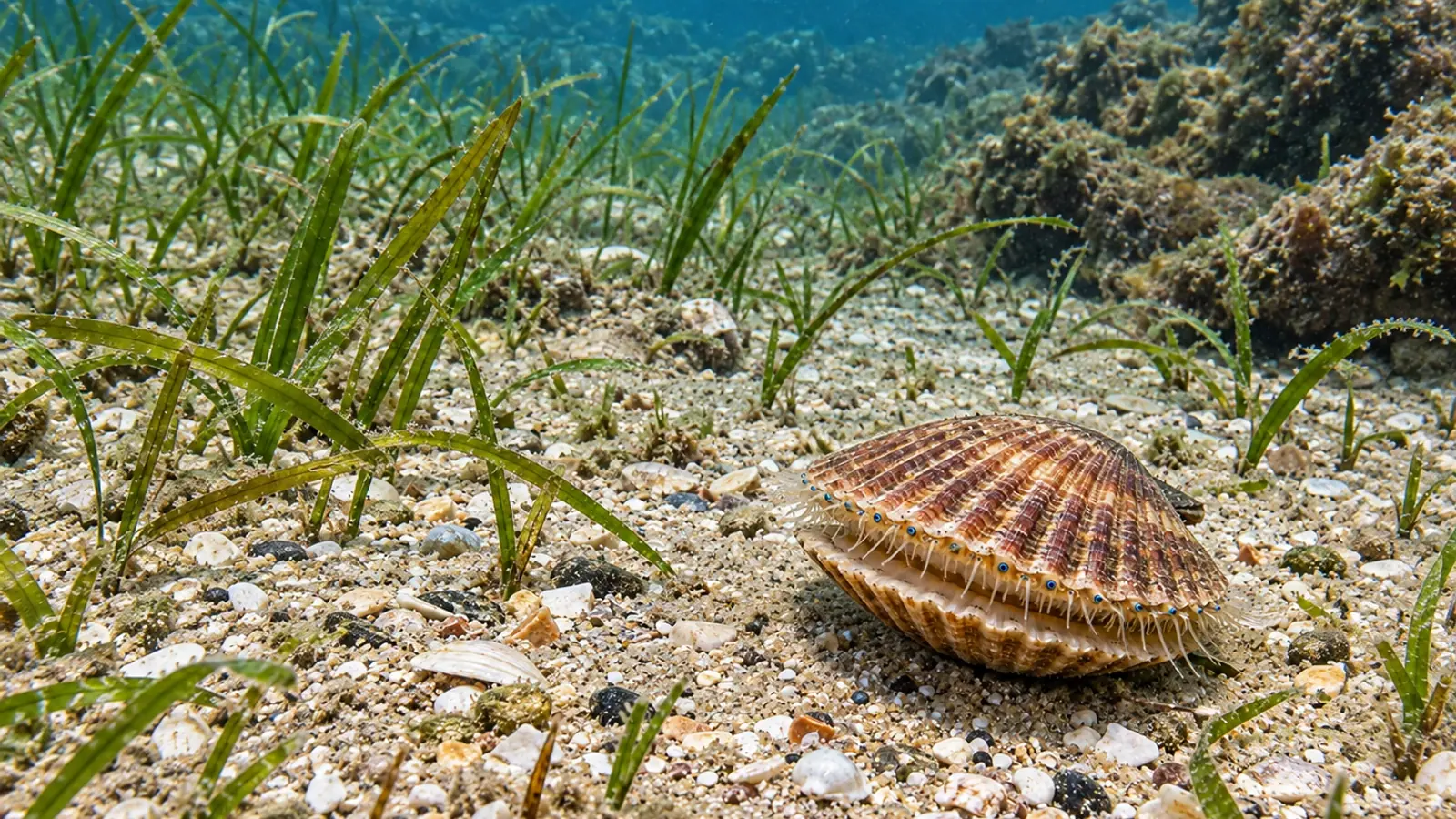
A scallop may appear motionless while the margins of its valves remain behaviourally active. In the bay scallop, Argopecten irradians, these margins carry numerous small eyes as well as sensory tentacles. Chappell and colleagues asked whether the animal could locate visual cues, rather than simply detect their presence. Their 2021 study identifies a particular sensory response that can help public aquarium teams describe what they observe more precisely.
A visual system distributed along the mantle
Bay scallops have dozens of eyes arranged around the edges of their valves. The mantle also carries several kinds of tentacles. The large sensory tentacles examined in this study can extend and change direction; shorter structures in the same region have different characteristics. Counting every visible projection in a photograph would therefore not reproduce the measurement used by the researchers.
Spatial vision requires information about where a stimulus is located. A response to a change in illumination alone does not demonstrate that ability. The study used tentacle direction as an external indication of localisation. The scallop could express a directional response without moving its entire shell, allowing the researchers to compare the orientation of tentacles around the body. This distinction between response presence and response direction matters when deciding what to record.
Static cues and rotating patterns
The animals had shell heights of 3.5–5.7 cm. They were maintained in recirculating natural seawater at 19.5°C and a salinity of 33, under a 12-hour light and 12-hour dark cycle. These values describe the study animals and their context. They are not a husbandry specification for every scallop species maintained in an aquarium.
Each of two experiments with static stimuli used 21 animals. Dark stripes varied in position or angular width, with controls and randomised presentation orders. A third experiment involved 16 animals viewing rotating patterns with controlled average luminance. This helped distinguish location-related responses from responses to an overall brightness change. Video recordings provided the positions and lengths of extended tentacles. The measured response was thus a spatial pattern of movement, rather than an impression that the animal had become generally more active.
Direction revealed more than tentacle counts
Scallops directed their sensory tentacles towards static cues placed in several positions around the valves. They also directed extensions more frequently towards the largest static cue tested. The total number of extended tentacles did not differ significantly between the static treatments. A record limited to tentacle counts would consequently have missed part of the main result.
Rotating stimuli elicited rotating waves of tentacle extension. Tracking was observed in 11 of 16 animals viewing the 20° pattern, and in none viewing the 2° pattern or the control. These observations belong to this apparatus and behavioural criterion. They do not establish the absolute resolution of each eye or a universal visual threshold for the species. Tentacle movement could also lag behind the rotating cue, so an instantaneous view need not capture the full directional sequence.
Record the sequence before assigning a function
Aquarium teams can begin by making their observation records more specific. Observer position, movement outside the glass and contrasting objects form part of the context of a recorded sequence. Noting when and where tentacles extend is more informative than writing only “responds to light”. Video can help when the visible pattern changes as a cue moves around the animal.
The authors propose that vision helps direct tentacles towards objects that can then be investigated through tactile and chemical information. Predator detection is one function they discuss. That interpretation does not demonstrate that a visitor is recognised as a predator. Nor do the trials establish the animal’s subjective experience or the overall suitability of its environment. An observable response needs additional evidence before being assigned a positive or negative welfare meaning.
A missing response is not a diagnosis
Not every recorded trial entered every analysis. Some trials with insufficient tentacle extension were excluded, so analysed sample sizes varied between treatments. A scallop that does not show the expected orientation cannot be classified as blind or unwell from that observation alone. Tissue visibility and observation conditions also limit what aquarium staff can reliably record.
Species identity matters. The bay scallop Argopecten irradians is different from the European great scallop, Pecten maximus. Shared anatomical features do not authorise transfer of every result between them. The study investigates sensory and motor coordination; it supplies neither a veterinary diagnostic test nor a validated enrichment programme or welfare threshold. Proposed neural mechanisms should likewise remain distinct from the tentacle trajectories that were actually measured. A plausible explanation of coordination is not a direct recording of the complete underlying circuit.
Conclusion: retain direction, timing and context
The study shows that apparent bodily stillness can accompany a directional response to visual cues. In an aquarium observation record, species, lighting context, tentacle direction and changes over time can make the account more faithful to the behaviour. Comparisons between sequences need enough contextual information for an observed difference to be interpretable. A single photograph supports a more limited conclusion.
Vetofish’s animal welfare service can help teams select observable behaviours and examine the limits of their interpretation. Our work with public aquariums connects that framework with daily care, without turning a research finding into an individual clinical diagnosis.


