

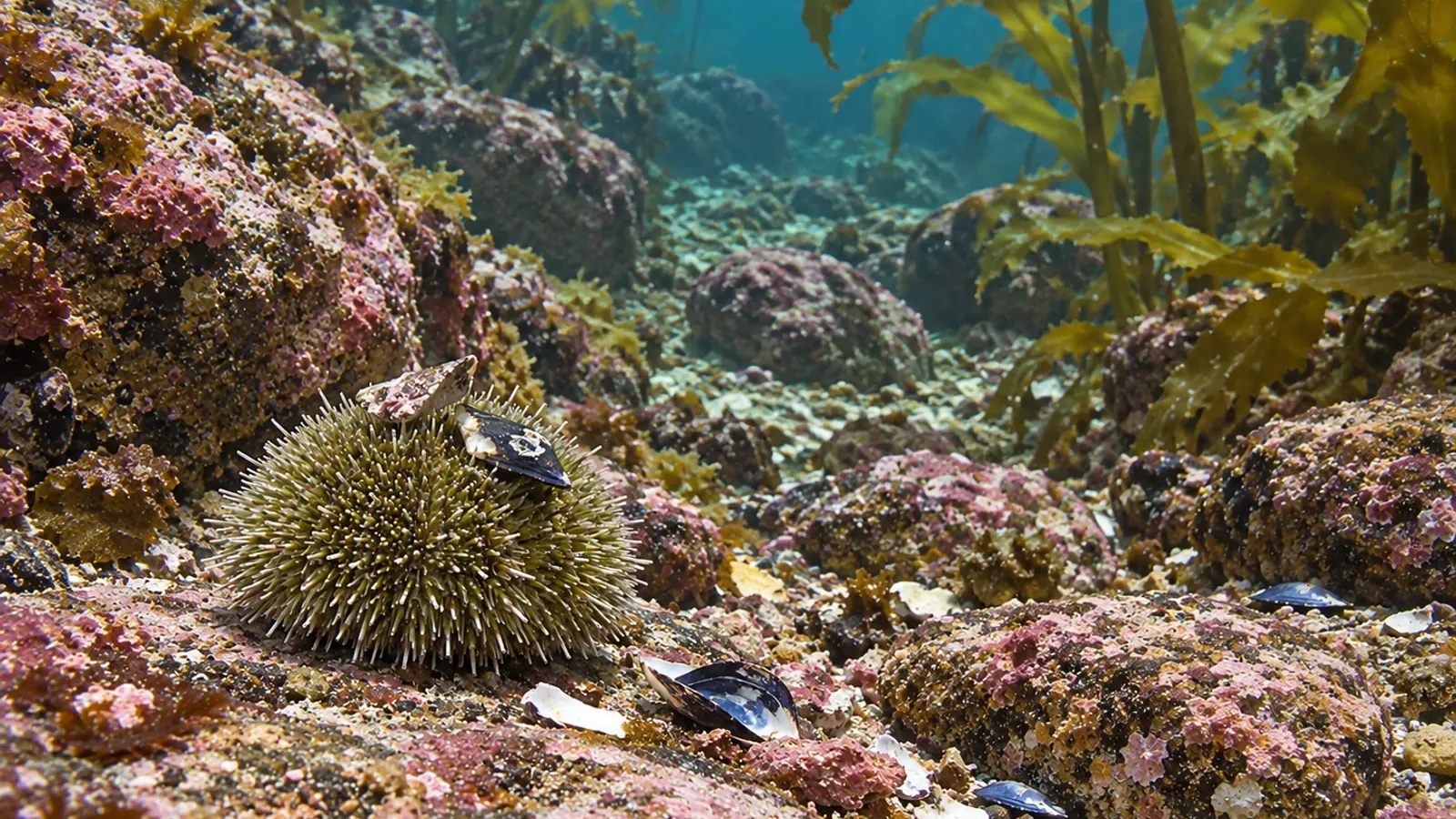
Green sea urchin covering responds to water movement
Material carried by a green sea urchin does not necessarily indicate excessive light. A study published in 2026 links covering mainly to water movement and body size in Strongylocentrotus droebachiensis. For aquarium teams, the physical setting belongs in the behavioural record.


- Content type
- Scientific news
- Sector
- Public aquariums
- Animal group
- Corals and invertebrates
- Keywords
- EthogramLightingEnrichment
A sea urchin carrying shell pieces or algae is actively collecting and holding material on its upper surface. An aquarium team needs to ask: how much of the behaviour reflects the species, the animal’s size, available material or the physical conditions around it?
Chantelle R. Clermont and Patrick Gagnon addressed that question in the green sea urchin, Strongylocentrotus droebachiensis. Their 2026 paper combines a wave-tank experiment with field observations made in Newfoundland in 2016. It provides a reason to consider water movement before treating every covered urchin as an indication of excessive light.
Covering is an active behaviour, with two measurable components
The urchin uses its tube feet, among other structures, to handle and retain material on the aboral surface, opposite the mouth. This is different from particles settling passively on the animal. It is also different from staff placing a covering on an urchin to reproduce a particular appearance.
The researchers distinguished frequency from intensity. Frequency is the proportion of urchins that cover; intensity is the proportion of surface covered among those that do. An aquarium could have more covered animals without each individual carrying a larger quantity. Recording these endpoints separately makes comparisons more informative and avoids treating several different changes as one response.
An experiment separating body size, light and wave action
The study compared two test-diameter classes, excluding the spines: 1–2 cm and 4–5 cm. Three light conditions were crossed with three oscillatory water velocities: 0, 0.1 and 0.2 m/s. The resulting eighteen combinations were each replicated eight times, with five previously unused urchins placed in each forty-minute trial. The trials structure the experimental design; repeated images do not create additional independent trials.
Available cover included mussel shell pieces and fragments of rhodolith, a calcareous red alga. Covering frequency was 58% without waves, 65% at the low velocity and 89% at the intermediate velocity. The first two did not differ significantly, whereas the intermediate-velocity treatment had a higher frequency. Small urchins also covered more often than large ones.
Light did not have a statistically significant effect on frequency or intensity under the conditions tested. This is a result about that species and experimental setting. It does not demonstrate that light has no effect on any urchin under any exposure or spectral conditions, and it does not establish an aquarium lighting standard.
Field observations show why context matters
The field survey covered five dates between May and September 2016 at depths of 3, 5 and 9 metres. Image analysis included 12,467 observations of urchins. These were not records from 12,467 separately identified animals followed through time, nor were they independent study sites.
Covering frequency varied with body size, depth and date, while the materials used also varied with the setting. For a benthic aquarium display, the practical implication is to record what animals can actually collect. A change after cleaning or rearrangement may coincide with a different supply of material on the bottom. Without that information, a team could mistake availability for a stable preference or a new health problem.
Observe the setting before changing it
A useful record can include animal size, carried materials, location and the state of water movement at the time. Describe the substrate and recent maintenance. A simple behavioural record should distinguish covering, movement, feeding and inactivity, rather than grouping them all as withdrawal. Repeated observations and the animals’ broader health history give an isolated photograph a more useful context.
The study does not justify routinely removing material held by urchins or increasing pump output to make animals cover. A measured oscillatory velocity in a research channel is not interchangeable with the nominal flow rating of an aquarium pump. The reported values are experimental conditions, not operating instructions. Any proposed alteration needs to address the installation and the actual question being investigated.
Mechanical protection is a hypothesis, not a welfare diagnosis
The authors propose that covering primarily protects external organs from contact with moving debris. Several findings support this interpretation, but the study did not directly demonstrate fewer injuries or better survival. The association between more covering and less movement also cannot diagnose an animal’s overall welfare state.
The management conclusion is to keep several explanations open until the evidence supports a choice. Providing suitable materials may be considered as part of environmental enrichment, with attention to the species, material compatibility, maintenance and health monitoring. Adding objects solely to create the appearance of a covered urchin is not itself a demonstrated welfare benefit. The study concerns green sea urchins and does not supply a common protocol for tropical species or all echinoderms.
Connect behavioural records with display management
Vetofish can help define an observation scheme and examine behaviour alongside aquarium conditions and technical interventions. Our animal welfare service supports teams working in public aquariums that need a measurable question rather than a single interpretation of a visible behaviour. The resulting records can guide a justified observation or adjustment while retaining the distinction between evidence, explanation and a proposed benefit.


