

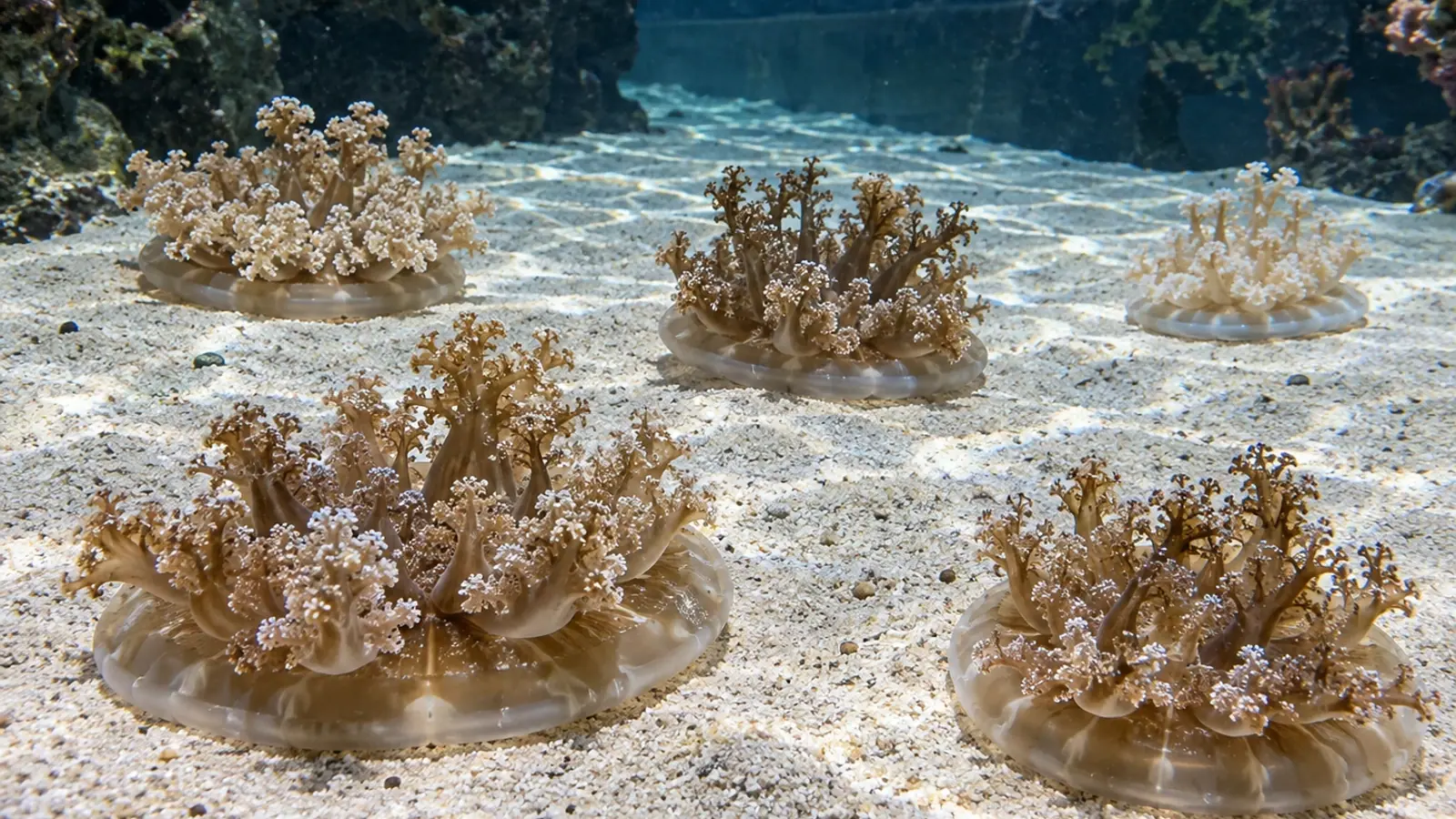
Cassiopea in aquariums: reading pulsations in context
Slower night-time pulsation in Cassiopea does not by itself establish illness. A study published in January 2026 characterises rest using several behavioural criteria, giving public aquariums a reason to record patterns and context rather than judge an animal from a single count.


- Content type
- Practical guide
- Sector
- Public aquariums
- Animal group
- Corals and invertebrates
- Keywords
- LightingTemperatureStress
Rest does not require pulsation to stop
In Cassiopea andromeda, the bell usually rests on the bottom while the oral arms face the light. This upside-down jellyfish lives with photosynthetic microalgal symbionts. Its normal posture differs from that of jellyfish swimming through the water column, so remaining in one place is not sufficient evidence of abnormal inactivity. Pulsation provides another observation, but it needs a time context.
Raphaël Aguillon and colleagues examined this animal’s rest in a Nature Communications paper published in January 2026. Their work combines laboratory behaviour, field observations and investigation of DNA damage. The behavioural findings help explain why a single pulsation count cannot describe an animal’s whole condition.
The researchers found that pulsation continued during periods classified as sleep, at a reduced rate. They used several behavioural criteria, including delayed responses to a stimulus and rebound rest after disruption. These measures establish an experimental behavioural state. They are not a set of daily tests for keepers to impose on display animals in order to assess their health.
Time of day and body size change the comparison
The studied Cassiopea rested mainly at night, with additional short periods around midday. The light–dark cycle therefore matters when observations are compared. A count after lights-out cannot be treated as equivalent to a count during the usual active period. At a minimum, a record needs the time, lighting state and identity of the animal or group under observation.
Size matters too. In the field at Key Largo, Florida, the authors found a relationship between relaxed bell diameter and pulsation rate. They used that relationship to adjust predictions of rest for animals of different sizes. These predictions were not individual diagnoses confirmed by the same stimulus tests used in the laboratory.
The experimental threshold established for their colony should not become a common health limit for every Cassiopea. Species identity, size, husbandry conditions and counting method can alter the comparison. The study’s value comes from combining criteria and following a pattern, rather than adopting one number as a tank-side rule.
Build observations that can be compared
For a public aquarium team, repeated comparable observations can help identify departures from a group’s usual pattern. A record could bring together observation duration, time, lighting, temperature, animal position and appearance. Water movement and recent events such as feeding or maintenance also provide context. These are practical record-keeping proposals for a site, rather than a clinical monitoring protocol validated by the study.
Count an identifiable animal over a known interval. Video can allow a second review where contractions are difficult to distinguish, provided the original recording and unreadable sequences are retained. An animal obscured by a neighbour or moving out of frame has not produced a pulsation rate of zero. Its measurement is missing, which is a different result.
An intervention can itself cause stress and change the behaviour being assessed. Existing observations and routine footage are therefore useful starting points before adding disturbances. The sleep-deprivation and stimulus experiments in the paper address research questions. They do not establish a routine surveillance method for aquarium staff.
A shared observation sheet also needs a stable vocabulary. Describe what was visible, such as reduced pulsation or a different posture, before attaching an interpretation. If different staff members use “inactive” to mean different things, the register can create an apparent change that belongs to the recording method rather than the animals. Agreeing those terms makes handovers easier to review.
Sleep research is not a disease diagnosis
A night-time slowdown that fits an animal’s usual pattern does not exclude every health problem. Equally, a brief deviation does not establish disease. Persistent changes, particularly alongside altered appearance or posture, deserve assessment with the other observations and water records. Counting helps describe the change; it does not identify its cause on its own.
The authors also studied the sea anemone Nematostella vectensis, whose daily organisation differed from that of Cassiopea. That comparison is a reason to avoid applying one schedule or practical definition of rest across all cnidarians. Similar body features or zoological relatedness do not make behavioural indicators interchangeable.
The broader study links sleep and DNA damage under experimental conditions. It does not show that a low pulsation rate can estimate DNA damage in a display tank. Nor does it validate a treatment or universal lighting programme for improving jellyfish sleep. Moving from fundamental research to husbandry requires this distinction to remain visible.
Record the usual rhythm before interpreting departures
Describe the usual pattern to provide a reference when pulsation slows. A clear register allows comparisons between observations made under similar conditions and distinguishes missing data from a real change. This gives keepers, biologists and veterinarians a more precise basis for discussion without promising an automatic diagnosis.
Vetofish can help teams develop an observation framework and assess departures through its animal welfare service. Our work with public aquariums connects behaviour, husbandry conditions and surveillance decisions. The aim is to collect observations that help both animals and staff while avoiding unnecessary disturbance.


