

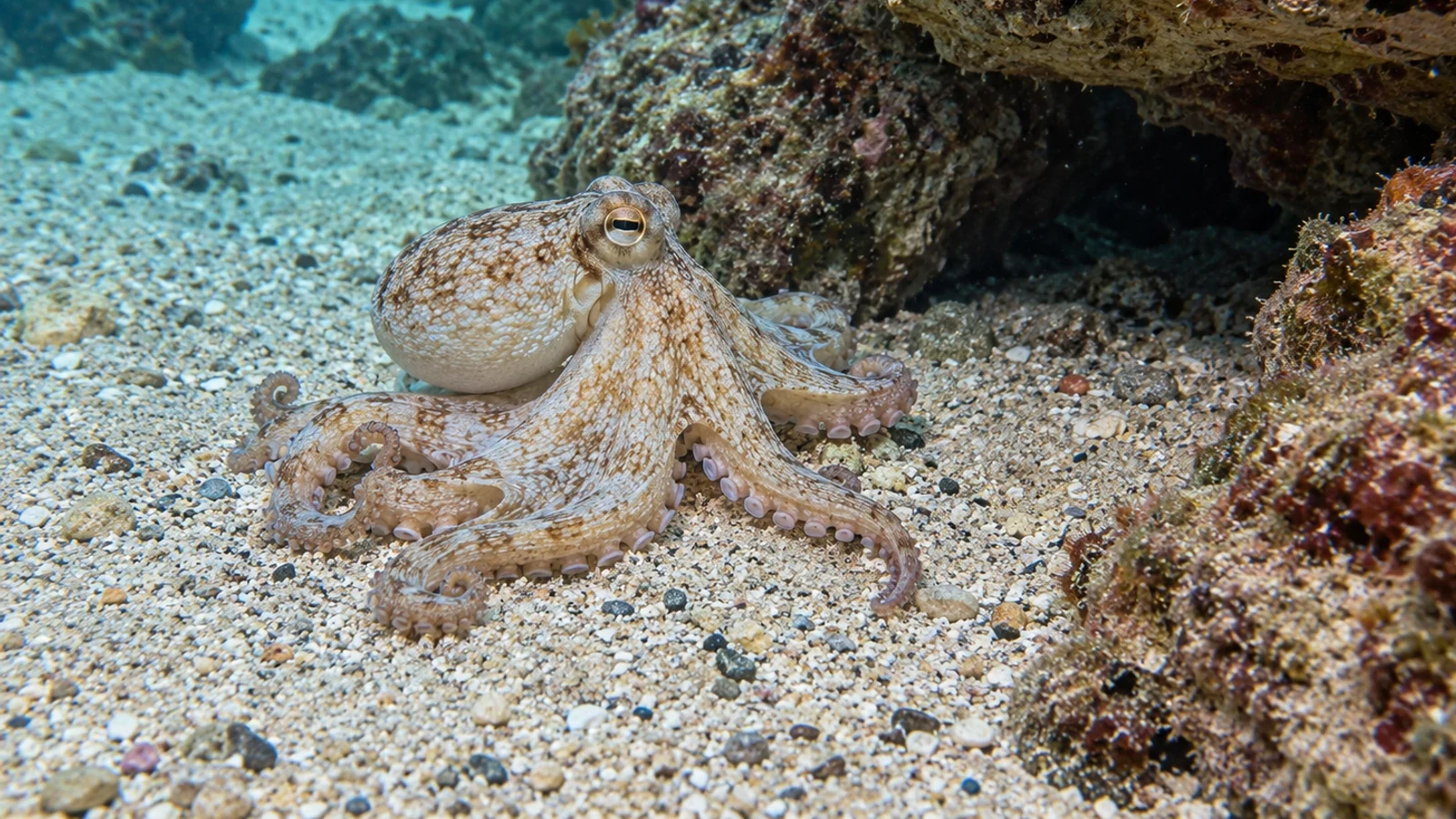
Octopus skin patterns can change during active sleep
An octopus at rest can switch skin patterns rapidly without being awake. A 2023 study in Octopus laqueus describes quiet and active sleep. Aquarium teams can use the distinction to organise observations across time, rather than assigning meaning to a single photograph.


- Content type
- Scientific news
- Sector
- Public aquariums
- Animal group
- Cephalopods
- Keywords
- EthogramLightingTemperature
A rapid change in an octopus’s skin attracts a keeper’s attention. It does not, by itself, reveal whether a resting animal is awake. The events before and after the change, and the movements accompanying it, carry information that a still photograph cannot preserve.
Pophale and colleagues combined behavioural observation, skin-pattern analysis and recordings from the brain of Octopus laqueus. Published in Nature in 2023, their study provides evidence for two sleep states in this nocturnal species. It offers a basis for interpreting sequences of behaviour, rather than a clinical test for aquarium octopuses.
Two states in a particular octopus
During daytime quiet sleep, the animals adopted a flattened posture, closed their eyes and generally appeared pale. Brief active episodes interrupted that state, bringing changing skin patterns, body and eye movements, and altered ventilation. Visible activity was therefore compatible with continuing sleep.
One part of the analysis segmented nine animals across 1,743 hours of video to quantify changes in skin brightness. Other experiments had their own sample sizes. Repeated bouts from the same animal should not be reported as though they were independent octopuses, and no single denominator describes every result in the paper.
Chromatophores help produce the patterns under neural control. Skin patterning can thus provide an observable motor output associated with the animal’s state. That does not make every colour change equivalent, or turn the skin into a direct display of subjective experience. The relationship has to be investigated rather than assumed.
Why the active episodes count as sleep
Movement alone would not distinguish an active sleep episode from waking. The researchers considered several criteria: the state could be reversed rapidly, responses to stimulation depended on stimulus strength and state, and disturbing sleep changed subsequent active-bout occurrence. Together, these findings support a regulated sleep state.
The rebound following disturbance contributes to the evidence for sleep homeostasis. It is not a reason to deprive a collection animal of rest to check its condition. Research interventions used to test a hypothesis should not be adopted as routine keeper assessments without a separate justification.
Electrical recordings showed that activity in some brain regions during active sleep resembled waking activity more than quiet-sleep activity. Those recordings required specialised equipment and animals held for the recording procedure. Normal aquarium observation does not provide the same neural measurement, even when a visible pattern looks similar to a published example.
Familiar patterns do not establish dreaming
Computer analysis identified active-sleep patterns resembling patterns seen while the animals were awake. Their sequences were diverse. Octopuses did not all pass through one fixed visual sequence, and a striking video cannot identify a particular hunt or encounter supposedly being replayed.
The authors discuss possible functions, including maintenance of motor control and reactivation of activity associated with experience. These remain hypotheses. The study does not demonstrate dreams, assign a specific memory to each pattern or establish that a familiar-looking skin pattern has one internal meaning.
Comparisons with vertebrate rapid-eye-movement sleep help generate questions, but they do not make the underlying anatomy equivalent. Public aquarium interpretation should preserve both the functional similarities and the limits of the comparison. A visitor explanation can describe active sleep without presenting a speculative narrative as an observed event.
Record the sequence within its daily context
The organisation of active bouts across the day persisted during experimental changes to lighting, supporting internal circadian control. Water temperature also influenced the intervals between episodes under the study conditions. Published durations should therefore not be used as a universal clock for sleep in all aquarium octopuses.
An observation sheet can record time, lighting regime, temperature and nearby husbandry events. Behaviour after waking, feeding and shelter use add context. Combining these observations can improve description, but this paper does not validate a comprehensive welfare score built from them.
A fixed camera may reduce disturbance from an observer approaching the enclosure. Its position and settings still need attention. Automatic exposure changes can alter recorded brightness without a corresponding change in the animal’s skin. Staff comparing recordings need to know whether the apparent change came from the octopus, the lighting or the camera.
Retain the clinical question
The results concern O. laqueus in an experimental setting. They do not establish identical sequences across octopus species, life stages and housing systems. A collection animal needs its own documented baseline, including relevant changes in the environment and husbandry routine.
An episode compatible with rest does not explain persistent appetite loss, unusual ventilation or deteriorating general condition. The study was not designed to distinguish all pathological causes of those changes. A sequence of video can support a veterinary assessment while leaving the diagnostic question open.
A documented history provides the context that a single dramatic clip lacks. Observing an apparent active-sleep episode should neither lead to repeated disturbance nor dismiss a lasting departure from the individual’s normal behaviour.
Describe the skin without inventing its story
Aquarium teams can preserve opportunities for rest and record posture, patterning, movement and timing together. Recognising that an active skin pattern may accompany sleep helps prevent a hasty interpretation, while sustained changes in the individual still receive appropriate attention.
Vetofish can support observation design, video interpretation and review of routine disturbances through its animal welfare service. This support for public aquariums uses criteria suited to the species and enclosure, without turning a hypothesis about sleep into a diagnosis.


