

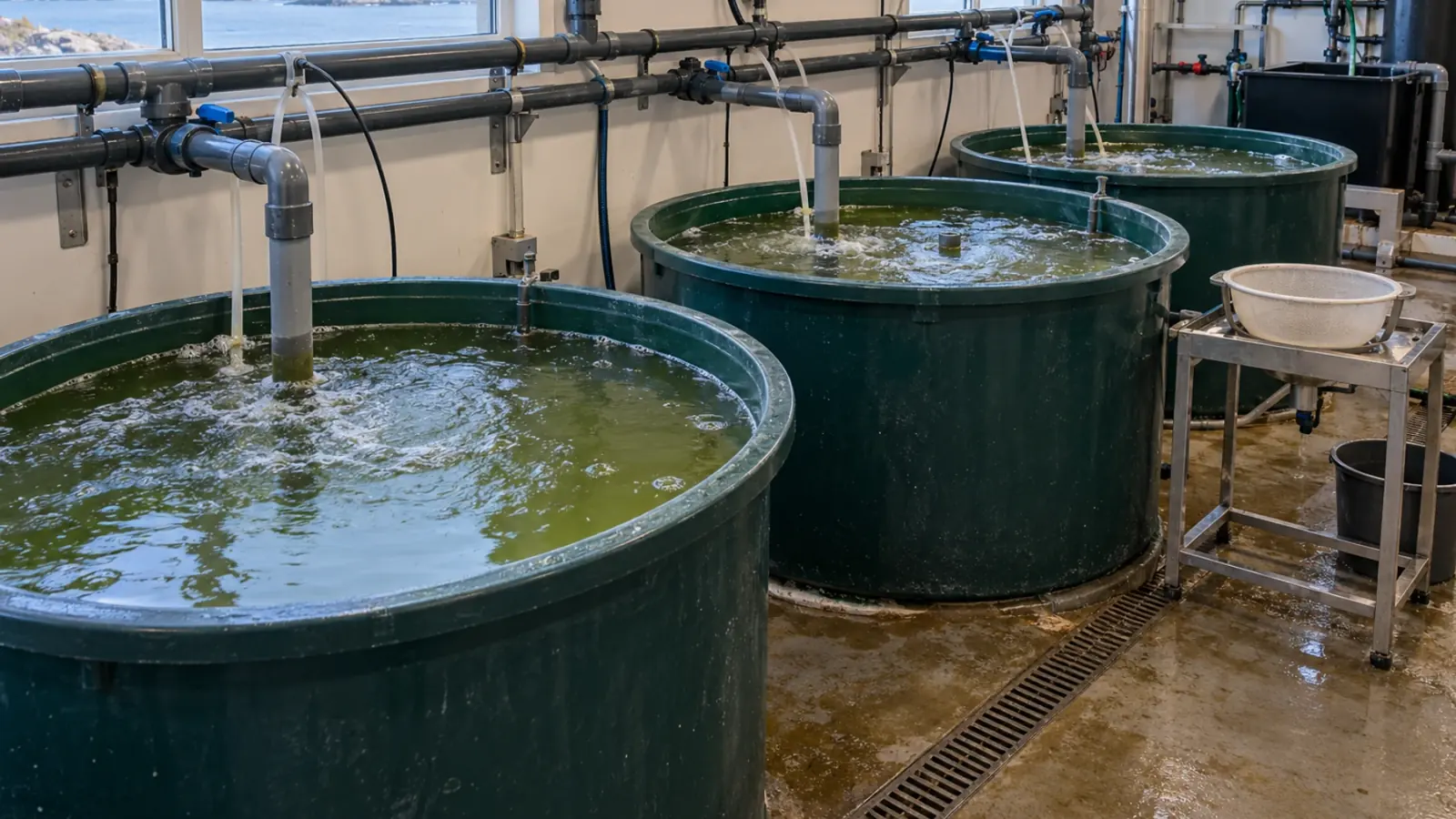
When should hatcheries diversify into copepod live feeds?
Copepods offer another feeding option for marine fish larvae. Choosing them requires a comparison of prey stages, nutritional quality and dependable production, alongside the rotifers and Artemia already used by the hatchery.
- Content type
- Practical guide
- Sector
- Aquaculture
- Animal group
- Fish
Start with the feeding problem
A hatchery choosing a live feed needs to describe what its larvae can find, capture and digest. The FAO manual on live food production, published in 1996, explains these selection criteria. It is a historical technical reference, rather than evidence that every practice it describes is the best option for a present-day hatchery. Its biological principles need to be considered alongside the species, facilities and production results involved.
Feeding success cannot be reduced to an empty feeding container. Prey may enter the rearing tank without being captured, and ingestion does not establish that the diet meets the requirements of that developmental stage. Keeping these questions separate helps the team distinguish a problem with prey choice from one involving distribution or feeding opportunity. Poor growth alone does not identify the cause.
Define which copepods are being compared
Copepods are available at different developmental stages. The FAO chapter distinguishes nauplii, copepodites and adults, whose sizes and behaviour differ. A trial described simply as a comparison with copepods is therefore incomplete. The species cultured, harvested stage and actual material delivered to the fish all need to be recorded.
The manual discusses their potential nutritional value for marine larvae, while explaining that culture diets influence composition. It also identifies production constraints. These findings support testing a defined feeding option, rather than assuming that every copepod culture will outperform established feeds. Biological suitability and the ability to produce dependable quantities are separate requirements.
Compare them with real rotifer and Artemia batches
Rotifers and Artemia should remain part of the comparison where they fit the target fish and developmental stage. Their properties also depend on the strain, size, culture diet and any enrichment used. A comparison between a well-prepared copepod batch and a poorly prepared conventional feed would not isolate an effect of prey type.
A practical decision sheet can describe capture suitability, daily availability, nutritional preparation and staff time for each option. It should include the fallback feed available if a culture fails. This is a way to expose the trade-offs, rather than produce a permanent ranking of organisms. A prey type that suits one stage may be unsuitable or unnecessarily demanding at another.
Observe feeding in the larval tank
Counting prey delivered measures supply to the tank. It does not measure intake by every fish. Observations should record water circulation, delivery location and time, together with evidence of capture and ingestion. General activity around feeding is less informative than a description of what the larvae actually do.
A limited trial can address a precise question before the hatchery changes its whole feeding programme. Success criteria and stopping conditions should be agreed before the first batch. Comparable husbandry and recording methods make the findings easier to interpret. The number of larvae observed must also be distinguished from the number of independent tanks: many fish sharing one tank do not provide independent repetitions of the rearing system.
Check the additional culture requirements
Temperature and salinity need to suit the organism being cultured. Settings carried over from a different live-feed line are not validated merely because production starts. Culture feeding, renewal and harvesting also need their own documented approach. Introducing a new prey organism means checking the complete production chain, including periods when demand is highest.
Live-feed transfers also belong in the biosecurity plan. The FAO manual describes the potential for living feeds to influence associated microbial communities. This does not make every bacterium on a prey organism a pathogen. It does mean that batch origin, equipment use, transferred water and culture incidents should remain traceable if larval health deteriorates.
Labour and backup capacity are part of the biological decision. A new line may require separate cleaning arrangements, additional stocks and more monitoring. These demands should be measured during the trial. A feed that performs well when available can still be difficult to rely on during a production interruption.
Judge the outcome on fish and production reliability
The assessment should connect observed feeding, development, survival and variation among larvae with their rearing conditions. It should also show whether the live-feed culture supplied usable batches reliably. If diets are tested in different periods, changes in water conditions or egg quality may account for some of the difference. The report should keep that uncertainty visible.
The resulting decision could be to retain the existing diet, use copepods at a particular stage or continue testing. A trial showing no advantage in one installation does not establish that copepods have no value for other species or systems. Conversely, one successful cohort is insufficient evidence for replacing an entire feeding programme.
Comparisons also need a clear account of what was changed. Replacing a prey organism while simultaneously altering light, stocking or water exchange leaves several possible explanations for the result. Where changes cannot be separated for operational reasons, the team can still learn from the trial, provided it describes a comparison of programmes rather than claiming a specific effect of prey identity.
Plan a change the hatchery can evaluate
Live-feed diversification is most useful when a nutritional question, dependable culture and comparable larval observations are considered together. The decision should be revisited if prey strain, fish stage or production constraints change. The historical manual provides a framework for asking those questions, not a universal production recipe.
For aquaculture facilities, our consultancy and support service can help structure the comparison, choose useful observations and organise trial records. The purpose is to support a documented decision, without promising a production gain.


