

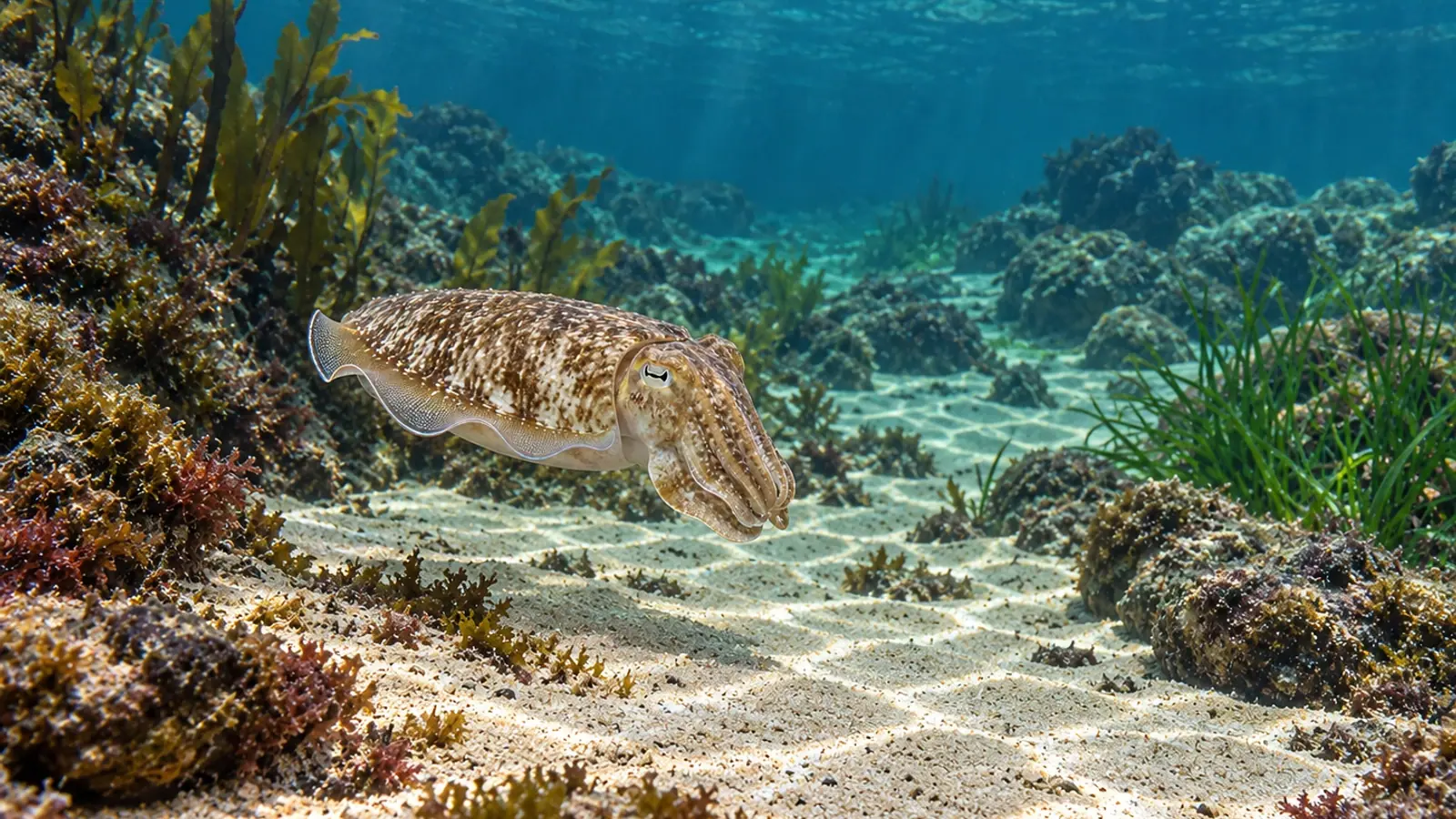
Common cuttlefish use two eyes to judge prey distance
Seeing a prey item and positioning for a strike are different tasks. A 2020 study showed that common cuttlefish use differences between the images reaching their two eyes to judge distance. Public aquarium teams can use this distinction in feeding records, with the experimental task kept separate from clinical assessment.


- Content type
- Scientific news
- Sector
- Public aquariums
- Animal group
- Cephalopods
- Keywords
- LightingEthogramEnrichment
A cuttlefish can notice a moving target before it is in the right position to seize it. Recording a hunt therefore benefits from separating detection, approach, positioning and tentacle extension. These observations are more informative than a single entry stating that an animal fed or refused food.
Feord and colleagues examined this distinction in the common cuttlefish, Sepia officinalis, in a study published in 2020. They demonstrated the use of information from both eyes to locate prey in depth. Emotional state and the benefits of visitor-facing displays were not assessed.
A screen-based experiment changed perceived depth
The researchers presented shrimp images on a monitor and used coloured filters in front of the animals’ eyes. Offsetting the images intended for the left and right eyes changed the target’s apparent depth while the physical screen remained in place. This allowed a particular visual cue to be investigated.
Stereopsis means extracting depth information from the difference between the two eye views. Having two eyes, or an overlapping visual field, does not by itself prove that an animal uses this computation. The relevant evidence comes from a response to a controlled change in those views.
The cuttlefish altered their pre-strike position with the presented disparity. This supports the use of binocular depth information. It does not imply that they watched a film as a person would, or that the neural mechanisms underlying their performance are identical to those of humans.
The total sample was not the sample for every analysis
Data were collected from eleven adults aged 22–24 months. Numbers contributing to particular tasks were smaller, depending on the task and on usable responses. Reporting eleven animals beside every result would therefore give a misleading account of the evidence.
For example, the comparison of binocular and quasi-monocular cues involved five and three animals, respectively. Individuals could contribute multiple trials. Repeated recordings help characterize behaviour, but they do not create an equivalent number of independent cuttlefish. The small biological sample remains relevant to interpretation.
Five of the eleven trained animals did not pursue targets in the random-dot task and were excluded from that analysis. The remaining six responded. That selection is part of the study’s scope, rather than a detail to remove from an accessible account. The task cannot be assumed to describe every animal placed before a screen.
Better positioning is different from faster detection
With binocular cues available, the animals in the relevant comparisons positioned themselves sooner, travelled less distance and struck from farther away. The main differences concerned the positioning phase. Summarizing the result as faster prey detection would lose an important distinction between stages of the hunt.
The quasi-monocular condition did not completely block information to one eye. Some light crossed the filters. It should therefore not be described as a comparison between ordinary vision and complete blindness on one side. The authors explicitly considered this limitation in interpreting the visual conditions.
Eye movements could also be independent during the hunt. The two eyes were not continuously oriented in a perfectly symmetrical way. For an observer, this is a reason to be cautious about a single photograph: an apparently unusual eye position does not independently establish a coordination disorder or a clinical problem.
What the assay cannot establish for an aquarium
A screen image lacks some properties of a real prey item. Target shape, movement, contrast and the information delivered through each filter are controlled in a particular way. Success in this assay does not validate a screen as enrichment for a collection, or establish an appropriate daily visual challenge.
The methods also describe incomplete water monitoring during test sessions: ammonia and pH were not measured throughout, and temperature varied. These limitations should remain visible in a critical reading. They are not husbandry conditions to copy into an aquarium procedure.
The study supplies behavioural evidence for stereopsis without directly identifying the responsible neural circuit. It offers no universal normal strike latency across ages, and no threshold for diagnosing visual impairment. Failure to respond remains an observation requiring context, rather than a ready-made clinical classification.
Improve routine records without reproducing the experiment
An aquarium team can use the distinction between stages during feeding already planned for the animal. Orientation towards food, approach, attempts to seize it and their outcomes can be recorded separately. The purpose is better description, without adding an experimental visual challenge or a food-withholding period.
A shared ethogram can help keep categories consistent between keepers. Records can identify food position, visibility, lighting changes and recent interventions. A latency becomes interpretable only when its starting event and finishing action are defined. Comparing different definitions can otherwise create an apparent change where none has been established.
Persistent changes call for a broad assessment of health, food access, presentation and water conditions. Earlier observations of the same individual may help frame the questions. They do not replace veterinary examination where other abnormalities or sustained changes are present. The experimental result is a guide to asking more precise questions.
Describe where a feeding sequence changes
The common cuttlefish uses visual information to position its body as well as to detect a target. For public aquariums, the useful lesson is to record the stage at which a sequence changes, while retaining the limitations of a small study involving trained animals.
Vetofish can help teams develop observation categories and review routine monitoring videos through its training services. Its work with public aquariums supports discussion of observed changes without turning a research apparatus into a routine clinical vision test.


