

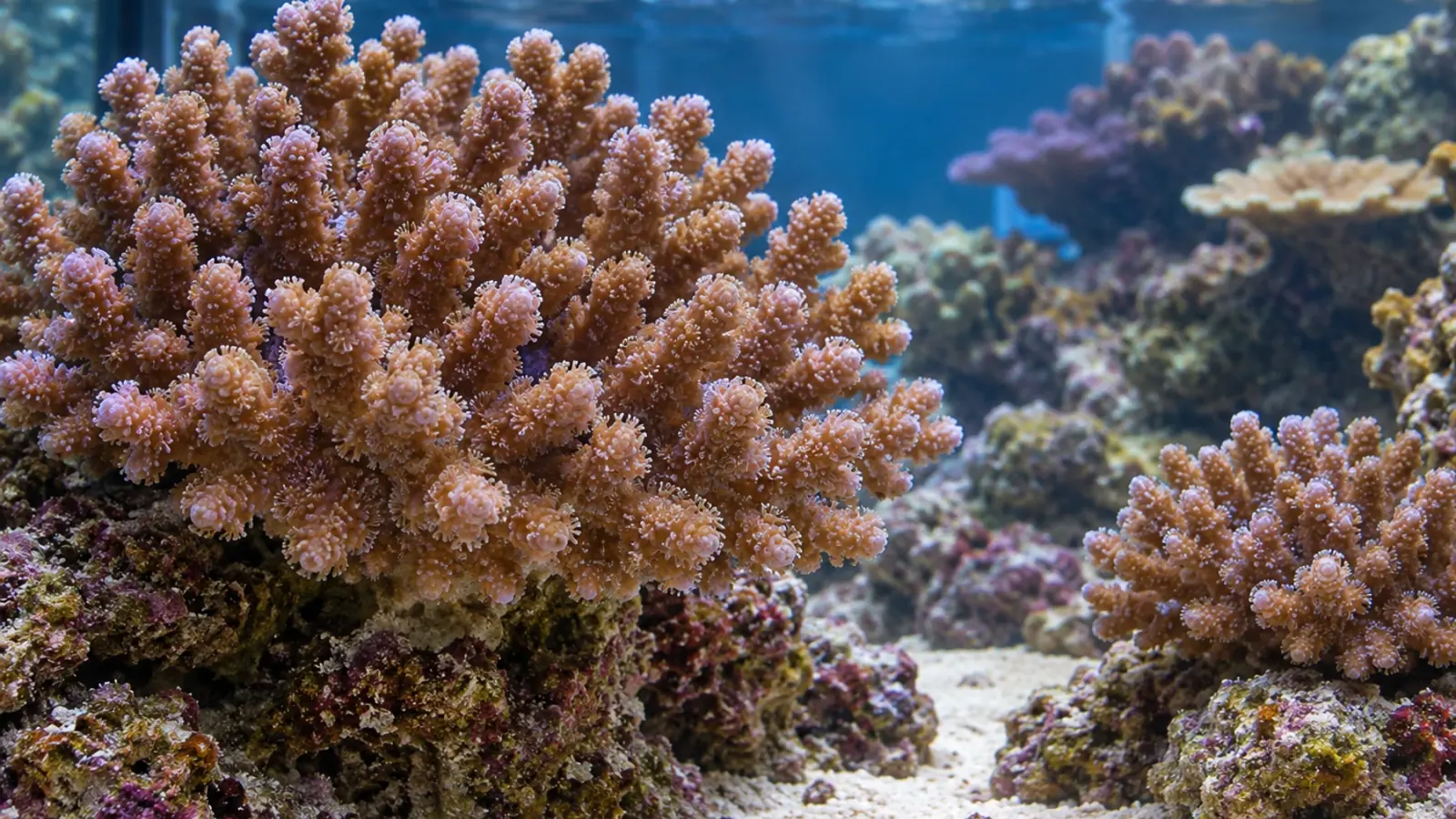
Corals: what antioxidant feeding actually shows
A Centre Scientifique de Monaco study tests antioxidant delivery to Stylophora pistillata through enriched Artemia. Physiological responses support further investigation, while differences between endpoints limit immediate use across aquarium collections.


- Content type
- Scientific news
- Sector
- Public aquariums
- Animal group
- Corals and invertebrates
- Keywords
- TemperatureStressSalinity
A nutritional supplement can change a physiological marker without preventing every effect of a warm-water episode. That distinction matters in a public aquarium, where an experimental response does not establish a protective diet for an entire collection. Dorantes-Aranda and colleagues’ August 2026 study tests a particular delivery route: feeding antioxidants to Artemia and then supplying the enriched prey to coral.
The work, conducted at the Centre Scientifique de Monaco with Australian collaborators, concerns Stylophora pistillata. It connects feed preparation and ingestion with several coral responses. Differences between those responses qualify any claim of protection.
Delivering a compound through food
Stony corals are colonial animals composed of polyps and associated with microorganisms, including symbiotic dinoflagellates. Photosynthesis within that partnership contributes to their functioning, while heterotrophic feeding supplies organic material. The researchers investigated the feeding route as a way to deliver antioxidants during experimental heat exposure.
Two experimental components used Artemia pre-fed either five antioxidant-containing preparations or five phytoplankton cultures. Curcumin and Pavlova lutheri were among the candidates. Enrichment lasted five hours, followed by filtration, rinsing and freezing before the Artemia were used to feed corals. The experiment should therefore not be described as continuous delivery of live prey.
That distinction matters when considering an aquarium trial. Storage and preparation are part of the intervention, alongside the ingredient itself and the food carrier.
Establishing the scale of the experiment
The team prepared 140 fragments from three parent colonies maintained in Monaco and originally collected from the Red Sea. Each experimental component used fourteen aquaria, with two tanks per condition and five fragments in each tank. Multiple fragments thus shared water and exposure. Counting fragments does not create the same number of independent tank replicates.
Exposed groups followed a temperature increase from 26 to 33°C, a hot period and a partial reduction; non-heated controls remained at 26°C. Feeding took place over a three-week experiment. These temperatures define a challenge scenario for comparison. They are neither routine husbandry recommendations nor a general thermal tolerance limit for the species.
Controls also differed between the two experimental components because the feed vehicles differed. Treating every product as though it belonged to one interchangeable formulation trial would lose that feature of the design.
The endpoints do not tell one uniform story
The authors identify curcumin and Pavlova lutheri as promising candidates for limiting aspects of oxidative stress. Oxidative stress involves an imbalance between reactive molecules and the organism’s defences. A higher defensive response cannot automatically be interpreted as a healthier coral.
Several measured outcomes did not differ significantly between groups. These included maximum photosystem II efficiency and relative electron transport rate. Chlorophyll concentrations also showed no significant treatment differences. Within the antioxidant-preparation component, symbiont density did not differ significantly between experimental groups.
Some lipid damage markers and enzyme responses provided a different view. Curcumin and Pavlova produced profiles that the researchers considered favourable. However, clustering response profiles does not demonstrate biological equivalence with a non-heated control. A non-significant difference likewise does not establish the absence of any effect.
For an aquarium team, the relevant question is which endpoint changed, against which comparator and within which part of the design. Reducing the findings to a single label of “protected” would conceal information needed for a practical decision.
What a collection can use now
The immediate lesson is methodological: document what the coral actually receives. Artemia batch, enrichment preparation, storage, rinsing and distribution help distinguish a dietary change from a change in the surrounding system. An ingredient name alone does not quantify what each colony ingests.
A useful monitoring plan combines tissue appearance, polyp extension and feeding observations, with photosynthetic measurements where suitable equipment is available. Temperature, lighting, circulation and salinity should accompany these records. Altering several factors at once makes any improvement or deterioration harder to attribute.
Before a local trial, define a measurable question and an appropriate comparison. A separated, closely monitored pilot is more informative than immediate collection-wide feeding. Stopping criteria should address animal condition and system performance, rather than require mortality before an adverse response is recognised.
Monitoring also needs to distinguish a stable-looking colony from a favourable laboratory endpoint. Neither observation can replace the other without evidence that it answers the same question.
Limits that still constrain application
The study covers one coral species, a small number of source colonies and limited tank replication per condition. It does not establish identical protection across coral species or symbiotic associations. Shared conditions within an aquarium remain relevant when interpreting measurements from its fragments.
Preparation stability, transfer of compounds and their fate within organisms require further investigation at operational scales. A more strongly coloured prey item is not, by itself, a measurement of the dose received by coral. The authors call for additional work before field application and broader scaling.
On this evidence, there is no universal feeding protocol for preventing bleaching and no demonstrated reef restoration outcome. Nutrition remains an experimental intervention to assess alongside water management and the requirements of the animals.
Turning a research lead into an assessable question
The Monaco study supports targeted investigation of trophic antioxidant delivery. A collection’s first decision is to identify the controls, observations and records needed to evaluate any proposed trial.
For public aquariums, our consultancy and support service can help review a nutritional proposal, design monitoring and distinguish a physiological response from demonstrated benefit to the animals.


