

Farm biomass: sample beyond the feeding points
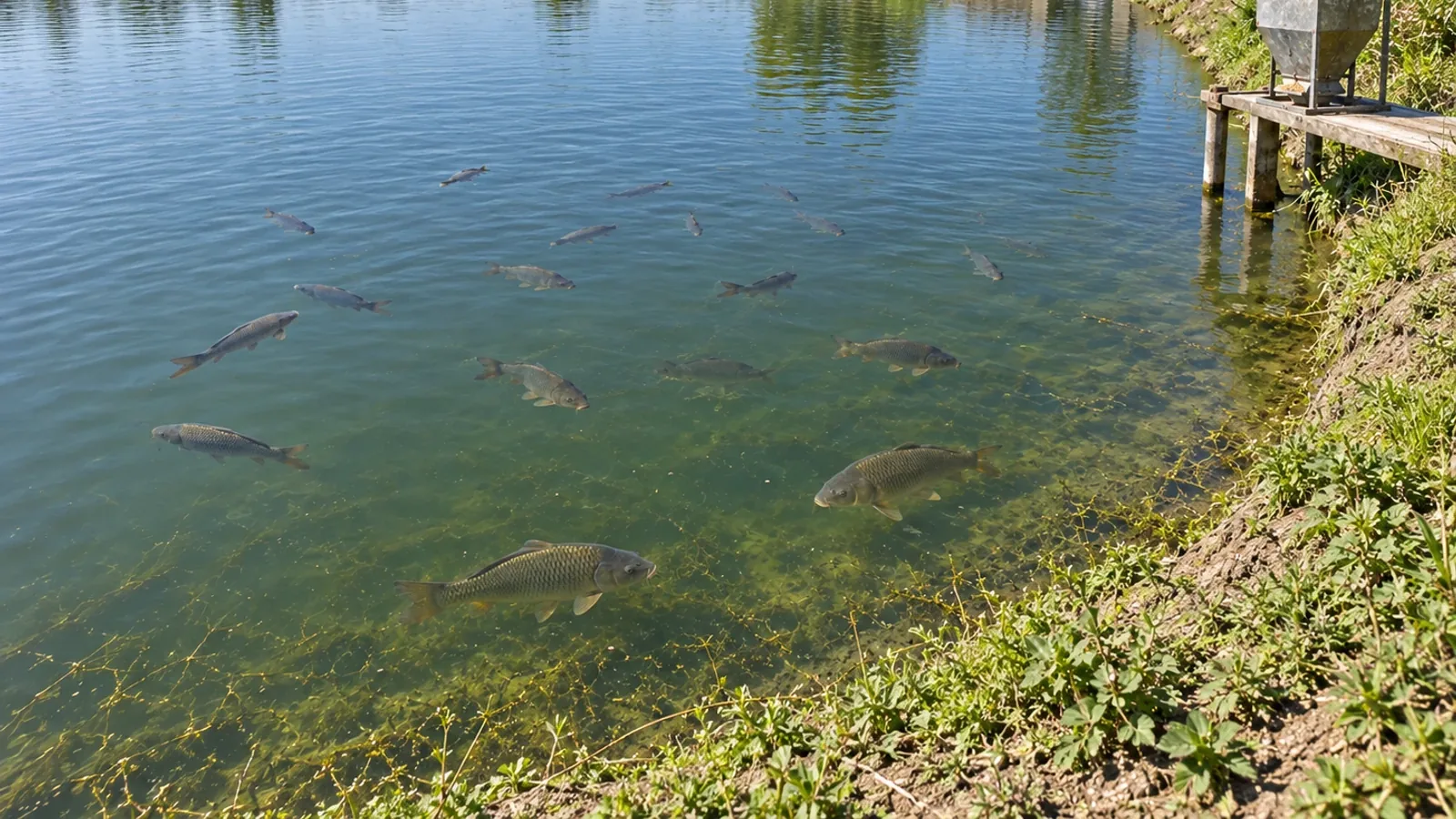
Fish collected at a feeding point may not represent the whole pond. A longstanding FAO manual identifies this sampling problem. The assessment separates which animals enter the sample, how mean weight is calculated and uncertainty about the number still present.


- Content type
- Practical guide
- Sector
- Aquaculture
- Animal group
- Fish
- Keywords
- TemperatureStressOxygen
A reliable balance cannot compensate for a sample drawn from an unrepresentative part of a pond. Before converting mean fish weight into a stock estimate, a farm needs to know which animals had a chance of being caught. Michael B. New’s 1987 FAO manual describes this sampling problem. Its guidance on pond coverage needs to be distinguished from its old feeding tables, which are not current nutritional prescriptions.
Feeding points can influence the sample
The manual’s biomass assessment section recommends collecting samples from different parts of a pond. Larger or more active animals may gather around feeding points, so a catch taken only there can distort the estimated mean weight. The direction and size of that distortion depend on the stock and capture conditions. The guidance supplies no universal correction factor that would turn a feeding-point sample into an unbiased estimate.
Sampling needs a location and a context. Gear, accessible depth and time relative to feeding influence which fish are available for capture. Catching more animals at the same position describes that position more precisely, but does not establish that the rest of the pond has the same size distribution. Sample size and spatial coverage address different questions. A large catch can therefore leave an important part of the stock poorly represented.
Define the stock before choosing the stations
The target population might be a whole pond, a cage or a batch separated after grading. Its boundary must match the stock records used in the calculation. Combining measurements from two units and applying their mean weight to only one can create an error that weighing equipment will never detect. Transfers, additions and batch mixing belong in the measurement record rather than in a separate, disconnected account of farm operations.
One useful preparation is to map the areas reached by sampling and mark those that remain inaccessible. This is an operational suggestion, not a substitute for a site-specific statistical design. It makes a restriction visible that would disappear if the farm retained only the total number of fish weighed. Water level, vegetation and equipment changes should also be recorded when they alter access to the sampling areas or change the animals available there.
Keep the components of the mean
Mean weight depends on a measured mass and a matching animal count. The record should say whether fish were weighed individually or in groups. For grouped weighing, each group needs a known count. Averaging group means without accounting for unequal group sizes can change the result. Tare and water retained in the weighing container are further sources of measurement error to check before interpreting a difference between samples.
Size variation contains information that a mean conceals. Two samples may have identical mean weights but different size distributions. Keeping individual measurements, where available, allows that heterogeneity to be examined. Differences between stations still require caution: they could reflect the fish present, the selectivity of capture, or both. They do not by themselves demonstrate different growth rates. A repeat survey using a different method also needs an explicit account of that methodological change.
Weight uncertainty and stock-number uncertainty are separate
The FAO manual also explains that average weight alone is insufficient: the number of animals remaining in the unit must be estimated. The original stocking count is not automatically a current count. Recorded deaths, removals, transfers and harvests need to be reconciled with the correct production unit. An unrecorded loss remains an uncertainty even when the spreadsheet requires a single numerical answer.
Consider a hypothetical calculation, rather than an observation from the manual. A stock estimated at 8,000 fish with a mean weight of 250 g represents 2,000 kg. If the actual number is 7,200 fish at the same mean weight, total biomass is 1,800 kg. These figures illustrate sensitivity to the count; they describe neither a Vetofish client nor a normal mortality rate. Both the mean weight and the estimated stock number should retain their own source and measurement date.
Repeat sampling to answer a defined question
A further measurement is useful when it addresses a specific uncertainty: weight change, an unsampled area, different capture gear or an inconsistency in the stock register. Repeating catches without stating what is being checked can mainly add handling. Stress and oxygen conditions should be considered when planning an operation, using an approach suited to the species and the production system.
The 1987 manual does not validate modern optical tools, nor does this review establish a universal sampling interval or minimum fish count. Temperature, stock condition and feeding response are also needed to interpret a ration. A stock estimate describes the mass used in the feeding calculation. A biomass estimate does not, on its own, provide a feeding instruction independent of husbandry conditions. Historical percentage-based feeding examples should not be copied into a current farm programme without assessing their applicability.
Conclusion: retain what the estimate represents
A useful weighing record connects the production unit, sampled areas, animals measured, observed mass and estimated number remaining. It separates measurements from assumptions. Recording a procedural change helps prevent a break in the time series from immediately being interpreted as a biological change. The purpose is to identify which decision an estimate can support and which uncertainty still needs attention.
Vetofish’s advice and support service can help examine the chain from stock records to the sampling plan. Our aquaculture expertise places those choices within the practical constraints of the pond, feeding management and stock health, without promising that a more elaborate calculation can resolve missing observations.


