

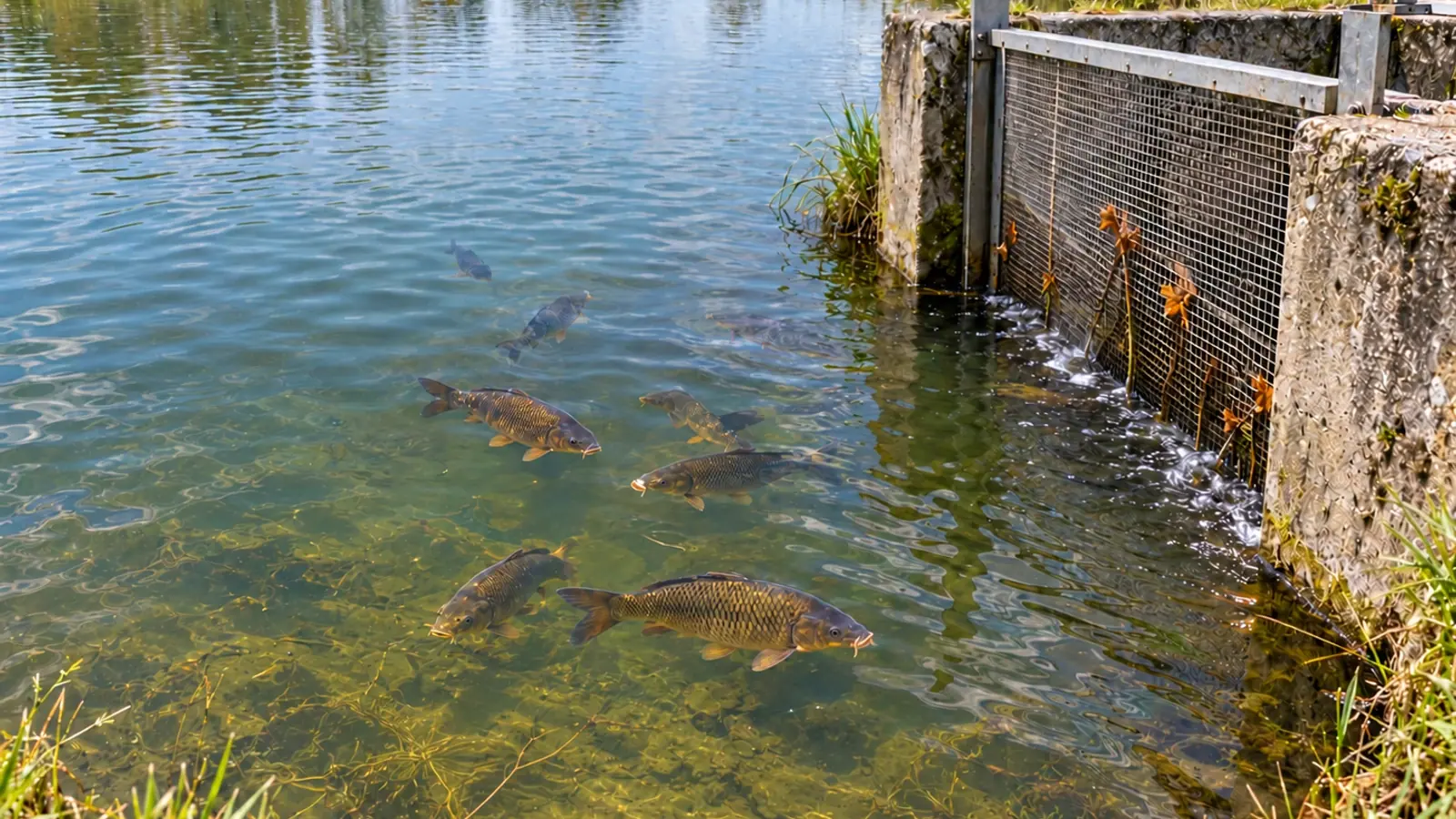
Pond screens: retain fish while keeping water moving
Keeping fish in a pond while allowing water through involves more than choosing fine mesh. FAO’s technical manuals connect screen area, secure fitting and maintenance, offering a practical basis for reviewing farm inlets, outlets and overflows.


- Content type
- Practical guide
- Sector
- Aquaculture
- Animal group
- Fish
- Keywords
- BiosecurityOxygenTemperature
A pond outlet has to let water leave while keeping fish inside. Those functions can compete. Coarse mesh may allow small fish through, while a fine screen with too little working area can quickly collect debris. Checking only for broken mesh leaves the screen’s hydraulic performance unexamined.
FAO’s technical manuals on pond construction and management explain these relationships through practical arrangements for water control. They provide an established basis for reviewing screens, rather than evidence of a new technology. Their examples should also be kept separate from current legal requirements in the country where a farm operates.
Map the routes before inspecting the mesh
The main drain may be the most visible exit, but it is rarely the only route worth checking. Overflow structures, temporary pipes and equipment used during harvesting can also carry fish. A useful review begins by identifying where water enters, where it normally leaves and where it goes when the level rises.
The screen, its frame and its connection to the structure work together. Suitable mesh offers little protection if fish can pass around an edge or lift a poorly secured panel. The bottom, corners and fixing points therefore belong in the same inspection as the mesh itself.
FAO describes sliding screens, pipe covers, baskets and sleeve filters, among other arrangements. These examples answer different needs. Choosing between them requires information about the structure, the animals to be retained, the expected water movement and the access available for maintenance. A familiar design is not automatically suitable for a different pond.
Separate frame dimensions from open area
Water passes through the openings that remain available. Leaves and fragments of plants reduce that area without changing the outer dimensions of the panel. As a screen clogs, water movement and the level around the structure may change.
The manuals describe a trade-off between retaining smaller material and maintaining flow. Smaller openings generally clog more readily. Increasing the filtering area can help accommodate this constraint, but cannot replace cleaning or a secure fit. Supports, mesh material and accumulated deposits all occupy part of the panel.
For this reason, the width of a screen is an incomplete description of its capacity. Two panels of similar size can provide different open areas. The difference becomes particularly relevant when a clean screen is compared with the same screen after it has collected material.
There is no universal mesh size in this review. The smallest fish present, their shape and the conditions at the outlet matter. A screen intended for a grow-out group cannot simply be assumed to retain fry. Hydraulic sizing needs a site-specific assessment, rather than the transfer of an example from a training manual.
Look at the material arriving with the water
Suspended particles and large floating debris create different demands. Rainfall, leaf accumulation or disturbance of settled material can alter maintenance needs even when the equipment has not changed. A fixed cleaning interval says little unless it is checked against what the screen actually receives.
Water turbidity can help describe the pond, but it does not directly measure the burden of large leaves at an outlet. Water that looks fairly clear may still carry enough floating debris to block a small part of a screen. Observing the equipment complements water measurements.
Mechanical screening also has a defined scope. It retains material according to the openings and the way the equipment operates. It does not amount to disinfection. A barrier designed to retain fish cannot be assumed to stop infectious agents carried in water, and it does not replace the farm’s other biosecurity measures.
Keeping these functions distinct helps when an incident is reviewed. Evidence that a screen was intact addresses retention. It does not by itself establish that water quality was suitable or that a health risk was controlled.
Plan cleaning without creating an escape route
Maintenance may require a panel to be lifted or removed. Before that happens, the team needs to know where water will flow and what will retain fish during the intervention. FAO illustrates arrangements in which an additional screen protects the route while a horizontal screen is cleaned.
The transferable principle is continuity of retention. The exact arrangement has to match the equipment on the farm. An improvised replacement that does not fit its frame may leave the very gap the cleaning procedure is meant to prevent.
Access is part of the design. Equipment that is difficult to reach, remove or refit can become a recurring weakness. Removed debris should be placed where it will not immediately return to the same screen. Checking the edges and fixing points after cleaning helps establish that the retaining function has been restored.
The procedure also needs to reflect the pond’s operating state. Normal maintenance, harvesting and unusually high inflows may expose different water routes. A written instruction is useful only if staff can relate it to the structures and fish currently present.
Read equipment performance alongside fish and water
Restricted circulation is more than a maintenance observation. The needs of the stock and the conditions within the pond also require attention. Dissolved oxygen changes with biological activity, temperature and time of day. A clean screen cannot establish that those conditions are appropriate for the fish.
Equally, fish gathering near an inlet do not identify a clogged outlet on their own. Behaviour needs to be considered alongside water measurements, equipment operation and recent events. This avoids assigning an abnormal observation to a single cause before the surrounding evidence is examined.
A useful maintenance record identifies the structure, observed water level, deposits, intervention and defects found. Repeated observations can reveal a recurring access or design problem that an isolated entry would miss. They also help staff prepare for leaf fall, heavy inflows and harvesting operations.
Keep retention and circulation working together
The practical objective is a retaining system that continues to function with the fish and water conditions actually present. Inspection links escape prevention, maintenance and environmental monitoring. No single screen provides an absolute guarantee.
Vetofish can help review incidents, interpret health observations and develop monitoring for a fish farming site. A circulation sketch, stock characteristics and a record of events around the structures provide a useful starting point for discussing the issues with the farm’s technical specialists.
To move from evidence to action, explore our advice and support service and our expertise in aquaculture.


