

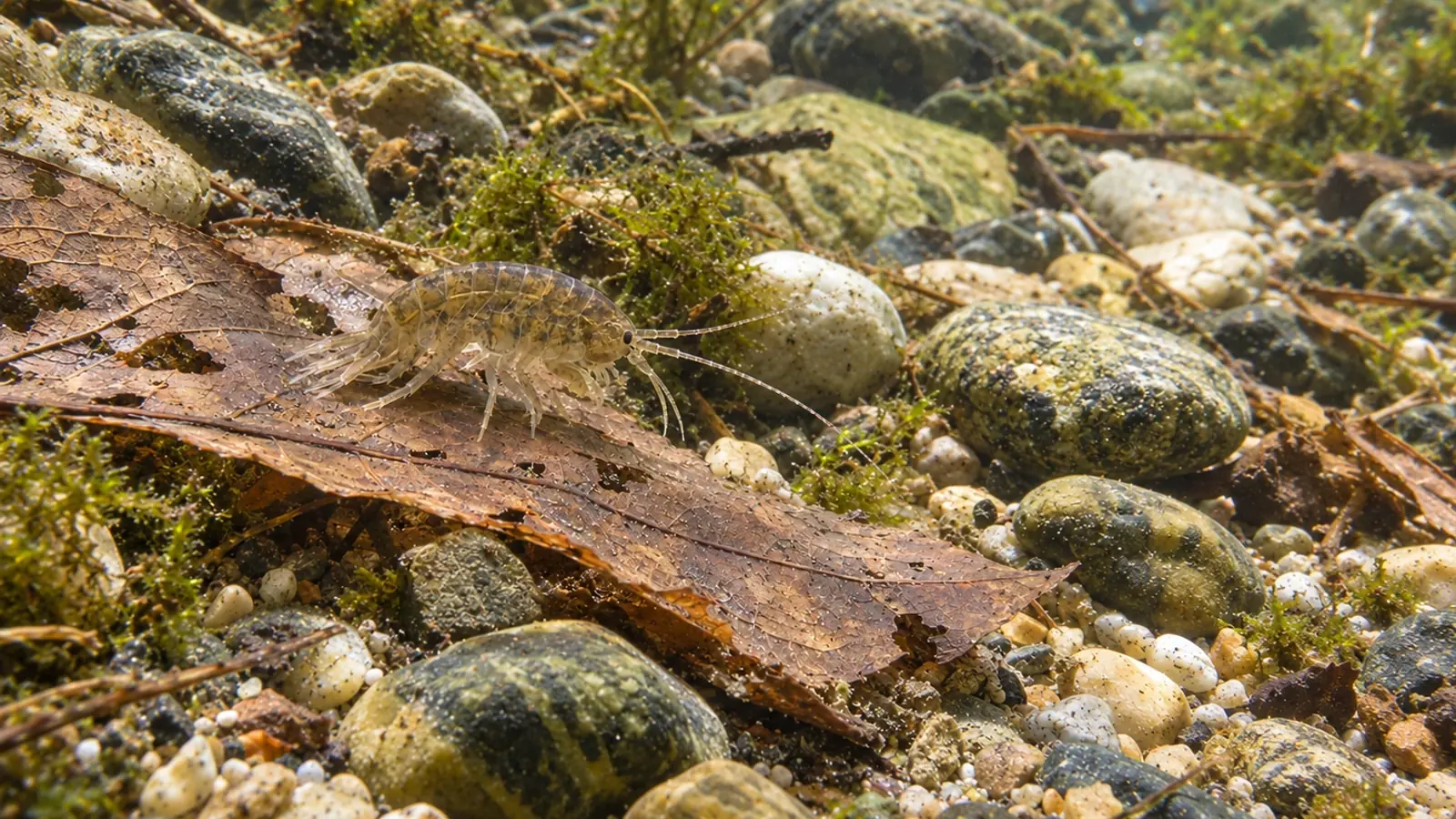
Gammarus: leaf litter is not a uniform food resource
Equal amounts of leaf litter need not offer gammarids the same food resource. A 2013 study of Rhône Valley populations examined leaf characteristics, animal origin and consumption. The results help distinguish leaf processing from the nutritional state of stream invertebrates.


- Content type
- Scientific news
- Sector
- Environment
- Animal group
- Crustaceans
- Keywords
- TemperatureOxygenReproduction
Leaves entering small streams from their banks contribute to aquatic food resources. Their presence alone, however, does not describe the food available to invertebrates. In 2013, Foucreau and colleagues compared leaf species and Gammarus pulex populations from the Rhône Valley in France. The experiment distinguishes available material, consumption and the consumers’ energy stores.
A resource shaped by trees and decomposition
Gammarids are crustaceans that can fragment and consume submerged leaves. This detritivorous activity connects riparian vegetation with stream organisms. It does not mean that leaves are their only food: the authors discuss a broader diet. Describing the resource only as a mass of litter can therefore conceal differences in its characteristics and how animals use it.
Five tree species were compared: black alder, European hornbeam, European hop-hornbeam, pedunculate oak and downy oak. They represented continental or Mediterranean vegetation, with alder occurring in both contexts. Leaves were conditioned in a stream before the feeding experiment. That stage, involving microbial communities, formed part of the resource offered to the animals. Freshly fallen and already conditioned leaves are therefore not interchangeable experimental materials, even when collected from the same tree species and weighed in the same units.
Six populations and five leaf species
Three gammarid populations came from the northern Rhône Valley and three from the south. The authors distinguished the southern populations designated Gammarus pulex gallicus. Consumption was examined over ten days at 12°C, separating sex, population and leaf species, with 20 animals per condition specified in the factorial design. Animals were held individually during the feeding observations.
Leaf mass losses were corrected using controls without animals to account for processes other than consumption. The team also measured leaf mechanical characteristics and body triglycerides. These endpoints answer different questions. A leaf losing mass does not reveal, by itself, how much energy a gammarid stores. A change in energy reserves does not automatically identify the mechanism responsible for litter degradation. Keeping the measurements distinct is necessary before combining them into an account of stream functioning.
Toughness was more informative than a north–south label
The two hornbeam species had similar mechanical toughness despite their different climatic origins. Oak leaves were tougher than hornbeam and alder leaves. Across the contrasting leaf types, tougher material was generally consumed less. That relationship did not explain every comparison between closely related tree species, particularly the two oaks.
Calling a leaf “Mediterranean” did not, on its own, predict lower consumption. Tree identity, conditioning and the identity of the consumers offered more specific information. For stream managers, this supports examining functional characteristics of riparian vegetation rather than relying on a broad geographical label. It provides neither a universal planting list nor a complete ranking of tree species by ecological value. The experiment concerns the leaves and animals tested under its defined conditions, rather than every consequence of a change in bank vegetation.
Greater consumption did not establish better nutritional condition
Southern populations generally consumed more litter, with variation according to leaf species and sex. This pattern cannot be replaced by a single multiplier applicable to all gammarids. Differences in activity and possible adaptation to local food resources were among the explanations discussed. They do not establish that every southern individual would process litter more effectively in a warming stream.
Changes in triglyceride stores showed no simple, general relationship with leaf consumption. Animals without detectable consumption were also excluded from analyses of changes in those energy stores. That selection limits how the reserve results describe the full set of animals exposed to the leaves. Litter disappearance and consumer nutrition consequently need their own criteria. They should not be treated as equivalent measurements of an undefined “healthy ecosystem”, particularly when the biological units contributing to each analysis differ.
Conditions that the experiment did not reproduce
Conditioning periods differed between leaf species so that consumption could be measured. Animals also remained in water originating from their own collection sites. A common temperature therefore did not make every environmental component identical. Geographical origin combined different biological and environmental histories rather than representing an isolated thermal treatment.
A natural habitat adds flow, transport of material, multiple food resources and interactions between organisms. The experiment did not measure their combined balance across a stream reach, nor did it impose warming during the feeding trial. Future changes in the distributions of vegetation and gammarid populations were discussed as possible consequences, distinct from changes directly observed in a river. Low consumption is also not a pollution diagnosis without examining other explanations. Resource characteristics and consumer differences already provide alternatives within the scope of this study.
Conclusion: specify what a litter study measures
Before comparing degraded leaves between sites, retaining tree identity, material condition, immersion duration and observation conditions makes interpretation more defensible. Consumer population composition and the question being asked also need to be specified. This reading framework draws on the experiment without converting its apparatus into a validated monitoring protocol for every stream. Fragmentation activity remains a result distinct from the nutritional state of individual consumers.
Vetofish’s advice and support service can help define those criteria. Our work in aquatic environmental management connects observations, measurement limitations and monitoring needs, so that a single indicator is not assigned a meaning it cannot support.


