

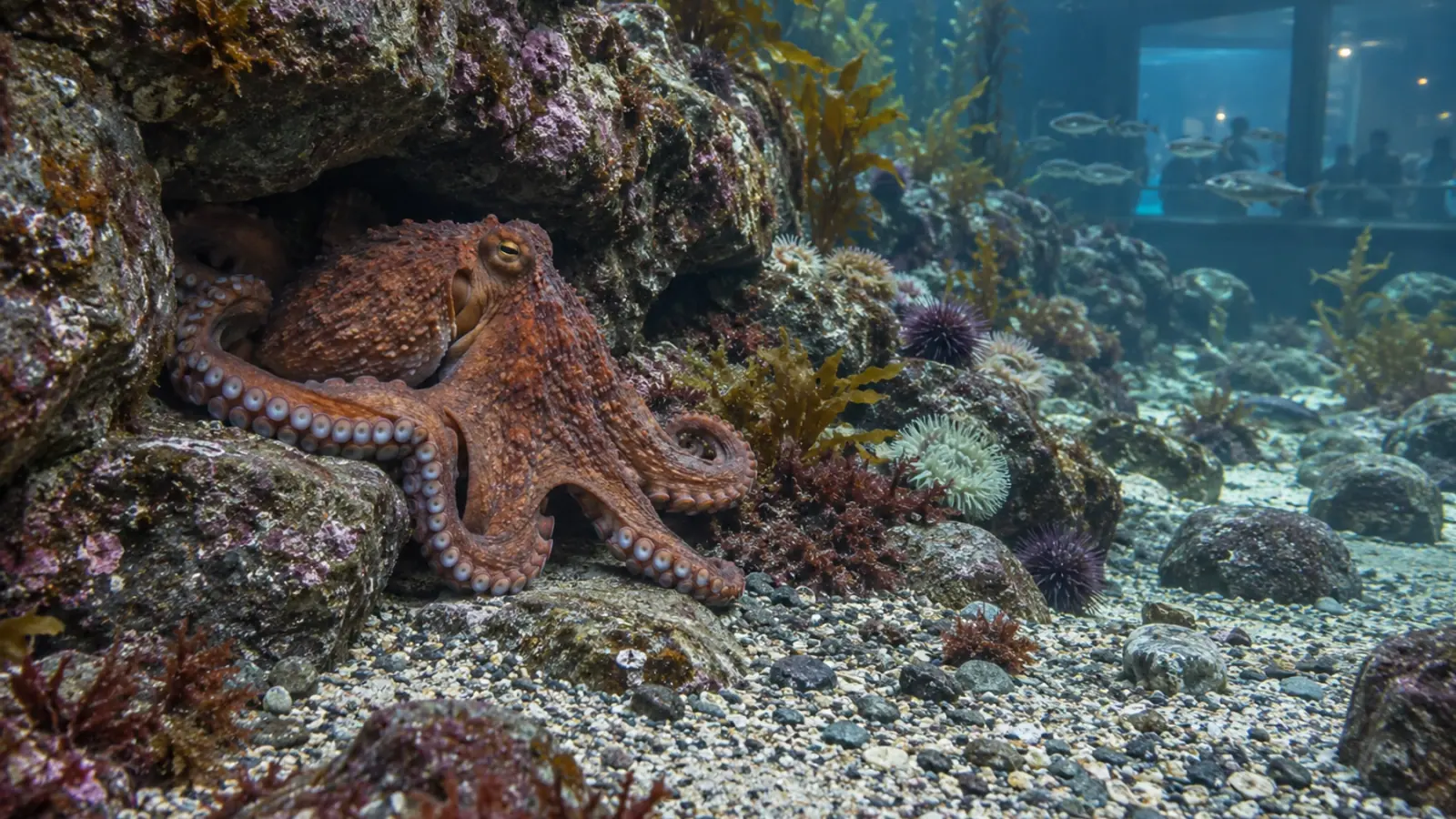
Giant Pacific octopus: assess decline before calling it senescence
Loss of appetite or responsiveness in a giant Pacific octopus may accompany senescence, disease or unsuitable conditions. A public aquarium study structures observations of each animal’s trajectory and inform care decisions.
- Content type
- Practical guide
- Sector
- Public aquariums
- Animal group
- Cephalopods
A giant Pacific octopus that stops taking its usual food needs an assessment, even when its life history makes senescence plausible. Disease, environmental disturbance and terminal decline can produce overlapping observations. Assuming the cause too early may delay an investigation of something the care team could change.
In a public aquarium, the record should follow the individual: what the animal could do, what changed and how it responded to care. A structured scoring tool can support that discussion while leaving room for veterinary examination and the keeper’s knowledge of the animal.
What the giant Pacific octopus study actually followed
Holst and Miller-Morgan developed a species-specific health and welfare assessment for Enteroctopus dofleini. The paper appeared online in 2020 and in its journal issue in 2021. Forty octopuses entered the monitoring programme, but the analysis of terminal decline concerned nine animals from six institutions that died naturally or were euthanised during the study.
That distinction matters. Forty enrolled animals do not amount to forty independently analysed end-of-life trajectories. Keepers completed weekly assessments of appearance, behaviour and clinical concerns using four severity levels. The framework was intended to make observations easier to record and discuss, particularly when different staff held different views of an animal’s condition.
The study was observational. It did not randomly compare treatments, and it did not establish that every observer would assign the same score to the same animal. Its relevance to public aquariums comes from the setting and the species, alongside those limits.
Feeding and responsiveness changed near the end
Across the nine terminal trajectories, feeding behaviour and responses to stimuli deteriorated significantly between four weeks before death and the final week. Other categories showed considerable individual variation and did not all change significantly across the animals as a group.
The analysis worked backwards from a known date of death. It therefore does not provide a validated countdown for an octopus refusing food today. A similar change could have another cause, while the absence of that change cannot guarantee good health. Applying the reported time window as an individual prognosis would exceed the evidence.
The authors also identified a measurement problem: feeding sticks and food-related objects could contribute to the assessment of responsiveness. The two categories might consequently share a stimulus. A care record should identify what was offered and under what circumstances, so that apparently separate measures can be interpreted honestly.
Make the observation reproducible
An ethogram defines the behaviours the team wants to recognise. “Did not grasp the familiar food item during its presentation” is more informative than “looks senescent”. Interest, grasping, ingestion and rejection are distinct observations. Combining them into a single unchecked impression can hide the stage at which the difficulty occurs.
Record skin integrity, posture, coordination, shelter use and ventilation as well. Colour change in a cephalopod depends on context and does not diagnose a condition by itself. Short, dated videos obtained without provoking the animal can help staff compare observations across days and shifts.
Missing information should remain missing. An octopus concealed in its shelter cannot be scored as normal for a behaviour that nobody could observe. Repeatedly disturbing it to complete a form may alter the very state being measured. The assessment method needs to account for that conflict.
Investigate changeable causes alongside life stage
Senescence here refers to a decline associated with the animal’s life cycle. It does not exclude a concurrent disease. Water quality, temperature changes, shelter access, feeding and recent husbandry interventions should be considered alongside reproductive history and the clinical trajectory.
Use the word stress with an identifiable context and response. A change after work in the enclosure does not establish irreversible decline. A persistent lesion or loss of function warrants veterinary assessment even when senescence appears likely from the animal’s history.
Investigation should still be proportionate. Looking for a reversible cause does not mean repeating examinations without a clear question. Available observations should help choose procedures likely to change care, taking account of the burden those procedures place on the individual.
Skin hormone measurements are still a research approach
Chancellor and colleagues examined hormone immunoassays using skin mucus in a different species, Octopus bimaculoides, in 2023. Their study included twelve animals: four reproductive adults and eight classified as senescent. They observed life-stage differences, with substantial individual variation.
Those findings do not provide a validated clinical test for E. dofleini. The authors called for chemical confirmation of the glucocorticoids measured. Repeated swabbing can itself disturb an animal, and concentrations cannot be transferred uncritically between species, sampling methods or assays.
A hormone result cannot replace assessment of the enclosure or the animal’s functions. It cannot, by itself, distinguish disease from environmental burden and senescence, or set an automatic end-of-life decision. The research is informative precisely because it identifies questions still requiring validation.
Use the record to support a care decision
The giant Pacific octopus tool helps communicate persistent deterioration. It primarily assesses welfare concerns; a favourable score does not establish positive welfare in all its dimensions. The proposed action categories are not universal euthanasia thresholds validated in a prospective clinical trial.
A care plan should state which functions are compromised, which causes were investigated, what measures were attempted and when the animal will be reassessed. Serious deterioration requires a timely veterinary discussion. Maintaining an apparently complete public display should not delay that assessment.
Vetofish supports animal welfare assessment and the organisation of individual monitoring in public aquariums. The aim is a shared, documented basis for care, with the animal’s condition and the limits of the evidence guiding the decision.


