

Grouper larvae need access to air during early development
Early swim bladder inflation in some marine fish larvae requires air from the water surface. A study of two grouper species combined tissue sections with tank comparisons. It helps hatcheries examine surface conditions and developmental timing without supplying a universal rearing timetable.
- Content type
- Scientific news
- Sector
- Aquaculture
- Animal group
- Fish
- Keywords
- TemperatureSalinityLighting
An anatomical swim bladder and an inflated swim bladder are different findings. A larva may have formed the organ without yet filling it with gas. Hatchery investigations therefore need to distinguish organ development, the temporary connection to the gut and access to atmospheric air. Swimming position alone cannot document all three.
Iwasaki and colleagues examined these stages in longtooth grouper, Epinephelus bruneus, and red spotted grouper, Epinephelus akaara, in Japan. Their 2016 paper combines histological sections with larval-rearing observations. The experiments were conducted in 2012 and 2013, under species-specific facilities and temperature conditions.
A temporary route from the gut
The swim bladder contributes to buoyancy control. In a physoclistous fish, its connection with the digestive tract disappears during development. Initial inflation may nevertheless depend on the surface. A temporary pneumatic duct can provide a route for air swallowed early in life.
The investigators looked for this connection in tissue sections. They describe the duct, its separation from the bladder and its eventual disappearance. In some larvae whose bladders remained uninflated, epithelial cells occupied the cavity. An altered swimming pattern by itself cannot establish which developmental step has failed.
The two species did not share an identical schedule. Under the trial conditions, inflation increased mainly between days 6 and 9 after hatching in E. bruneus and days 5 and 8 in E. akaara. Those intervals describe the experimental stocks. They should not become a universal timetable for all groupers or hatcheries.
What the tank comparison can establish
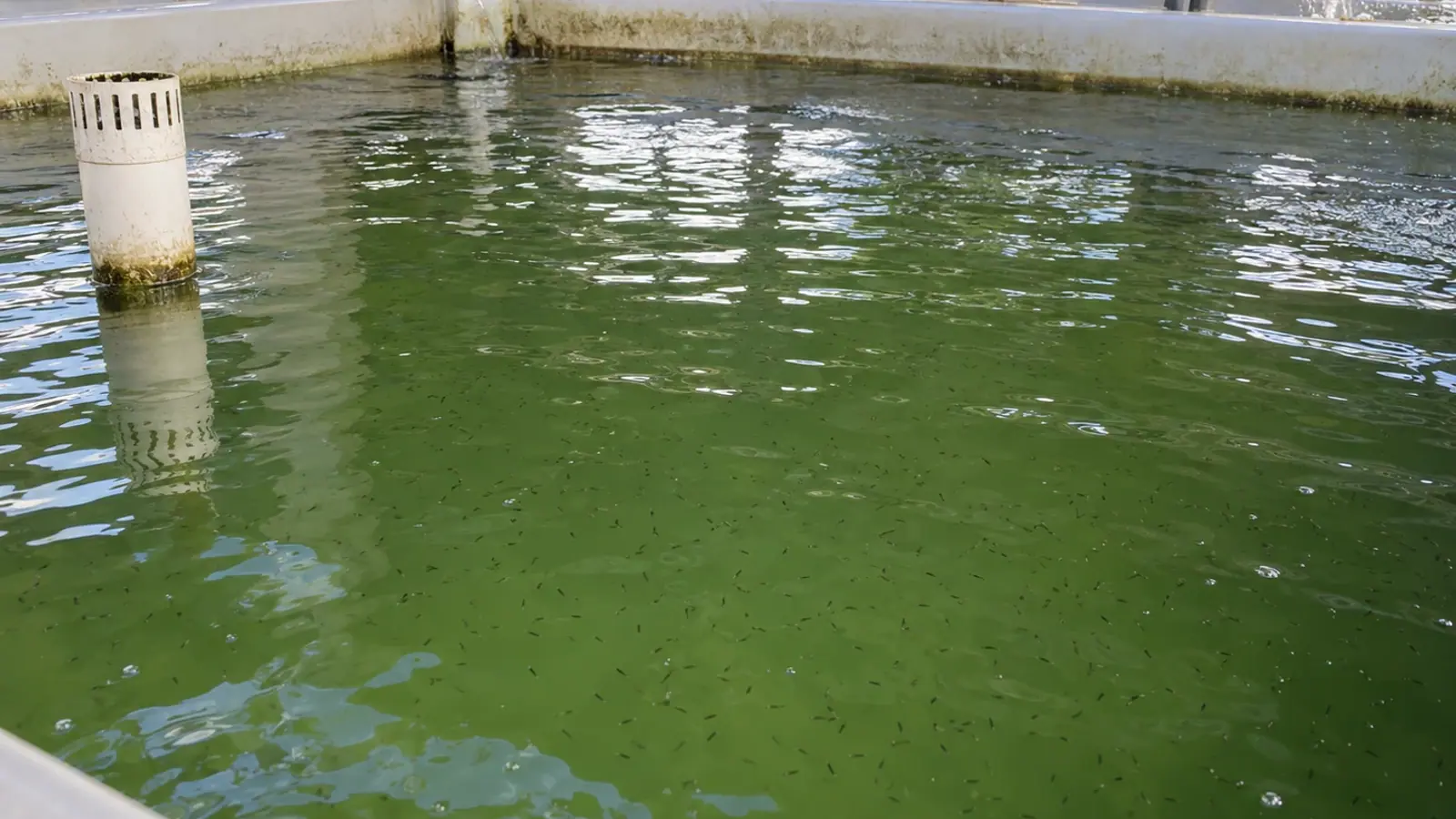
For each species, larvae were followed in a tank where the surface film was removed and a tank without removal. Repeated samples were examined for body length and gas in the bladder. The inflation percentage was the number with inflated bladders divided by the number examined, rather than a measure of the entire tank population.
More larvae had inflated bladders in the film-removal tanks. The finding supports a role for surface air in initial inflation, while the histological observations show a temporary anatomical route through which swallowed air could pass. These are complementary observations rather than interchangeable measures.
Each condition, however, had only one tank per species. Sampling many larvae on several days does not create independent tank replicates. Film removal by overflow also involved a different water-exchange regime. The comparison cannot cleanly isolate every effect of the equipment and water conditions. Its apparent treatment difference needs that limitation alongside it.
Surface management involves competing functions
The paper does not portray every surface film as something to eliminate throughout production. In these grouper systems, an oil film can be used to reduce the trapping of very young larvae by surface tension. Removing it permanently could therefore conflict with another husbandry objective.
The practical question is how to preserve that protection while allowing access to air during a limited developmental period. Before changing equipment, a hatchery needs to specify what each surface intervention is intended to achieve. Otherwise, an improvement in one endpoint may conceal a disadvantage in another.
Some larvae also inflated their bladders in tanks without film removal. The authors leave the mechanism behind this partial success unresolved. The film should not be described as an absolute barrier. Equally, a surface that looks clean is not proof that every larva has successfully inflated its bladder.
Build the stock record before changing practice
A local investigation starts with species identity, hatch date and observations of developmental stage. Temperature, salinity, lighting and water movement belong in the same record. A daily average cannot replace the timing of an equipment change or a short-lived departure from normal conditions.
Feeding records also matter. Rotifers were used as live prey in the systems described by the study, but their presence alone does not establish the origin of a particular film. Staff should record what was seen separately from proposed explanations, including the history of feeds and interventions at the surface.
If management options are compared, the experimental unit and endpoints should be specified beforehand. Inflation percentage, growth and survival answer different questions. Replacing one with another after seeing the outcome would weaken the basis for deciding whether the change was useful. Independent tank replication, where feasible, addresses a limitation that repeated larval sampling cannot remove.
Keep developmental findings within their scope
The paper discusses several environmental influences that may affect development and inflation. It does not establish one optimal temperature, surface-flow setting or piece of equipment for other installations. Nor does it validate a commercial device or a treatment procedure. The developmental intervals remain tied to species and conditions.
A buoyancy problem observed later in life cannot automatically be assigned to failed initial inflation. Age, examination of the animal and the wider health history still matter. This work addresses early development in two grouper species; it is not a diagnostic framework for every fish that swims abnormally.
The uncertain contribution of water exchange also matters when transferring the result. Copying the visible surface arrangement while changing other conditions would not reproduce the original comparison. A hatchery needs a documented rationale and suitable endpoints for its own system.
Support a hatchery decision with evidence
The useful lesson is to connect surface conditions with the developmental stage actually observed, while retaining the other functions of the rearing tank. A change should be judged through defined endpoints and a sound comparison, rather than through the visual disappearance of a film alone.
Vetofish can help organise stock histories, select relevant observations and examine proposed changes through its advisory and support service. This work forms part of our support for aquaculture facilities. The aim is an installation-specific decision, without assuming that the Japanese trial provides the same answer for every hatchery.


