

Farmed oysters: separating shell hardness and strength
A thick, hard oyster shell may still perform poorly under compression. A study of Pacific oysters farmed in two Tasmanian estuaries finds that several mechanical properties vary in different ways. Assessing a batch therefore starts with defining what “strong” is intended to mean.


- Content type
- Scientific news
- Sector
- Aquaculture
- Animal group
- Corals and invertebrates
- Keywords
- TemperatureSalinitypH
Oyster farmers encounter shell damage during grading, basket handling, transport and shucking. These events place different demands on a shell. A batch described simply as strong may perform well under one type of loading and poorly under another, making that description difficult to use when investigating losses.
A study in Scientific Reports examines several shell properties in farmed Pacific oysters, Magallana gigas. The researchers measure local surface hardness, overall resistance to compression, density and breakage during opening separately. These measurements address related questions, but they are not interchangeable.
Comparing families within two farming environments
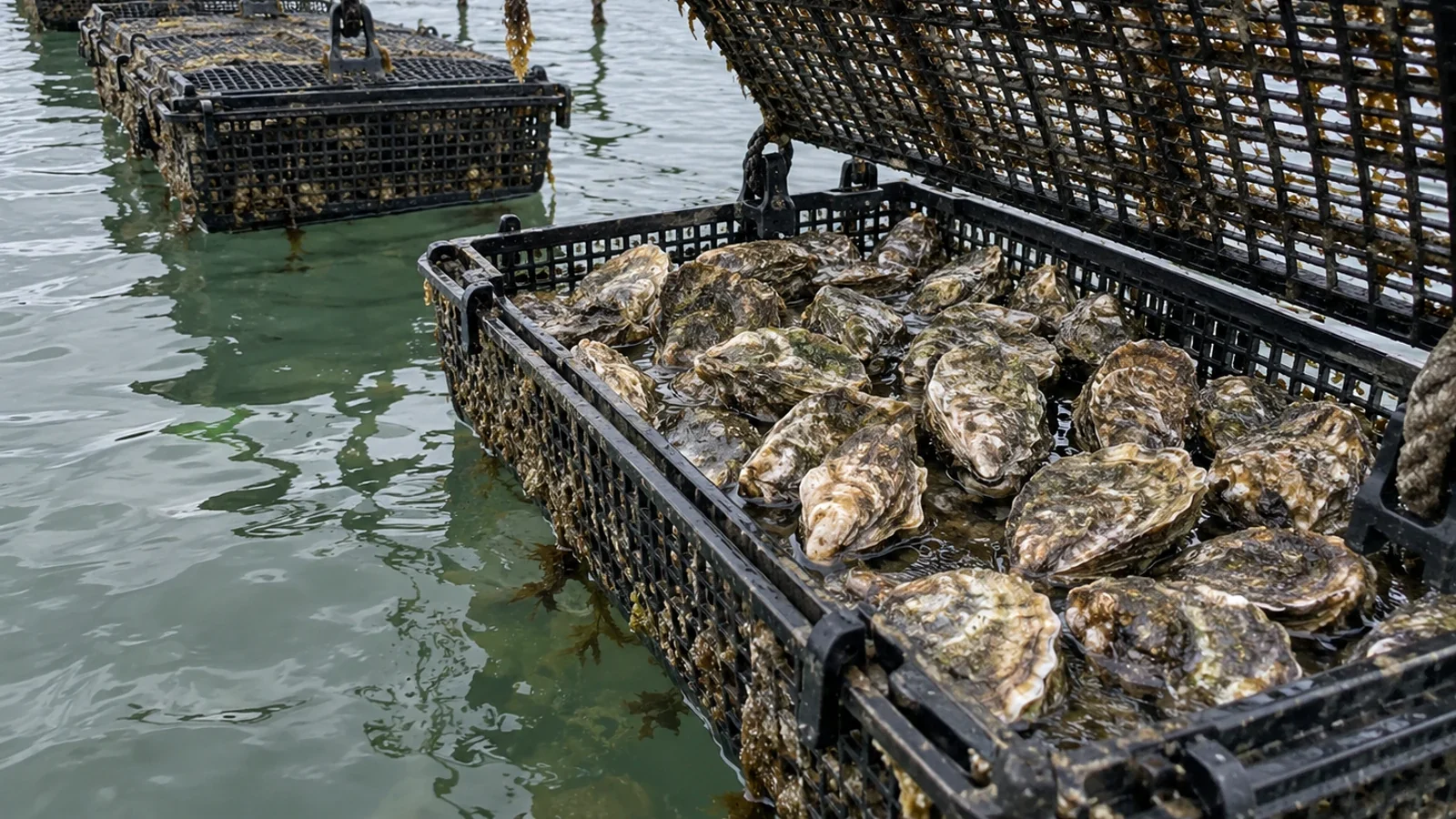
The researchers distributed oysters from twenty families between Little Swanport and Pitt Water, two Tasmanian estuaries. The animals came from the same cohort and were grown in mesh baskets attached to longlines on working oyster leases. Grow-out monitoring took place in 2022 and 2023, over approximately fifteen months.
The design allowed family performance to be compared across two environments. Twenty families do not mean twenty independent farms: family, basket and estuary represent different levels of the experiment. That structure matters when assessing how widely a result can be applied. Treating every oyster as an independent replicate of an estuary would overstate the environmental replication.
Water monitoring included temperature, salinity and pH alongside other variables. These records describe the conditions experienced by the oysters; the study did not independently manipulate each water parameter. Air exposure was made broadly comparable through farm management, but its duration was not directly measured. The comparison therefore retains uncertainties about the combination of conditions at each site.
Surface hardness and breaking force describe different properties
Hardness was assessed on the inner shell surface using an ultrasonic contact method with an indenter. It describes the response to a small, local loading. Compression testing instead measured the force required to break a shell in a specified mechanical arrangement. Shell shape, internal structure and how the load is distributed can all affect that outcome.
Oysters at the faster-growth Little Swanport site had, among other differences, thicker and harder shells, yet lower shell density and lower resistance to compression. They also showed more breakage during shucking. In this comparison, greater thickness did not mean better performance under every form of mechanical stress.
This does not make thickness or hardness uninformative. It means that replacing one property with another requires validation for the intended use. A measurement at the surface cannot describe the entire shell architecture. Equally, a breaking force obtained in a testing machine will not automatically predict every handling or transport incident. The relationship between a laboratory measure and a production loss must be established rather than assumed.
Family differences do not identify a single environmental cause
A phenotype is an observable characteristic shaped by genetic background and the conditions in which an animal develops. The family and estuary differences in this study indicate that several components contribute to shell performance. Calcification, shell geometry and the arrangement of shell material are not captured by a single external dimension.
Because the estuaries differed in several ways at once, the results do not show that changing one water parameter would, by itself, produce a stronger or weaker shell. They also do not establish that deliberately reducing growth would improve the overall outcome of an oyster farm. Such a decision would involve consequences beyond the properties measured here.
The paper estimates heritability for a range of traits. Heritability describes genetic variation within a particular population and environment; it is not the proportion of an individual oyster that is genetically determined. The findings suggest possible directions for breeding programmes, while the authors call for validation in larger populations and across further production cycles before operational selection objectives are set.
Start batch monitoring with a defined problem
A useful investigation first distinguishes the event of concern. Is the farm experiencing damage during grading, fractures during shucking or inconsistent presentation? Recording these outcomes separately preserves information that would be lost if they were grouped under a general label such as weak shells. Different outcomes may require different measurements and different comparisons.
Biometric records also need consistent methods. Dimensions, shell condition, sampling date and batch identity should accompany the measurement. Photographs can document shape or visible damage, but cannot substitute for a mechanical assessment. Where compression testing is used, the fixture, loading position and storage conditions belong with the reported result.
Production history provides the context for those records: site, cohort, transfers, basket management and observation dates. A comparison following a change in location or handling leaves more possible explanations open than one made within a stable setting. A mechanically resistant shell is also not a certificate of disease freedom or an adequate assessment of the sanitary condition of the flesh. Mechanical and health questions may intersect, but they need their own evidence.
Match the indicator to the loss being investigated
The useful lesson is that shell strength comprises several properties. Thickness alone cannot stand in for the whole assessment. The Tasmanian findings support relating each observation to the loading or production event of interest, while retaining the limits of a study conducted in two estuaries.
A batch review should bring shell measurements together with documented losses and production history. It can identify a hypothesis for further testing without turning a site association into an immediate instruction to alter water quality or breeding policy. It should also specify what evidence would be needed to distinguish competing explanations in the next monitoring period.
For aquaculture businesses, Vetofish offers technical support to structure observations and separate husbandry, mechanical and health questions. The aim is to select indicators that address the batch problem before a change in farming practice is introduced.


