

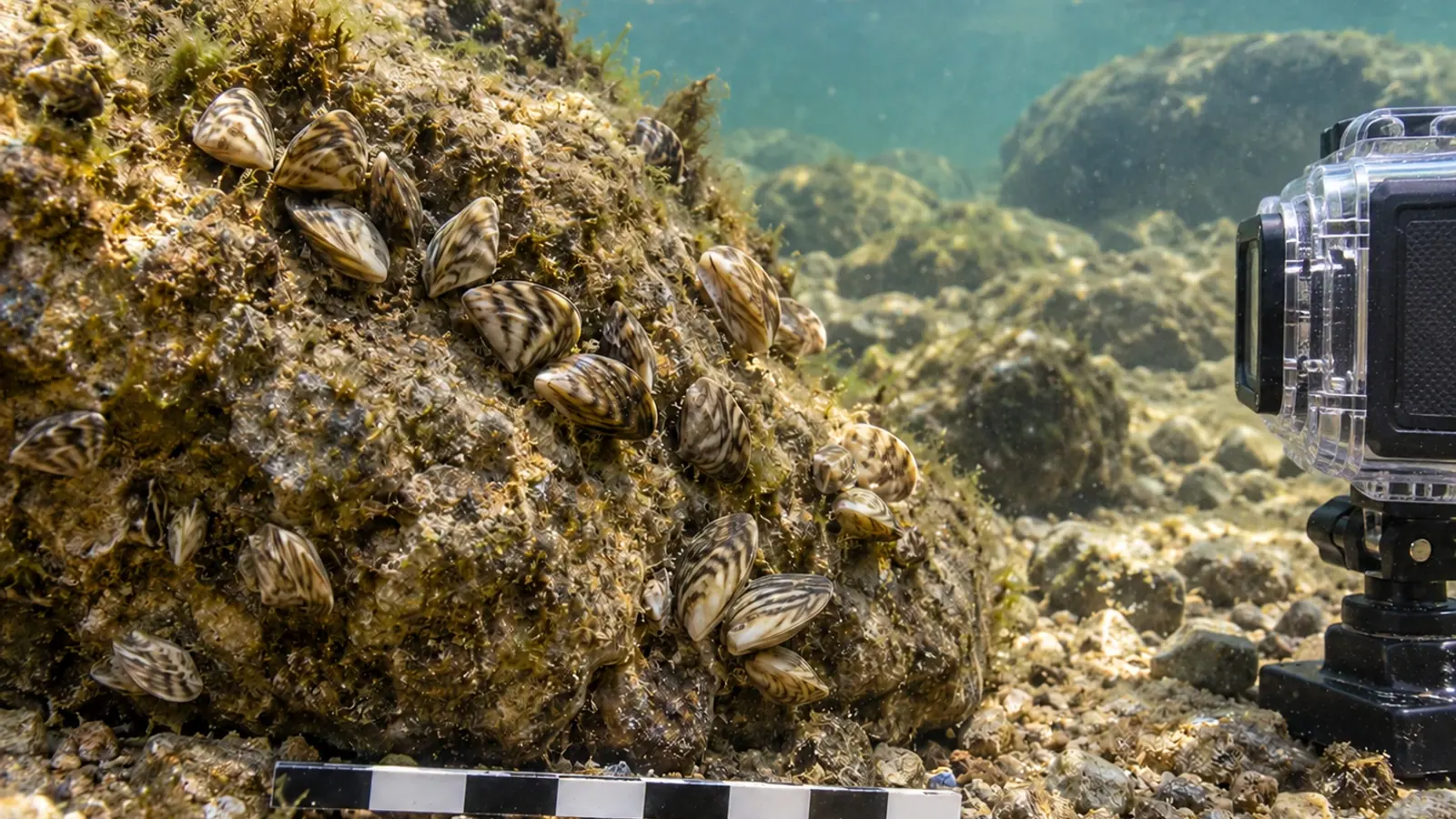
Quagga mussels: following growth in the same individuals
A larger-looking patch of quagga mussels does not reveal which individuals have grown. A public CIPEL report follows shells in three-dimensional photographic models, bringing attention to the unit that matters for individual growth: the same animal revisited over time.


- Content type
- Practical guide
- Sector
- Environment
- Animal group
- Corals and invertebrates
- Keywords
- TemperatureLightingBiosecurity
Follow a shell, rather than a changing patch
The CIPEL report for its 2024 campaign describes quagga mussels, Dreissena rostriformis bugensis, monitored in Lake Geneva. Photographic observations run from October 2023 to September 2024. The authors use three-dimensional models to relocate individuals and measure maximum shell length over successive visits. Their analyses retain individuals that can be modelled adequately.
The subject is individual growth. A change in shell length between dates does not measure how many mussels occupy the site or how much living material the population contains. Before interpreting a result, a manager needs to specify the question: following the same animals, describing the area occupied by a colony, or estimating abundance. Those tasks require different units and evidence.
A bivalve remains associated with its position and neighbouring shells in the photographed scene. Returning to the same patch does not, however, prove that every visible shell has been matched correctly. Records need to connect each measurement with a recognisable individual, or explain why that particular comparison cannot continue.
Give the three-dimensional model a physical scale
The report uses overlapping photographs and a Structure from Motion approach to reconstruct the scene. Measurements can then be made on the model, but a reference of known dimension is required to express them as physical lengths. A detailed image or visually convincing reconstruction does not establish its own scale.
Before comparing surveys, ask where the scale reference appears, how it was used and how consistency was checked. A result reported in millimetres should be traceable to that information. If the reference is missing or unsuitable, preserve the limitation in the report instead of producing a number that merely looks precise.
Acquisition conditions also need to remain retrievable. Illumination, underwater visibility and obscured portions of a shell affect what the observer can describe. For another site, preparation should focus first on which photographs will be usable, which measurements will be possible and which observations must be excluded. The number of decimal places can be decided only after those questions have been addressed.
Check agreement with a direct measurement
The authors compare model-derived lengths with direct calliper measurements as part of their method assessment. The report presents a correlation between the two series. Strong correlation means that the values vary together; it does not establish, on its own, that two measurements are interchangeable or that their difference is unimportant for the monitoring question.
For an operational application, ask to examine the differences between measurements, their direction and their relationship to shell size. This is a proposed framework for reading the evidence, not a claim that the report has completed every such validation. An error acceptable for distinguishing broad size groups may be too large to interpret a small change between closely spaced visits.
Decimal places require the same caution. They describe a numerical display, rather than measurement accuracy. Reported precision should be consistent with the system actually evaluated. This article does not repeat the report’s very fine precision claims and proposes no universal acceptance threshold for underwater photogrammetry.
Describe which individuals cannot be followed
Sampling determines the population to which a result can reasonably refer. Shells that remain visible and identifiable in repeated models may differ from those hidden inside a cluster or lost from view. Excluding them can be necessary, but exclusions should be counted. Otherwise an average can appear to describe an entire colony while representing only the individuals that remained measurable.
Initial size, dates, depth and substrate should accompany comparisons. The report acknowledges difficulties in separating some depth and support effects. A difference between observed groups should therefore not be presented as proof that depth alone causes a particular growth response. Different monitoring settings require their own assessment.
Temperature can be retained as environmental context, with the associated dates and locations. A reading does not explain every observed change. Useful reporting distinguishes the measurement itself, variables associated with it and hypotheses about how the environment operates. That separation keeps a suggested explanation available for further testing without presenting it as an established cause.
The same distinction applies when an individual disappears from a usable sequence. Failure to relocate or model it does not automatically establish death. A monitoring record should state what was observed and why the sequence ended. Otherwise a limitation of image coverage could be converted into an unsupported biological event.
Match the indicator to the management decision
Define the question before collecting more images so the indicator serves the intended decision. If the objective concerns abundance, occupied area or ecological impact, individual shell-length tracking will not answer it alone. It may complement other observations, provided the outputs remain separate and a longer shell is not treated as proof of lake-wide proliferation.
A comparison file can bring together original photographs, scale references, individual matching rules, measurements and exclusions. Documenting an equipment or processing change makes clear when a series has changed method. This is an organisational proposal for readers, rather than an official CIPEL surveillance protocol.
Biosecurity also needs consideration during field operations. Equipment used in a colonised water body should not become a route for transfer to another site. Practical measures must follow the instructions applicable to the operation and jurisdiction. A shell-growth study supplies neither a treatment recipe nor a guarantee that an invasive population can be eradicated.
Vetofish supports environmental managers in defining indicators, critically reading reports and organising monitoring around a specific question. The aim is to clarify which decisions a measurement can inform, which uncertainties must remain visible and what additional observations would be needed before action.
To move from evidence to action, explore our advice and support service and our expertise in aquatic environmental health.


