

Rainbow trout: stronger currents do not guarantee better growth
Moderate sustained swimming does not automatically improve trout growth. A 2015 trial found that under restricted feeding, the energy cost of swimming could outweigh the expected production benefit. Feeding and tank hydraulics require a joint assessment.

- Content type
- Scientific news
- Sector
- Aquaculture
- Animal group
- Salmonids
- Keywords
- OxygenTemperatureStress
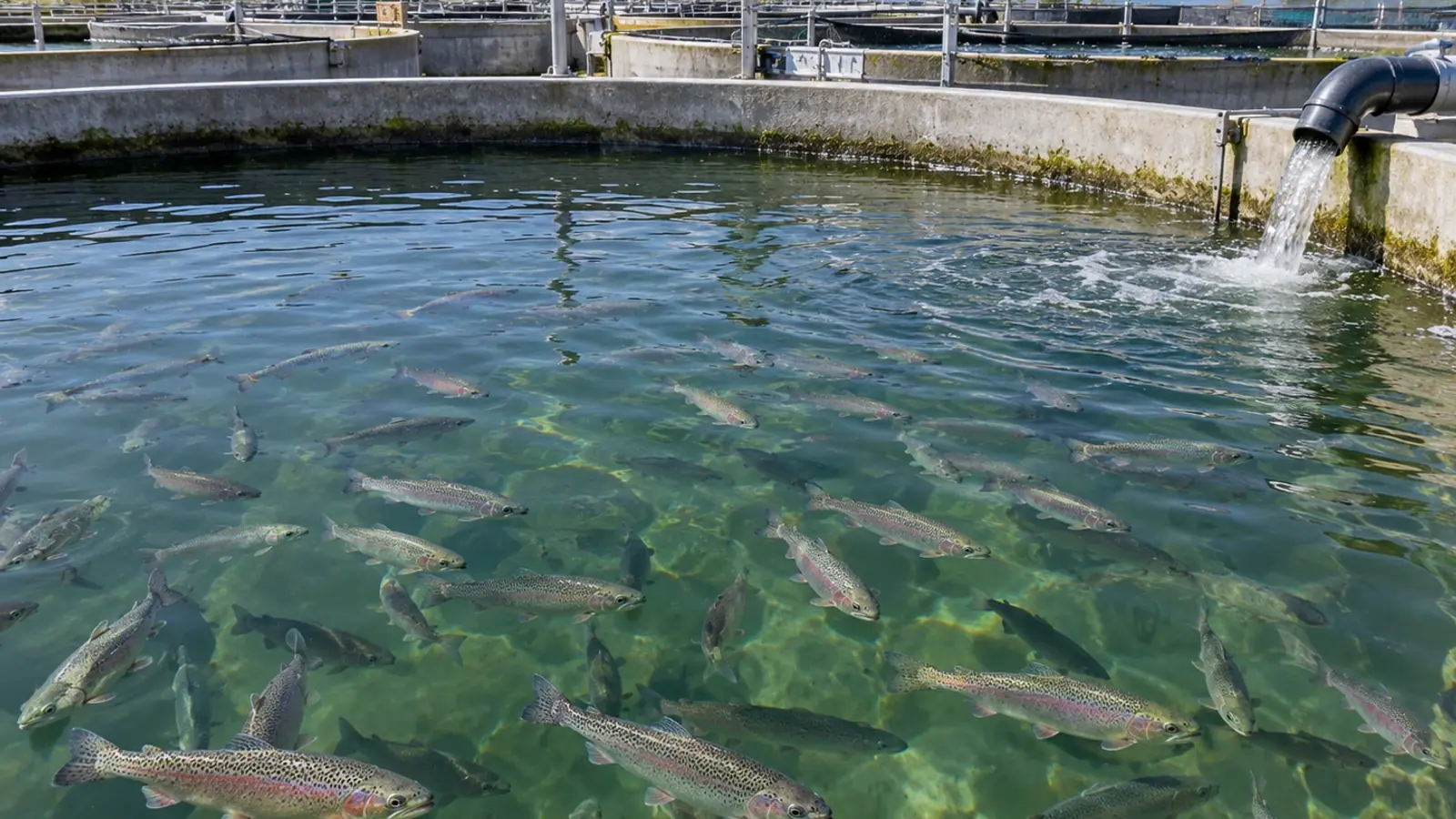
A tank of rainbow trout (Oncorhynchus mykiss) swimming steadily against a current can look like a productive, well-managed group. That impression does not establish a growth benefit. Swimming uses dietary energy, leaving a different share available for tissue production. Feeding and water movement both affect that balance.
Skov, Lund and Pargana examined that balance in a trial published in 2015. The fish received restricted rations throughout the comparison. The experiment did not compare freely fed and ration-fed trout, so it cannot establish how much additional food would have offset swimming costs. It does show why a moderate current should not automatically be credited with improving production.
A current comparison under restricted feeding
The researchers used twelve circular 600-litre tanks, each initially containing 100 trout. Four tanks represented each of three conditions: very little current, approximately half a body length per second, and one body length per second. Water exchange was maintained at comparable rates across treatments. The low-current condition therefore still received fresh system water; it was not a stagnant-water treatment.
The water temperature was held at 15 °C during the fifteen-week trial. Feeding was controlled below the estimated maximum intake. Measurements of biomass and fish length supported periodic adjustment of the ration and the relative current speed as the trout grew. A velocity expressed in body lengths per second changes its physical meaning with fish size. It cannot simply be translated into a permanent pump setting for a different group or tank.
Greater swimming costs without a growth advantage
Trout in the highest-current group had a lower specific growth rate and a higher feed conversion ratio than the other two groups. In these conditions, more feed was required per unit of biomass gained. Growth and feed conversion did not differ significantly between the intermediate-current group and the group experiencing very little current. The results provide no demonstrated production advantage for the intermediate treatment under this rationing regime.
Routine oxygen consumption was higher in the highest-current group, consistent with an additional activity cost. This is different from standard metabolic rate measured under resting conditions: the researchers found no significant difference in standard metabolic rate between groups. Keeping the distinction matters. The study did not identify one universal increase in every component of metabolism; it measured particular changes in energy expenditure during ordinary tank activity.
Feeding determines the meaning of a current setting
With a limited energy supply, extra expenditure can leave less energy available for growth. The authors propose this explanation for their findings. However, feeding level was not independently varied across several rations within each current treatment. The trial therefore cannot tell a farm exactly which feeding adjustment, if any, would have reversed the outcome. That remains a separate question requiring suitable evidence.
Increasing the ration is consequently not an automatic response to a higher current. Appetite, water quality, system capacity and the production objective all affect the decision. The study tested a particular combination of fish, feed and hydraulic conditions; it did not produce a replacement feeding table. Nor does it justify reducing circulation at the expense of water exchange, solids removal or oxygen availability. These basic functions need to be protected when considering any potential production benefit from swimming.
Separate observations from physiological explanations
Growth, feed conversion and swimming behaviour measure different aspects of the group. A visually orderly swimming pattern does not demonstrate efficient feed use. Equally, slower growth alone does not diagnose chronic stress or establish poor welfare. The experiment did not assess every welfare dimension, and its production results should not be used as a substitute for a wider assessment of the animals.
The researchers also measured nitrogen excretion and estimated the contribution of protein to metabolism. The apparent reduction in relative protein use by swimming fish was a trend rather than a significant demonstrated benefit. For practical interpretation, direct measurements, calculations and proposed mechanisms should remain distinguishable. A plausible explanation of nutrient use is useful for developing further questions, but it should not become a promised improvement in farm performance before that improvement has been shown.
Look beyond an average tank velocity
Tank geometry, inlets and areas close to the walls affect where fish can position themselves. In this experiment, current was checked at different depths and adjusted as fish size changed. The researchers did not systematically quantify every gradient or its effect on individual fish. A single average speed therefore describes only part of the hydraulic environment represented by the trial.
Before changing farm settings, records should connect water movement, the distribution of the group and production data. Comparisons between periods with different fish sizes or feeding levels can otherwise assign a change to current when another factor has changed as well. Comparable tanks and consistent observations make an assessment easier to interpret. The operational constraints also matter: any evaluation of swimming benefits must retain water conditions appropriate for the fish, rather than treating growth as the only criterion for selecting a setting.
Make the decision from a documented energy balance
The useful finding is specific: among these ration-fed trout, the highest tested current increased routine expenditure and reduced production performance. It does not identify a universal optimum, and it does not establish that current should be removed from trout systems. It shows why energy intake and expenditure need to be considered together when assessing the value of sustained swimming.
For aquaculture professionals, the next step is to relate the question to the actual stock and system. Vetofish can support that assessment through farm management advice: defining the intended outcome, identifying useful records and examining results before extending a change across the farm. The aim is a decision supported by production and health observations, with the limits of the comparison made explicit.


