

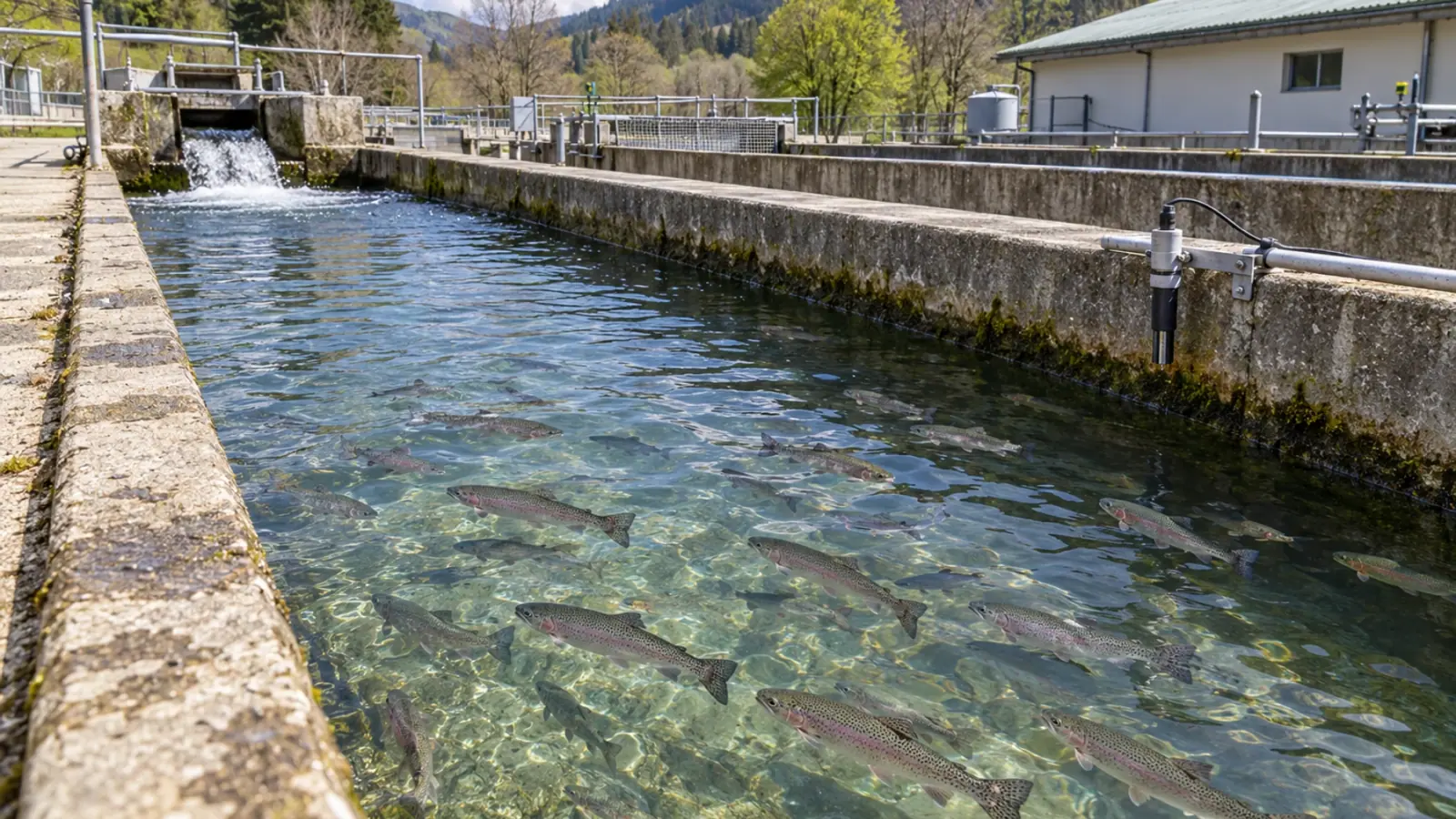
Farm digital twins: validate before making decisions
A model can compare oxygen supply and trout transfer scenarios without proving that automated control improves farm outcomes. Lima and colleagues’ case study helps separate a promising decision aid from a tool validated for a particular farm.
- Content type
- Practical guide
- Sector
- Aquaculture
- Animal group
- Salmonids
- Keywords
- OxygenTemperatureCO₂
Start with a decision the farm needs to make
Should some trout move to another raceway, should feeding change, or does oxygen provision need adjusting? A digital twin aims to compare the consequences of decisions such as these using a representation of the farming system. Its practical value depends on the question it can answer. A detailed digital reconstruction may offer little support if its predictions are unreliable for the proposed intervention.
Lima and colleagues describe rainbow trout, Oncorhynchus mykiss, at a land-based Italian farm. Their revised 2023 paper presents a conceptual application combining farm information with mathematical models. It is not a comparative production trial demonstrating that automated management improves growth or health across trout farms.
Represent the water, the fish and their interactions
The authors organise the digital representation into two components: water and fish. One describes conditions within the rearing system; the other represents animal growth and requirements. The two components interact: more biomass can increase total oxygen demand, while water temperature influences the biological processes of the stock.
Dissolved oxygen is consequently more than a line on a dashboard. It connects a local measurement with environmental exchange, technical oxygen provision and consumption by the animals. Fish metabolism contributes to that demand. The resulting prediction depends on several assumptions, some less directly observable than the concentration recorded by a probe.
Stock numbers, body masses, transfers and feed deliveries must reflect actual farm events. If a transfer is missing from the record, a model might incorrectly attribute a change in oxygen to fish physiology. In that situation, the first correction concerns the stock history rather than a mathematical parameter.
These connections also explain why a model from one installation needs examination before use elsewhere. A similar tank shape does not establish equivalent water exchange, stock composition or operating practice. The relevant boundaries of the system need to be described.
A favourable simulation is not a demonstrated benefit
A simulation answers a conditional question: what would the model predict if part of the stock moved? This can help prepare an intervention, but the comparison remains dependent on the relationships built into the model. A favourable output does not establish that the intervention is feasible or safe for the animals.
Chen and colleagues’ 2025 review describes applications and opportunities for digital twins in aquaculture. It places the technology’s ambitions in context. It does not establish that every proposed architecture is an operationally validated product. Connecting sensors to software, testing predictive performance and demonstrating improved outcomes after a decision are different achievements.
A farm can therefore begin with a narrow objective. Predicting oxygen conditions before a planned transfer requires different validation from allowing software to adjust oxygen equipment automatically. Where a prediction could lead to an immediate animal health consequence, its permitted use and the means of taking manual control need particular clarity.
Check predictions against observations not used for fitting
Before relying on a model, a team can retain observation periods that were not used to adjust it. Comparing predictions with subsequent measurements helps identify persistent discrepancies, including around feeding, stock transfers or changes in water movement. This is a proposed approach to local validation, rather than a quantified performance result from the case study.
Fish sampling needs similar scrutiny. A body-mass estimate based on the most accessible individuals may poorly represent the stock. The date and method of estimation should accompany the value entered into the model. Additional decimal places in later calculations cannot repair an inaccurate biomass estimate.
It is also useful to state when the model should no longer guide decisions. Missing inputs, a faulty sensor, altered hydraulics or a size range outside the evaluated conditions are examples. Software can continue producing numbers after its relevance to the actual decision has weakened.
An assessment should examine when errors occur, rather than report only a single average agreement. A model that performs adequately during stable operation might fail around the event for which support is most needed. Any such limitation belongs in its operating conditions.
Run a reversible farm trial
An initial trial can produce forecasts without giving the software control of equipment. Staff compare the outputs with farm observations and record disagreements. This approach still requires direct observation of fish; its purpose is to understand the tool before assigning it additional actions.
A trial record can retain the proposed decision, available inputs, known uncertainty, action actually taken and subsequent observations. Changes in model version also matter. If conditions improve alongside a change in feed or water flow, that improvement cannot automatically be credited to the digital twin.
Animal health and welfare remain separate outcomes to examine. A growth forecast does not replace investigation of unusual ventilation, reduced appetite or lesions. Such observations may point to influences outside the model. They warrant reassessment even when the predicted production trajectory appears satisfactory.
This also affects how staff respond to disagreement. An unexpected observation should remain visible in the record, rather than be removed simply because it does not fit the predicted pattern. It may reveal an input error or a missing biological process.
Use a model with a defined scope
A digital twin becomes useful when its users understand what it predicts, which information supports it and when its advice should be suspended. The rainbow trout example provides a methodological starting point. It offers neither a universal performance guarantee nor a replacement for farm judgement.
Vetofish can help define a monitoring question, connect fish health observations with technical records and plan a documented trial through its advisory support for aquaculture teams. The aim is an explainable decision with verification suited to the particular farm.


