

Zebrafish: what three-dimensional video tracking can measure
A dataset captures swimming and interactions between adult zebrafish pairs in three dimensions. It supports behavioural analysis, but does not establish a validated health alarm or automated humane-endpoint detector.


- Content type
- Scientific news
- Sector
- Research
- Animal group
- Zebrafish
Video can capture a brief chase or a change in spacing that a routine facility round will miss. Interpreting the recording is a separate task. Deligkaris and colleagues’ 2026 dataset describes adult zebrafish interactions at fine spatial and temporal resolution. It is a resource for behavioural research, rather than evidence that a detected movement change is an established marker of deteriorating health.
Reconstructing movement from three camera views
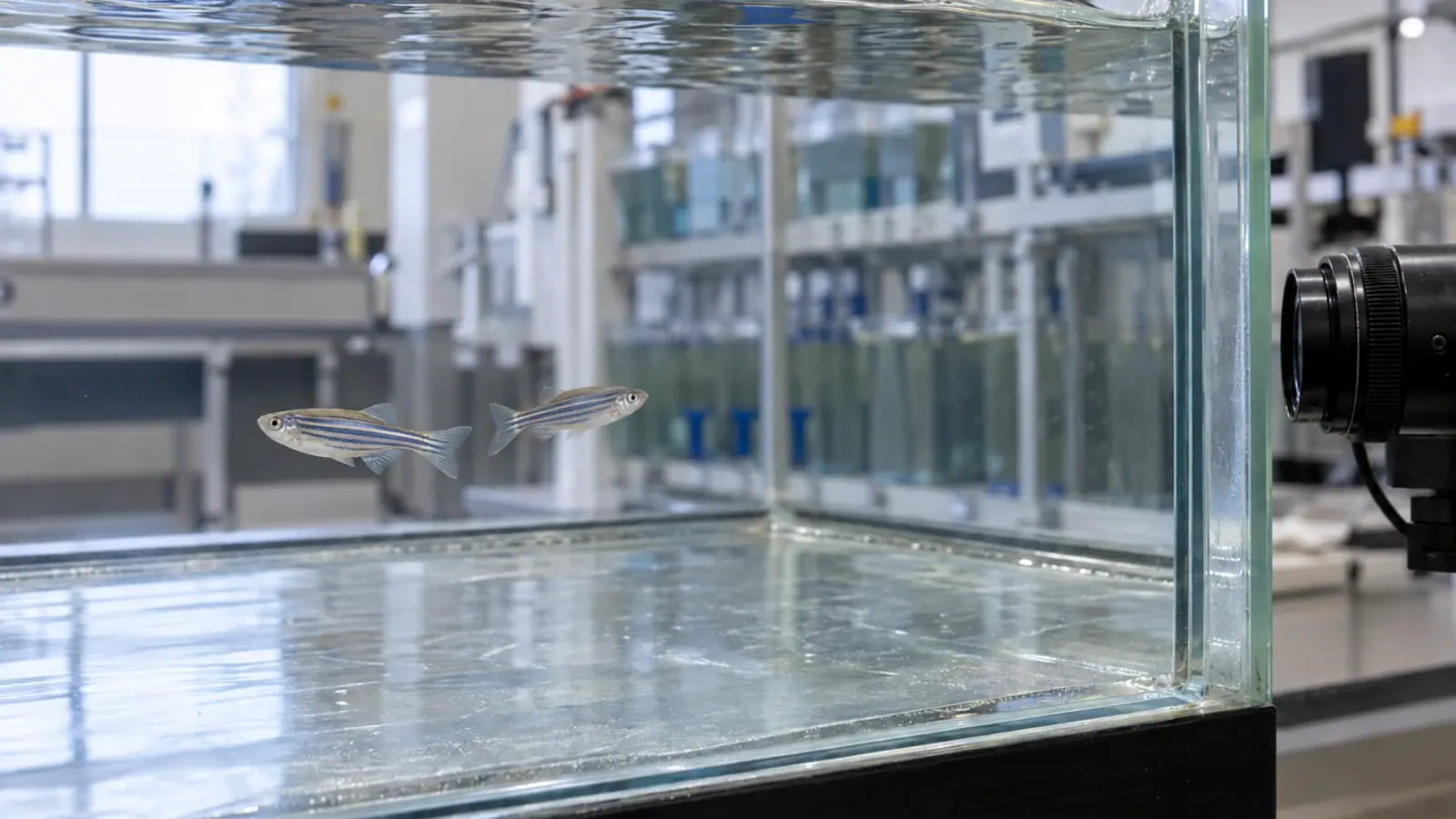
The system records a pair of Danio rerio using three synchronised cameras arranged along perpendicular axes. Each recording lasts one hour at 140 frames per second. Three-dimensional reconstruction follows body landmarks describing each animal’s position and orientation. This provides more information than displacement measured within the flat plane of a single camera image.
There are 173 recordings: 152 of wild-type pairs, nine of a mecp2 mutant line and twelve of an fgfr1a mutant line. Some animals appear in more than one recording. The number of videos is therefore not the number of biologically independent pairs. That distinction remains essential when statistical analysis draws on a large number of trajectory points.
The animals were prepared and placed in a dedicated arena to study social encounters. Those experimental conditions are not recommendations for routine housing. A research facility should not reproduce the preparation simply to obtain easier tracking. The question being investigated, welfare arrangements and daily husbandry need their own justification, independent of the camera’s technical requirements.
Define behaviour before assigning clinical meaning
An ethogram describes the behaviours a team intends to identify. Speed, spacing and orientation are potential measurements; linking them to a chase or other interaction requires an operational definition. That work comes before assigning a health interpretation. A change in swimming speed has no single clinical meaning and can arise under several different circumstances.
The dataset supports analysis of relationships between movement and social interactions. It does not validate the sensitivity or specificity of a disease test. Nor does it establish how much earlier an alarm could identify an animal approaching a humane endpoint. Such performance would require a separate comparison with clinical observations and prospectively defined decision criteria.
A facility exploring monitoring can begin by specifying the event it wants to recognise. A change from an individual’s usual pattern may be a more defensible initial target than automated diagnosis. Define what an alert will prompt: inspection of the footage, observation of the animals, an environmental check and veterinary contact where indicated. A warning is useful only if staff can interpret and act on it.
Tracking errors belong in the assessment
The workflow combines pose and identity tracking. Close encounters and crossings can lead to incorrect assignment of body landmarks. Processing excludes poor-quality segments and fills some short gaps. The released trajectories consequently should not be treated as perfect, uninterrupted accounts of every movement. They are processed measurements with identifiable limitations, not a substitute for the original recordings.
Applied monitoring needs to distinguish an absence of movement from a missing detection or a removed data point. A fish temporarily hidden from view may produce an incomplete track while still swimming normally. An identity error can assign one animal’s movement to another. Checking those cases against the footage helps prevent a technically generated alert from acquiring an unsupported biological interpretation.
Lighting, reflections, tank walls and occlusion also affect performance. A method demonstrated with two fish in a purpose-built arena has not thereby been validated in a densely stocked tank containing shelters. Trials should cover the facility’s actual conditions, especially situations in which tracking is most likely to lose an animal that staff need to observe.
Reference behaviour must fit the study population
Comparing successive days requires records of events that can affect behaviour: feeding, handling, cleaning, photoperiod and group changes. Activity after an intervention is not automatically evidence of disease. Those records help staff examine competing explanations before describing a change as stress or distress. Context turns a trace into interpretable information; without it, the same trace may support several incompatible accounts.
Age, sex and social setting further limit transfer. These recordings concern adults in pairs, and most wild-type pairs are male. They do not on their own provide a reference for larvae, groups of females or every laboratory line. A facility needs a reference appropriate to the animals being monitored and the conditions under which it intends to make decisions.
The mutant recordings require the same care. Including a line in a dataset does not demonstrate every proposed population-level behavioural difference. Repeated use of animals and individual variation must remain visible in the analysis. Thousands of position measurements from one fish cannot be treated as thousands of independent animals, however precise the camera system may be.
Validate the connection to welfare decisions
Automated collection can complement staff observation and help retrieve events for review. Before delegating a decision, assess both false alerts and missed changes. A tool that repeatedly flags normal feeding activity may be ignored. A tool that remains silent during a genuine deterioration can create unjustified confidence. Neither problem is resolved by recording more frames alone.
A pilot should retain human annotations, recordings and the reasons for interventions. Comparing them makes it possible to examine what video adds to routine rounds. Humane endpoints remain criteria defined for the project and animals, with agreed actions and responsibilities. A calculated trajectory does not replace those arrangements without a specific validation connecting the measurement to the intended decision.
Conclusion and Vetofish support
This resource enables detailed analysis of zebrafish interactions while leaving health-monitoring performance to be established. Our animal welfare support service can help aquatic research teams select observations, design a video pilot and connect the findings with the welfare decisions required by their projects.


