

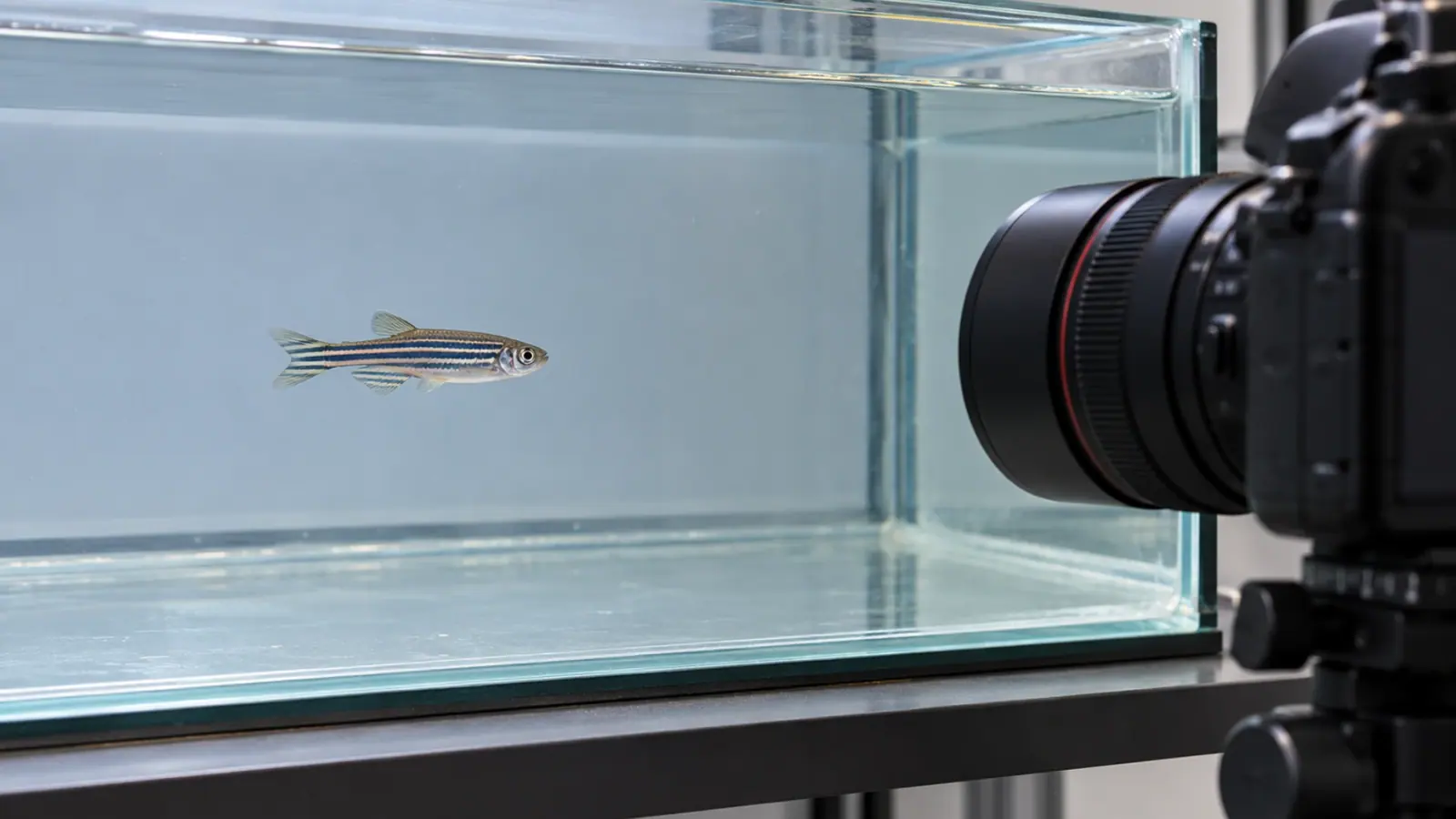
Zebrafish behaviour: observer experience matters
In a study published in June 2026, 28 students analysed recordings of the same 18 zebrafish. Some measurements were associated with observer experience or software familiarity, while many were not. Automated tracking still requires training suited to the task.


- Content type
- Scientific news
- Sector
- Research facilities
- Animal group
- Zebrafish
One set of fish recordings, several sets of measurements
Differences in behavioural results can arise from the animals, the test conditions or the way recordings are analysed. Cheung and colleagues focused on the last of these. Participants analysed the same videos and did not handle fish as part of this investigation. Published online on 16 June 2026, the study examined analyst experience as a possible source of measurement variation.
The recordings featured 18 adult zebrafish aged six months. Twenty-eight students were allocated to two analysis methods, with 14 students in each: automated trajectory tracking or observation-based behavioural coding. The comparison concerns different readings of shared recordings. It is not an experiment in which different keepers exposed live fish to different husbandry routines.
This design limits the practical conclusions that the work can support. Training for analysing a recording and training for handling an animal address related but separate tasks.
Different methods require different skills
Video tracking extracts movement parameters from the fish’s recorded positions. Even with common settings, someone needs to recognise detection failures and assess corrections. Reflections, bubbles or debris can be mistaken for the animal and generate an implausible path.
Observation-based coding requires recognition of a defined behaviour and recording of its occurrence or duration. An ethogram makes those categories explicit. Familiarity with keyboard commands cannot resolve disagreement if two people recognise different events in the same sequence.
Ethology provides the framework for studying behaviour, but measurement still needs operational definitions. Immobility, steady swimming and an abrupt movement are not interchangeable categories. Interpretation must remain tied to the test conditions. A movement category is not automatically a diagnosis of pain or stress.
The study’s common recordings reduce one source of difference between analysts: they all have access to the same animal behaviour. They do not remove differences in what analysts notice or how they deal with an uncertain observation.
Associations occurred for some outcomes
The researchers collected information about students’ experience with fish, time spent in the laboratory, previous viewing of zebrafish videos and self-rated software proficiency. They then examined correlations between those descriptions and the measurements produced.
For automated tracking, self-rated software knowledge was associated with some measures concerning variation in turn angles. For observation-based coding, some outcomes were associated with experience of fish or videos. Many other behavioural measurements showed no significant association with the experience categories examined.
Variance describes dispersion, rather than identifying which measurement is most accurate. Greater variation between fish might reflect better recognition of individual differences, but differences in scoring also need consideration. More trajectory edits do not establish better corrections: the number of edits was not significantly correlated with self-rated software proficiency.
Consequently, the findings do not support treating every difference between analysts as an error, or assuming that the person making the most corrections has produced the best dataset.
Keep the proof-of-concept limits visible
This was an exploratory investigation in one laboratory, using a particular behavioural repertoire and two software applications. Experience was characterised partly through questionnaires, and some experience categories overlapped. A correlation cannot establish that a particular training programme would itself cause improved results.
The same 18 recordings do not become 252 independent fish because 14 students analyse them. A comparable project needs to distinguish animals, recordings, observers and repeated measurements. Sampling and statistical analysis must respect that structure rather than inflate the biological sample size.
The study also cannot rank all available software, set a universal training duration or establish that an experienced observer is always correct. Its narrower message is that the relevant experience can depend on both the task and the outcome measured.
An effect of a keeper on a live fish’s behaviour would require a different design. Recording analyst identity may help investigate measurement variation, but it does not by itself separate husbandry, room and handling effects elsewhere in an experiment.
Practise agreement before analysing the main dataset
A team can use shared recordings separate from the main analysis to compare annotations and identify ambiguous categories. Discussions can establish when a behaviour starts, when it ends and how uncertain events should be recorded. This is a practical proposal for local quality assurance, rather than a quantified training benefit demonstrated in the paper.
For automated tracking, an exercise can focus on lost detections, reflections and implausible jumps in position. Software version, settings and corrections need to remain available. A different camera, lighting arrangement or contrast may justify another check even when the analysis program has not changed.
An analyst identifier makes it possible to recover the circumstances of a measurement. It should support investigation of the measurement process rather than become a league table of individuals. Where feasible, masking experimental groups can reduce expectations about outcomes; difficulties with masking should also be recorded.
Report a measurement others can examine
ARRIVE 2.0 provides a reporting framework for animal research, supporting clear accounts of methods and analytical choices. It does not certify a software package or an observer’s competence.
A usable record explains what was observed, by whom, under which definitions and with which exclusions. Retaining original videos and correction histories allows an unexpected difference to be examined later. Such documentation matters when interpreting a negative result as well as when reporting an apparent effect.
Vetofish offers training tailored to research teams in research facilities, helping staff define observations, share examples and plan agreement checks. The aim is an explainable and repeatable measurement process whose remaining uncertainties are visible.


